Japanese sweets wagashi: what they are, what they're made of, and what they're called
Japanese sweets wagashi (和菓子) is an umbrella term for traditional confections: mochi, dango, daifuku, taiyaki, yokan, and dozens of other kinds. They are made mainly from rice flour, bean paste anko, and agar kanten, with almost no butter, cream, or spices. Wagashi are contrasted with Western sweets yogashi (洋菓子), which took root in Japan only after the Meiji Restoration in the 19th century.
The word "wagashi" hangs on the sign of almost every Japanese confectionery, but tourists are rarely told that it stands not for a single dessert but for a whole family, built from the same ingredients and the same rules of taste. Let's look at how wagashi differ from European sweets, what kinds exist, what the changing seasons have to do with them, and what the kanji 菓 itself means.
Wagashi and yogashi: how Japan divides its own sweets from foreign ones
Wagashi (和菓子) is the general word for traditional Japanese sweets: mochi, dango, daifuku, taiyaki, yokan, monaka, and dozens of other kinds. They are made mainly from rice and rice flour, bean paste anko, and agar kanten, rather than from butter, cream, and chocolate, as is customary in the European confectionery tradition. The very division into "our own" and "foreign" appeared only at the end of the 19th century. Before the Meiji Restoration, all sweets in Japan were simply called 菓子 (kashi), and the words wagashi and yogashi (洋菓子) became necessary when chocolate, cookies, and Western-style cakes flooded into the country.
Three degrees of moisture: namagashi, hannamagashi, higashi
In Japan, wagashi are classified not by taste but by moisture and shelf life. Fresh namagashi (生菓子) contain more than 30% water and spoil quickly — these are daifuku, steamed dango, hanami dango. Dry higashi (干菓子), like pressed rakugan, keep for months: they contain less than 10% water. In between are hannamagashi (半生菓子) — sweets like yokan: not dried all the way through, but not falling apart in your hands either.
From yokan to taiyaki: types of wagashi in one line each
Wagashi have no single recipe — there is a common logic: dough or paste on the outside, anko or a similar filling inside.
| Sweet | In Japanese | What it is |
|---|---|---|
| Yokan | 羊羹 | a firm jelly of anko, sugar, and agar kanten; the name literally means "sheep's soup" — from the Chinese soup from which the sweet grew |
| Monaka | 最中 | two thin crisp wafer discs made from mochi dough with anko between them; the name means "full moon" |
| Dorayaki | どら焼き | two small sponge pancakes with anko between them; named after the bronze gong dora, which they resemble in shape |
| Namagashi | 生菓子 | any fresh sweet with high moisture — from daifuku to nerikiri with a seasonal pattern |
| Daifuku | 大福 | a thin layer of mochi wrapped around anko |
| Dango | 団子 | balls of rice flour on a skewer |
| Taiyaki | たい焼き | dough in the shape of a tai fish with anko filling |
Sweets that Japan once borrowed
Japan adopted some wagashi from its neighbors. In 704, recipes for karagashi (唐菓子) were brought from China — pieces of rice and wheat dough fried in oil; they are still offered as ritual food at some Shinto shrines. Centuries later, in the 16th century, Portuguese missionaries brought kasutera, boro, and konpeito — "sweets of the southern barbarians," nanban-gashi. Japanese confectioners reworked both waves of borrowing so thoroughly that today these sweets are also considered wagashi.
A sweet by the calendar: wagashi and the changing seasons
Expensive wagashi, called jonamagashi, have a separate task — not only to be tasty but to look like the time of year. Nerikiri — a sweet mass of white bean paste shiroan, sugar, and soft mochi gyuhi — is colored with food dyes and shaped with spatulas into flowers, leaves, and landscapes of the month: cherry blossoms in spring, maple in autumn, snow patterns in winter. The tradition took shape in the Edo period, when the state encouraged domestic sugar production and sweets for the tea ceremony became ever more refined.
Matcha alongside wagashi is no accidental pairing
Wagashi are traditionally made sweet primarily for matcha: the thick powdered tea is bitter on its own, and the sweetness of nerikiri or namagashi balances its taste at the tea ceremony.
How 菓 stopped being just a "fruit"
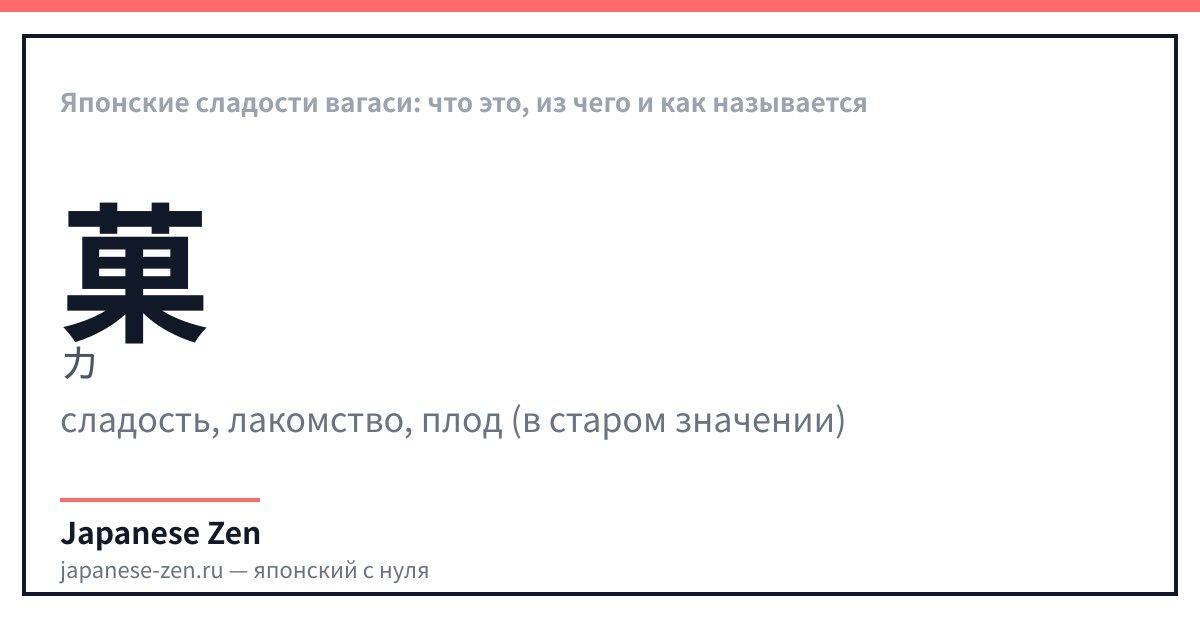
菓 — значение: sweet, confection, fruit (in the old meaning) — онъёми: カ — 11 штрих(ов). 菓 — "sweet, confection": the same character stands in the word 和菓子 (wagashi) and in 生菓子 (namagashi), fresh sweets with high moisture.
The kanji 菓 is read only by its on'yomi — ka — and paired with 子 it did not always mean "sweet." In ancient Japan there were almost no confectionery products, and the word 菓子 meant what people snacked on between meals — wild fruits and nuts. A trace of this meaning is alive today: an ordinary fruit is sometimes called mizugashi (水菓子), literally "water sweet." Recipes for sweets made from rice and wheat flour came from China at the beginning of the 8th century, and only then did the word 菓子 gradually come to mean what it means now.
和菓子, 洋菓子, and just 菓子
The word 和菓子 appeared only after the Meiji Restoration, when chocolate, cookies, and cakes flooded into Japan. The kanji 和 means "Japanese, native," while 洋 in the pair 洋菓子 means "Western." Before that division, one word 菓子 was enough — and today it still works as a general name for sweets of any origin.
| Japanese | Reading | Translation |
|---|---|---|
| 和菓子 | wagashi · wagashi | Japanese sweets |
| 洋菓子 | yōgashi · yōgashi | European sweets |
| 菓子 | kashi · kashi | Sweet, confection (general word) |
| 生菓子 | namagashi · namagashi | Fresh sweet with high moisture |
| 水菓子 | mizugashi · mizugashi | Fruit (literally "water sweet") |
Write 菓 along the guides — the character for "sweet," which gave its name to wagashi and all Japanese confections.
FAQ
- What are Japanese sweets wagashi?
- Wagashi (和菓子) is the general name for traditional Japanese sweets: mochi, dango, daifuku, taiyaki, yokan, monaka, and many other kinds. They are made mainly from rice flour, bean paste anko, and agar kanten, with almost no butter, cream, or chocolate — this is the main difference from the European confectionery tradition.
- How do wagashi differ from yogashi?
- Yogashi (洋菓子) are sweets of Western origin: cakes, cookies, chocolate, which entered Japanese daily life after the Meiji Restoration in the 19th century. Wagashi rely on a different set of ingredients — rice, beans, agar — with almost no dairy fats. The division into two words appeared only when there was something to choose from in Japan.
- Are mochi and dango also considered wagashi?
- Yes, both mochi and dango are varieties of wagashi, just with different technology: mochi is pounded from steamed glutinous rice, while dango is shaped from rice flour. Both belong to the category of namagashi — fresh sweets with high moisture that need to be eaten within a few days.
- Why do many wagashi have seasonal names and shapes?
- Expensive jonamagashi sweets, especially nerikiri, are shaped and colored so that they resemble a flower, leaf, or landscape of the current month. The tradition took shape in the Edo period along with the flourishing of the tea ceremony: the sweet on the tray was supposed to speak of the season no less than poetry or a scroll in the tokonoma alcove.
- What does the kanji 菓 in the word "wagashi" mean?
- 菓 is read "ka" and historically meant not a sweet but a wild fruit or nut — what people snacked on in ancient Japan. A trace of this meaning survives in the word mizugashi (水菓子), which is still sometimes used for ordinary fruit. The modern meaning "sweet" became attached to the character after the first confectionery recipes were brought from China in the 8th century.
- What tea are wagashi usually eaten with?
- Most often with matcha: the thick powdered tea is bitter on its own, and the sweetness of wagashi balances its taste at the tea ceremony. In everyday life, wagashi are just as often served with ordinary green tea sencha.
Sources
Updated: 2026-09-15