Ninja Costume: What It's Called, What It's Made Of, and Why It Wasn't Black
The ninja costume is called shinobi shōzoku (忍び装束): a loose-fitting jacket and trousers, a hood or face wrap, tekkō arm guards, kyahan leg wraps, and tabi. It was all black only on stage and in film. Surviving costumes are dark blue or reddish-brown, the color of kaki shibu persimmon tannin: a black silhouette is actually conspicuous at night.
The all-black costume with eye slits is an image from 20th-century film and manga, not from the battlefields of the Sengoku period. We look at what parts actually made up a spy's outfit and what kabuki theater and its "invisible" stagehands have to do with it. Along the way, we'll see how kaki shibu dye helped a person blend in at night and where in Japan you can see a ninja costume today.
What the Ninja Costume Is Called and What It's Made Of
The ninja costume in Japanese is shinobi shōzoku (忍び装束), or in the short form 忍装束 with the same reading. It's not a special uniform but repurposed mountain and peasant work clothes: a loose-fitting jacket and trousers so as not to restrict movement when climbing and running. By day, no one went on a mission in such an outfit: in daylight, shinobi worked under the guise of ordinary people.
- Zukin (頭巾) — a hood or wrap covering the head and part of the face.
- Tekkō (手甲) — arm guards on the forearms and back of the hand.
- Kyahan (脚絆) — leg wraps on the shins so the trouser legs don't catch and the legs tire less on the road.
- Tabi (足袋) or waraji (草鞋) — split-toe socks or straw sandals.
- Tenugui (手拭) — a long towel: used to wrap the face, bind wounds, or serve as a rope.
Where the Black Costume Came From
The black costume with chainmail underneath and a face smeared with soot is an image created by theater and film. The most common version traces it to kabuki: there, stagehands called kuroko (黒子) come out in black, and the audience conventionally considers them invisible. Ninja on stage were dressed the same way, and later people decided that real spies also wore black. The costumes kept as shinobi clothing are almost all dark reddish-brown, the color of kaki shibu (柿渋) — persimmon tannin — or dark blue. The explanation is that a black silhouette, on the contrary, stands out at night.
忍び装束: The Reading shōzoku and the Two Readings of the Character 装
装束 is read しょうぞく (shōzoku) and means "attire, outfit." The character 装 has two readings: "shō," as here and in 衣装 (ishō) "costume, outfit," and "sō," as in 服装 (fukusō) "clothing, appearance." The spelling 忍装束 without the okurigana び is read the same way — しのびしょうぞく.
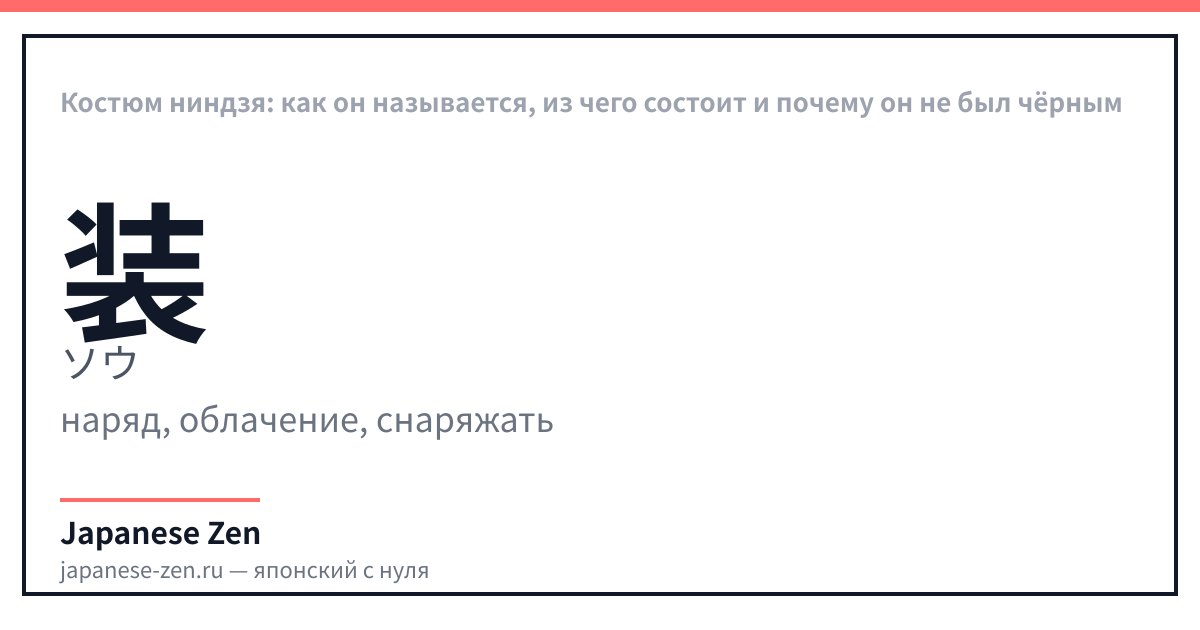
装 — значение: attire, outfit, to equip — онъёми: ソウ、ショウ — кунъёми: よそお.う、よそお.い — 12 штрих(ов). 装 — "attire, outfit; to equip": the second character in 忍び装束. In words about equipment it is read "sō" — 装備 (sōbi) "equipment, gear."
装束 and 服: How "Attire" Differs from "Clothing"
服 (fuku) is the ordinary word for "clothing" of any kind, from school uniforms to coats. 装束 (shōzoku) sounds more formal and means not just clothing but a complete outfit for a specific purpose — court dress, armor, a spy's costume. That's why 忍び装束 is not "ninja clothing" in the everyday sense but rather "gear" assembled for a task: from hood to footwear.
| Japanese | Reading | Translation |
|---|---|---|
| 忍び装束 | shinobi shōzoku · shinobi shōzoku | "spy's attire" — the full name of the costume |
| 忍装束 | shinobi shōzoku · shinobi shōzoku | short variant of the same word |
| 頭巾 | zukin · zukin | hood or head wrap |
| 手甲 | tekkō · tekkō | arm guards on the forearms |
| 足袋 | tabi · tabi | split-toe footwear |
| 黒子 | kuroko · kuroko | kabuki stagehands in black whom the audience "doesn't see" — according to one theory, this is the origin of the black ninja costume |
Write 装 along the guides — the character for "attire" from the name shinobi shōzoku (忍び装束).
Ninja Costumes in Anime and Games
- "Naruto" (manga — since 1999, author Kishimoto Masashi; anime — since 2002) — the characters wear colorful costumes, and Naruto himself wears bright orange. Here color works as a character identifier, not as a historical detail.
- "Ninja Hattori-kun" (忍者ハットリくん, manga — since 1964, author Abiko Motoo, who wrote under the name Fujiko Fujio; anime — since 1981) — a boy ninja from Iga moves in with an ordinary Tokyo family and wears his costume as a uniform.
- "Nintama Rantarō" (忍たま乱太郎, manga "Rakudai Ninja Rantarō" — since 1986; anime — since 1993) — students at a ninja school wear costumes of different colors by year of study.
- In the Ninja Gaiden games (since 1988, studio Tecmo, later Team Ninja), Ryu Hayabusa wears a dark, form-fitting suit — closer to the cinematic silhouette than to museum pieces.
Where to See a Ninja Costume in Japan Today
The Iga-ryū Ninja Museum (伊賀流忍者博物館) in the city of Iga, Mie Prefecture, displays spies' gear and puts on performances of shinobi techniques. In neighboring Shiga Prefecture, the Kōka Ninjutsu Village (甲賀の里忍術村) has been operating since 1983. The house of the Fujibayashi Yasutake family, compiler of the Bansenshukai, was moved there, and the local museum holds one of the largest collections of books and objects related to ninjutsu. "Ninja Day" is February 22: in 2015 the date was added to the Japanese calendar of commemorative days because 2-2-2 can be read as "nin-nin-nin." On this day, ninja-related events are held across the country.
What in Museums Is Authentic
Whether museum costumes should be considered the clothing of real shinobi is an open question: they are linked to spies by legend, not by documents. The most reliable information about gear comes from Edo-period treatises — the Bansenshukai (1676) and the Shōninki (1681).
FAQ
- What is the ninja costume called?
- The ninja costume is called shinobi shōzoku (忍び装束), or in short form 忍装束, read the same way: "spy's attire." It is not a single style but a set of parts: a hood or face wrap, a loose-fitting jacket and trousers, tekkō arm guards, kyahan leg wraps, and tabi or waraji on the feet.
- What is a ninja costume?
- It is repurposed mountain and peasant clothing for night raids. By day, shinobi worked under a disguise: the Shōninki treatise (1681) names seven disguises — a wandering komusō monk, a monk, a yamabushi mountain ascetic, a merchant, a magician, a sarugaku actor, and an ordinary person.
- Why is a ninja costume needed?
- To blend in and not hinder movement: dark but not black fabric is less noticeable at night, and the loose cut didn't restrict climbing walls and trees. Details like a hood or a long towel hid the face and also served other purposes — binding a wound or carrying things.
- How is "ninja costume" written in Japanese?
- The full name is 忍び装束, read しのびしょうぞく (shinobi shōzoku); the short form is 忍装束, read the same way. The character 装 means "attire, outfit" — the same character appears in 衣装 (ishō) "costume" in the broad sense.
- Is it true that the ninja costume was black?
- Surviving examples are mostly not black but dark blue or the color of kaki shibu, a dark reddish-brown persimmon tannin: a black silhouette under moonlight is more visible than you'd think. The all-black costume with eye slits is more an image from film and kabuki theater than real combat clothing.
- Where in Japan can you see a ninja costume?
- At the Iga-ryū Ninja Museum in the city of Iga (Mie Prefecture) and at the Kōka Ninjutsu Village in Shiga Prefecture: they display spies' gear and put on performances. And on February 22, "Ninja Day," ninja-related events are held all over the country.
Sources
Updated: 2026-09-13