Shōninki — "True Records of the Ninja": the treatise of the Natori-ryū school
Shōninki (正忍記) is a treatise on ninjutsu from the Natori-ryū school: it was compiled in 1681 by Natori Masazumi, a military scholar in the service of the Kishū clan. Unlike the voluminous Bansenshūkai, it is a compact practical guide in three volumes — on disguise, behavior among strangers, and the seven disguises for infiltrating enemy territory.
The Shōninki is much shorter than the Bansenshūkai, but it is precisely from it that the famous "seven disguises" of the ninja come, and it teaches not so much how to fight as how not to attract attention. Let's look at who wrote it and when, how it differs from the Bansenshūkai, what seven disguises it offers a spy, and what the title 正忍記 itself means.
Who wrote the Shōninki and for whom
The Shōninki (正忍記) was compiled in 1681 by Natori Masazumi — a military scholar in the service of the Kishū house, one of the branches of the Tokugawa clan. The three-volume treatise was taught to students along with other subjects of the military science of the Natori-ryū school: it is not a separate "ninjutsu school" in itself, but part of a broader martial curriculum.
How the Shōninki differs from the Bansenshūkai
The Shōninki is much shorter than the Bansenshūkai — three volumes versus 22 — and does not claim to bring together the knowledge of 49 schools, as the Bansenshūkai does. It is an author's practical course: not so much a description of combat techniques as a guide to the behavior and psychology of a spy among strangers.
What the Shōninki talks about: disguise and psychology
The treatise says less about technical techniques and more about how a spy should behave among strangers without arousing suspicion: how to read the mood of an interlocutor, stay calm under another's guise, and not give oneself away with a careless word. A separate list describes seven disguises for infiltrating enemy territory (七方出):
- Komusō (虚無僧) — a wandering monk with a shakuhachi flute, in a woven hat that hides the face.
- An ordinary monk (出家) — freely moved from temple to temple without explanation.
- The mountain ascetic yamabushi (山伏) — passed through mountain lands without attracting attention.
- A merchant (商人) — moved from province to province selling goods.
- A street magician (放下師) — a juggler and street performer whom no one specifically watched.
- A sarugaku actor (猿楽師) — a traveling performer of an old theater.
- An ordinary person (常の形) — the simplest guise without special distinguishing features.
Why a spy needs seven disguises and not one
The list from the Shōninki is built on a single principle: each disguise explains why its bearer ended up in a strange place, travels lightly, or hides his face, and never arouses unnecessary interest from those around him.
Where the Shōninki is kept and how it is translated
The manuscript of Natori Masazumi himself has not been found — only later copies of the treatise have come down to us, and from them historians reconstruct the original text.
The same university that studies the Bansenshūkai
The Shōninki is studied in the same place as the Bansenshūkai — at the International Ninja Research Center of Mie University and in its master's program "Ninja and Ninjutsu," the first of its kind in Japan. The modern Japanese translation of the treatise with commentary was prepared by researcher Nakashima Atsumi. The English translation, "True Path of the Ninja" by Antony Cummins and Yoshie Minami, was published in 2011. There is no other official translation — only amateur retellings are found.
正忍記: the true record of concealment
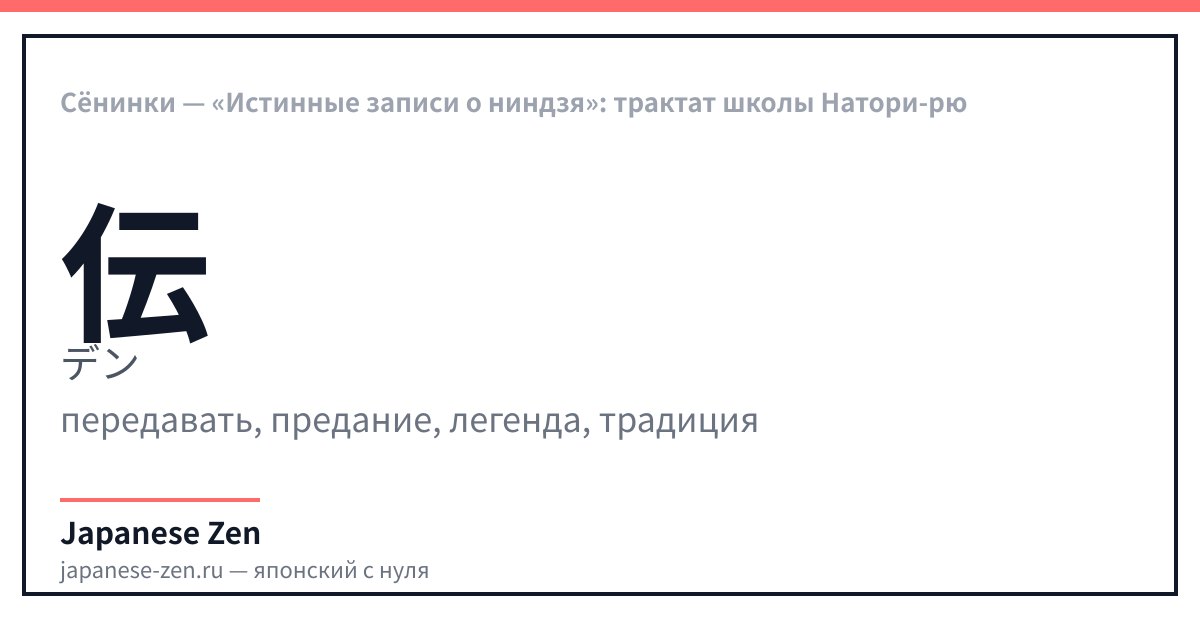
伝 — значение: to transmit, legend, tradition, tradition — онъёми: デン、テン — кунъёми: つた.わる、つた.える、つた.う、つだ.う、-づた.い、つて — 6 штрих(ов). 伝 — "to transmit": this character is used to name the treatises of ninjutsu schools in general — 伝書 (densho), "books of knowledge transmission." The Shōninki is exactly such a densho of the Natori-ryū school.
正忍記 is composed of 正 "true, correct," 忍 "to hide, to endure" — the same character as in the words shinobi and ninja — and 記 "record." Literally it comes out as "true record of concealment": the title presents the treatise as a reliable guide, not as a legend.
The character 伝: what such treatises are called
伝 is not part of the title Shōninki itself, but it is precisely this character that names such treatises in general: 伝書 (densho) — "book of transmission," a manuscript that the master of a school handed to selected students. The Shōninki is exactly such a densho of the Natori-ryū school, and the character 伝 shows what such texts were written for in the first place.
| Japanese | Reading | Translation |
|---|---|---|
| 正忍記 | Shōninki · Shōninki | Shōninki — the title of the treatise |
| 伝書 | densho · densho | book of knowledge transmission — a general word for such treatises |
| 伝える | tsutaeru · tsutaeru | to transmit |
| 伝統 | dentō · dentō | tradition |
| 忍ぶ | shinobu · shinobu | to hide, to endure — the same root as in the word shinobi |
| 名取流 | Natori-ryū · Natori-ryū | the school of military science that includes the Shōninki |
Write 伝 along the guides — the character "to transmit" from the word 伝書 (densho), the general name for treatises such as the Shōninki.
FAQ
- What is the book Shōninki?
- The Shōninki (正忍記) is a 1681 treatise on ninjutsu compiled by Natori Masazumi as part of the curriculum of the Natori-ryū school of military science. Unlike the encyclopedic Bansenshūkai, it is a compact practical guide — three volumes on disguise, behavior among strangers, and the psychology of a spy.
- Who wrote the Shōninki?
- The treatise was written in 1681 by Natori Masazumi, a military scholar in the service of the Kishū house — one of the branches of the Tokugawa clan. The author's original manuscript has not been found: only later copies have come down to us, from which historians reconstruct the original text.
- How does the Shōninki differ from the Bansenshūkai?
- The Shōninki is much shorter — three volumes versus 22 — and does not bring together the knowledge of 49 schools, as the Bansenshūkai does. It is an author's course from one school, Natori-ryū: less about technical techniques, more about behavior, psychology, and the ability not to attract attention among strangers.
- What disguises of the ninja are described in the Shōninki?
- The treatise names seven disguises for infiltrating enemy territory: the wandering komusō monk, an ordinary monk, the mountain ascetic yamabushi, a merchant, a street magician, a sarugaku actor of the old theater, and simply an ordinary person without distinguishing features. Each explains why its bearer ended up in a strange place.
- How is the title Shōninki translated?
- Literally — "true record of concealment": 正 means "true, correct," 忍 — "to hide, to endure" (the same character as in the words shinobi and ninja), 記 — "record." The title presents the treatise as a reliable, not legendary, guide.
- With what characters is Shōninki written?
- 正忍記, read as しょうにんき. The character 伝 is not part of the title itself, but it is used to name the treatises of ninjutsu schools in general: 伝書 (densho), the "book of knowledge transmission" that a master handed to selected students.
Sources
Updated: 2026-09-15