Buddhism in Japan: how it arrived, what schools exist, and how it lives today
Buddhism arrived in Japan in the 6th century — in 538 or 552, depending on which account you follow — and came not directly from India but through the Korean kingdom of Baekje. Over fifteen hundred years it grew into a dozen schools: from the esoteric Tendai and Shingon to Zen and Pure Land Buddhism. Today it is primarily a culture of funerals and ancestor memorials rather than everyday faith.
The arrival of Buddhism in Japan has a disputed date, Japanese schools have different founders and practices, and Japanese religious statistics count more believers than the country's entire population. Let's sort out where these discrepancies come from, what a Buddhist monk does today, and why the character 仏 — "Buddha" — appears in words that have no direct connection to religion.
How Buddhism came to Japan and acquired its schools
Buddhism reached Japan not directly from India but through the Korean Peninsula: the ruler of the Korean kingdom of Baekje sent a statue of the Buddha and Buddhist sutras to the Japanese court as a gift.
Why the arrival of Buddhism has two dates
The exact year is disputed. The Jōgū Shōtoku Hōō Teisetsu (上宮聖徳法王帝説) and the Gangōji Garan Engi (元興寺伽藍縁起) give 538, while the later official chronicle Nihon Shoki (日本書紀) gives 552. Modern historians more often accept the earlier date.
The first patron of the new religion was Prince Regent Shōtoku-taishi: according to tradition, in 607 he founded one of Japan's oldest Buddhist temples, Hōryū-ji in Nara. A century and a half later, in 752, at another Nara temple, Tōdai-ji, the "eye-opening" ceremony was held for a huge bronze statue of the Buddha — the Daibutsu — which became a symbol of state Buddhism in the Nara period.
In the Heian period the Tendai and Shingon schools came from China; in the Kamakura period came movements aimed at laypeople: Pure Land, Zen, and the Nichiren school. Hōnen's disciple Shinran spun off his own school from the Pure Land teaching — Jōdo Shinshū.
| School | Founder | When | Main practice |
|---|---|---|---|
| Tendai | Saichō | 806 | Study of the Lotus Sutra and a combination of various practices |
| Shingon | Kūkai | 816 | Esoteric rituals and mandalas |
| Jōdo (Pure Land) | Hōnen | 1175 | Recitation of the name of Amida Buddha, nembutsu |
| Rinzai | Eisai | 1191 | Working with koans under a teacher's guidance |
| Sōtō | Dōgen | 1227 | Zazen in the spirit of shikantaza — "just sitting" |
| Nichiren | Nichiren | 1253 | Recitation of the title of the Lotus Sutra, daimoku |
Why a Japanese person visits both a shrine and a temple
Buddhism did not displace the local kami deities but coexisted with them for centuries in the system of shinbutsu-shūgō — "the merging of kami and buddhas": the same deities were worshipped sometimes as kami, sometimes as manifestations of buddhas. The separation of the religions was ordered by a Meiji government decree of 1868: it ordered Buddhist objects removed from Shinto shrines. The formal separation did not abolish the everyday habit — a Japanese person today easily visits both without seeing a contradiction.
What Japanese Buddhism lives on today
In everyday life, Japanese Buddhism is primarily funerals and the memory of the dead. The vast majority of funeral rites in the country are conducted according to Buddhist canon, followed by memorial services on the seventh and forty-ninth days. This imbalance is so noticeable that there is a separate critical term for it — sōshiki bukkyō (葬式仏教), "funeral Buddhism": the name for temples that have reduced their role to rituals and stopped doing anything else.
How many Buddhists are there in Japan
An exact figure is hard to give. According to the Shūkyō Nenkan (宗教年鑑) — the annual religious almanac of the Agency for Cultural Affairs — both Shinto and Buddhism count more than 80 million adherents each in the country. The sum noticeably exceeds the entire population of Japan, and this is not a mistake. Temples and shrines report their own numbers of parishioners, and many Japanese are formally counted in both religions at once: newborns are taken to a Shinto shrine, while relatives are buried according to Buddhist canon.
How "Buddha" fit into four strokes: 仏 and 佛
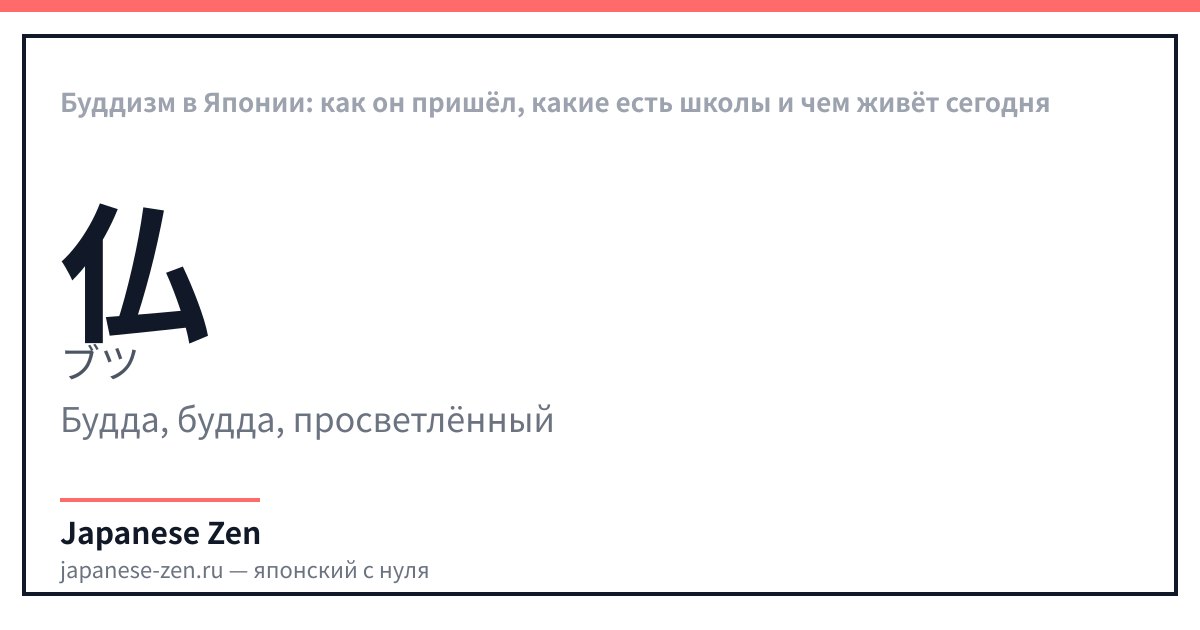
仏 — значение: Buddha, buddha, enlightened one — онъёми: ブツ、フツ — кунъёми: ほとけ — 4 штрих(ов). 仏 — "Buddha": the main character in Japanese Buddhist vocabulary. It also appears in 仏教 (Buddhism), 仏像 (statue of the Buddha), and 大仏 (giant statue of the Buddha).
仏教 — "Buddhism" — is put together simply: 仏 "Buddha" plus 教 "teaching". The modern character 仏 is a simplified form of the old 佛: the right-hand part 弗 was replaced with the compact 厶, and seven strokes became four. This spelling became official in the postwar writing reforms. The character has two on'yomi readings — butsu and futsu — and one kun'yomi, hotoke.
Why the deceased is called "hotoke"
The word ほとけ (hotoke) means both "Buddha" and, in everyday usage, "the deceased, the departed". Dictionaries acknowledge that its origin is not fully clear. One version traces it to the Chinese 浮図 — an early rendering of the Sanskrit "Buddha"; another connects the shift to the teaching that after death a person, like the Buddha, attains enlightenment, so both are called by the same word.
| Japanese | Reading | Translation |
|---|---|---|
| 仏教 | bukkyō · bukkyō | Buddhism |
| 仏 | hotoke · hotoke | Buddha, and in everyday usage — the deceased |
| お寺 | otera · otera | Buddhist temple |
| お坊さん | obōsan · obōsan | Monk |
| お経 | okyō · okyō | Sutra, Buddhist scripture |
| 大仏 | daibutsu · daibutsu | Giant statue of the Buddha |
Write 仏 along the guides — the character that begins the Japanese word for "Buddhism".
Not just Zen and not just celibacy: what people get wrong about Japanese Buddhism
- "Japanese Buddhism is Zen." Zen is only one of the traditions: the Pure Land schools — Jōdo-shū and Jōdo Shinshū — are no less widespread. At the same time, the largest single school by number of temples is indeed a Zen one — Sōtō, with more than 14,000 temples.
- "Japanese monks are not allowed to marry." In the Jōdo Shinshū school, priests have married since the time of its founder Shinran, and for the other schools the ban was lifted by a decree of the Dajōkan Council of State in 1872 — along with the right to eat meat and grow hair. Since then, a married abbot with children has been normal in almost any school.
- "Buddhism came to Japan directly from India." Between India and Japan there are several intermediaries: the teaching took shape in Buddhist China, and reached Japan through the Korean kingdom of Baekje, already reshaped by Chinese tradition.
FAQ
- When did Buddhism come to Japan?
- The sources give two dates: 538 according to the Jōgū Shōtoku Hōō Teisetsu and the Gangōji Garan Engi, and 552 according to the Nihon Shoki chronicle. The teaching was brought by envoys of the Korean kingdom of Baekje, not directly by Indian or Chinese missionaries. Historians today more often consider the earlier date more reliable.
- What schools of Buddhism are there in Japan?
- The major traditions are Tendai and Shingon, founded in the early 9th century; the Pure Land schools of Hōnen and Shinran; the two branches of Zen — Rinzai and Sōtō; and Nichiren Buddhism, built around a single sutra. Each school has its own head monastery and its own main practice.
- How does Japanese Buddhism differ from Shinto?
- Shinto is a local cult of countless kami with no founder and no sacred book; Buddhism came from outside along with texts, monasteries, and a teaching about rebirth. For centuries the two religions coexisted as shinbutsu-shūgō until the 1868 decree formally separated them — but not in the everyday life of Japanese people.
- How many Buddhists are there in Japan?
- According to the Shūkyō Nenkan — the annual religious statistics of the Agency for Cultural Affairs — more than 80 million people are counted as Buddhists. The figure is approximate: it is collected from the temples themselves, and many Japanese are also officially counted as Shintoists.
- Can Japanese monks marry?
- Yes. In the Jōdo Shinshū school, priests have been married since the time of Shinran, and for the other schools the ban was lifted by a decree of 1872: it allowed priests to eat meat and start a family. Since then, a married abbot with children has been normal in almost any Japanese school of Buddhism.
- How do you say "Buddhism" in Japanese?
- "Buddhism" in Japanese is 仏教, read bukkyō. The first character 仏 means "Buddha", the second 教 means "teaching": together they give "the teaching of the Buddha". The same first character appears in 仏像, "statue of the Buddha", and 大仏, "giant statue of the Buddha".
Sources
Updated: 2026-09-14