Koan — What It Is in Zen: The Sound of One Hand Clapping and Other Teacher's Questions
A koan (公案) is a short question, story, or dialogue that a Zen Buddhist teacher gives a student to work on their own thinking. A koan has no ordinary logical solution: it must drive reasoning to a dead end and through that dead end push toward satori, sudden awakening. The tradition formed in Chinese Chan Buddhism and especially took root in the Japanese Rinzai school.
In English, "koan" has long been a synonym for an unsolvable riddle, though the word itself has a precise origin — from Chinese legal proceedings. Let's look at where the most famous koans came from, who invented them, what happens at a private meeting between student and teacher, and why the teacher doesn't expect a witty answer at all.
What a Koan Is and Why a Zen Student Needs It
A koan is not an exercise in cleverness but a working tool of monastic practice: the student receives it from the teacher and sometimes carries it for a very long time, returning to it during meditation. Working with koans is primarily the domain of the Rinzai school; in Soto they are used much less often, with preference given to the practice of "just sitting."
公案 — a "precedent," not a "riddle"
The word 公案 itself came from Chinese legal language: it referred to an official court document, a recorded decision that became a precedent for similar cases. Zen teachers transferred this word to the sayings of earlier masters — just as a legal precedent was binding, so the words of the enlightened became an indisputable guide for students.
The most famous collections of koans are Chinese. "The Gateless Gate" (無門関, Mumonkan) is a collection by the Chinese master Wumen Huikai (in Japanese, Mumon Ekai), compiled in 1228 from forty-eight stories. "The Blue Cliff Record" (碧巌録, Hekiganroku) is one hundred koans by the monk Xuedou, to which in 1125 the master Yuanwu added his own commentaries.
How a Koan Is Worked on in a Monastery
In Rinzai monasteries, a koan is not a topic for group discussion but the subject of a private meeting with the teacher, dokusan: the student briefly states their understanding one-on-one, and the teacher immediately says whether the answer is ready or not.
Five Koans Even Those Who Haven't Studied Zen Know
- "The Sound of One Hand Clapping" (隻手音声) — a koan invented by the Japanese master Hakuin Ekaku (1686–1769), who preferred it to the earlier "Mu": the clap of two hands has a sound, but what sound does one hand have? Hakuin himself considered the new question even more effective than the previous one.
- "Mu" (無, from the story about Joshu's dog) — a monk asked the Chinese master Zhaozhou, in Japanese Joshu, whether a dog has Buddha-nature, and received in reply a single word, "Mu," "no." Mumon Ekai made this exchange the first and, according to him, the main koan of the entire "Gateless Gate" collection.
- "Your face before your parents were born" — a question about who a person was before their father and mother appeared. The koan is traced to a dialogue between the sixth patriarch of Chan Buddhism, Huineng, and the monk Huiming; in Japan, among others, the writer Natsume Soseki turned to it during practice at Engaku-ji temple.
- "Flag and Wind" — the same Huineng saw two monks arguing about what moves, the flag or the wind, and noted that it is neither that moves, but their own mind. The story is told in Huineng's "Platform Sutra," and in "The Gateless Gate" it became one of the koans.
- "Nansen Kills the Cat" — monks were arguing about a kitten, and the Chinese master Nanquan (in Japanese Nansen) threatened to kill it if no one gave a worthy answer; no answer was found, and Nansen carried out the threat. The koan from "The Gateless Gate" is one of the most disturbing in the tradition, and debates about its meaning continue to this day.
Does a Koan Have a Correct Answer?
Most koans have no single correct formulation of an answer — the teacher evaluates not the words but the state from which they are spoken.
From Court to Monastery: What 公案 Means by Its Characters
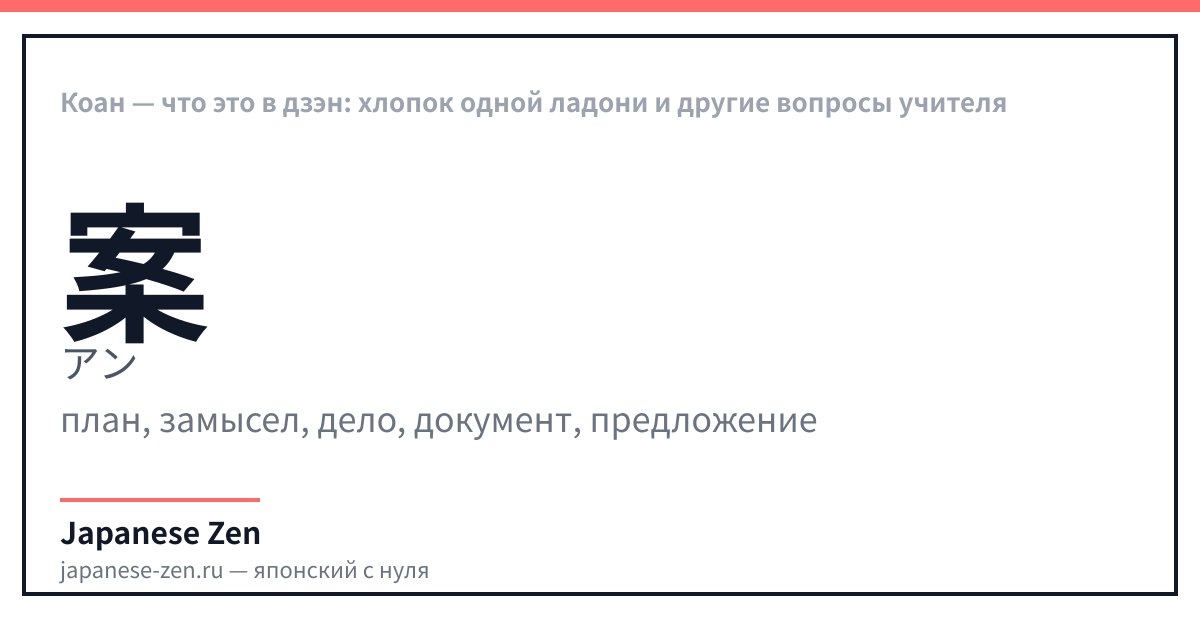
案 — значение: plan, idea, case, document, proposal — онъёми: アン — кунъёми: つくえ — 10 штрих(ов). 案 — the second character in 公案: "case, document," and in modern words — "plan" or "proposal." In the koan itself it still has the clerical meaning: an official record that became a precedent.
公案 is composed of 公 "public, official" and 案 "case, document": together — "official case," that is, the very legal precedent. The same second character appears in 案内 — "guide, accompaniment" — and in 提案 — "proposal submitted for consideration": in all cases 案 means something put in writing and presented for consideration.
How "禅問答" Became a Term for an Incomprehensible Conversation
In everyday life 禅問答 long ago detached from the monastery: it refers to any conversation where the speakers seem to talk in different languages, and the meaning of the answers does not match the meaning of the questions. Dictionaries record this meaning separately from the Buddhist one — "a dialogue that is hard to understand."
| Japanese | Reading | Translation |
|---|---|---|
| 公案 | kōan · kōan | Koan |
| 禅問答 | zenmondō · zenmondō | Zen dialogue, and in everyday use — a conversation without mutual understanding |
| 案内 | annai · annai | Guide, accompaniment |
| 提案 | teian · teian | Proposal submitted for consideration |
| 独参 | dokusan · dokusan | Private meeting between student and teacher |
| 隻手 | sekishu · sekishu | "One hand" — from Hakuin's koan |
Write 案 along the guides — the second character of 公案, "case" and "proposal" in one kanji.
A Koan Is Not a Riddle and Not a Japanese Invention
- "A koan is an unanswerable riddle or just an absurd joke." A koan is not a test of cleverness or humor: it is a tool meant to exhaust the student's habitual logic, not to entertain them.
- "Koans were invented in Japan." The tradition itself formed in China during the Song era, among Chan Buddhist masters; it migrated to Japan along with the Rinzai school in the twelfth and thirteenth centuries and received a Japanese pronunciation — "koan" instead of the Chinese "gong'an."
- "To solve a koan means to come up with a witty answer." The teacher evaluates not wit but a change in the student themselves: the same verbal answer may be accepted from one person and rejected from another.
FAQ
- What is a koan in simple words?
- A koan is a question that a Zen teacher selects for a particular student: habitual logic is useless in it, and what is sought is not a witty answer but a change in the person themselves. The task is to drive thinking to a dead end and through that dead end push the student toward sudden awakening, satori.
- Which koan is the most famous?
- Perhaps the most widely circulated is "the sound of one hand clapping" (隻手音声) by the master Hakuin Ekaku: if the clap of two hands produces a sound, then what sound can one hand make? Hakuin invented this question himself and considered it more effective than the earlier koan "Mu."
- Does a koan have an answer?
- There is no single correct formulation of an answer: the teacher evaluates not the student's words but the state from which they are spoken. The same answer may be accepted from one person and rejected from another — a memorized retelling is recognized immediately.
- What does "the sound of one hand clapping" mean?
- This is a koan by the master Hakuin Ekaku: an ordinary clap of two hands has a sound, but what can a single hand "say"? The answer does not imply a specific sound — the question must exhaust habitual logic and push the student toward a breakthrough.
- Where did koans come to Japan from?
- The koan tradition formed in China during the Song era, among Chan Buddhist masters who called them 公案 — "official case," by analogy with a legal precedent. It came to Japan along with the Rinzai school in the twelfth and thirteenth centuries and received the Japanese pronunciation of the word.
- How is "koan" written in Japanese?
- 公案, read こうあん. The first character 公 means "public, official," the second 案 — "case, document": together — "official case," that is, a legal precedent that Zen relies on as an indisputable model.
Sources
Updated: 2026-09-14