Sumi-e — Japanese ink painting: Zen and the Four Noble Plants
Sumi-e (墨絵) is Japanese painting with a single ink, without color: the artist conveys form through the density of black and the dilution with water. The technique came from China together with Zen Buddhist monks in the Kamakura–Muromachi period and in Japan merged with contemplative practice. The main name of the genre is the monk Sesshu Toyo, who lived in the 15th century.
Sumi-e is confused either with Chinese ink painting or with an ordinary black-and-white picture without technique behind it. In fact, it is a separate Japanese tradition with its own subjects, special brush techniques, and the idea of empty space on paper as part of the painting. Let's examine the technique, the character 墨, and how to recognize sumi-e in a modern game.
Sumi-e — painting with a single ink
Sumi-e (墨絵) is Japanese monochrome ink painting, also known as suibokuga (水墨画), 'ink and water painting.' The technique came to Japan from China together with Zen Buddhist monks in the Kamakura–Muromachi period as part of spiritual practice, not just visual art. A single black pigment instead of a palette of colors is not a limitation here but a conscious choice: the artist conveys form, volume, and mood only through the density of ink and the amount of water in the brush.
Sumi-e and Zen
The key figure of Japanese sumi-e is the monk Sesshu Toyo (1420–1506), who studied painting at the Kyoto temple Shokoku-ji, traveled to Ming-era China, and created his own recognizably Japanese style of sharp, energetic brushstrokes. In Zen Buddhism, ink painting itself was considered a form of meditation: the artist worked quickly and with almost no corrections, and the quality of the line directly reflected the state of his mind at the moment of painting.
Brush techniques and the Four Noble Plants
The classic set of sumi-e tools — brush, ink, inkstone, and paper — is shared with Japanese calligraphy, to which it is technically closest. The master grinds ink on the inkstone to the desired density and with a single brush, without changing color, achieves dozens of shades of gray — from almost transparent to deep black, depending on the amount of water and pressure.
- Haboku (破墨), 'broken ink,' is a technique where dark strokes are applied over a light wet layer, creating soft, blurred transitions without clear outlines.
- The Four Noble Plants, in Japanese shikunshi (四君子), are bamboo, orchid, plum, and chrysanthemum; a teaching program for beginners that came from China, where each plant practices its own basic brushstroke.
- Each of the four plants is associated with a season: plum with winter, orchid with spring, bamboo with summer, chrysanthemum with autumn.
Why empty space on the sheet is part of the painting
The unpainted area of paper in sumi-e is called yohaku (余白) and is treated as seriously as the ink strokes themselves: emptiness can signify fog, water, air, or simply give the painting room to breathe. This feature of sumi-e is directly contrasted with the Western habit of filling the entire canvas with paint.
The character 墨: black and earth
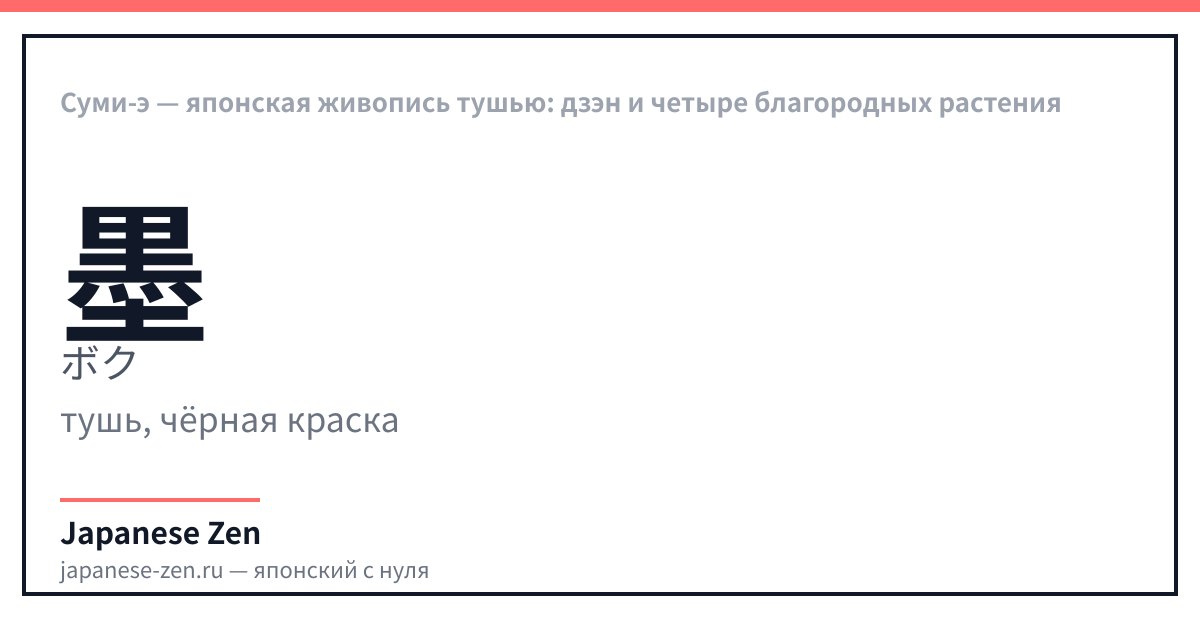
墨 — значение: ink, black paint — онъёми: ボク — кунъёми: すみ — 14 штрих(ов). 墨 — 'ink': an old way of writing from soot and glue pressed into a solid block. The same character is in 水墨画 (suibokuga), the second name of this painting.
墨 is composed of two parts: on top, a simplified character 黒 'black,' and below, 土 'earth': together — 'blackened earth,' an image of soot pressed into a solid block, from which ink is made. The character is read in two ways: the on'yomi boku — in words like 水墨画, the kun'yomi sumi — in the standalone word 'ink' and in the name of the technique sumi-e.
| Japanese | Reading | Translation |
|---|---|---|
| 墨絵 | sumie · sumie | Ink painting |
| 水墨画 | suibokuga · suibokuga | Second name for ink painting |
| 筆 | fude · fude | Brush |
| 硯 | suzuri · suzuri | Inkstone |
| 余白 | yohaku · yohaku | Empty, unpainted space on the sheet |
墨 in tattoos and ink
The same character 墨 is in the word 墨汁 (bokujuu), liquid ink in a bottle for everyday writing. It is also in 入れ墨 (irezumi), Japanese tattoo, whose name literally means 'inserted ink': the design is applied under the skin, not on paper.
Write 墨 along the guides — the character 'ink,' which names the entire genre of sumi-e.
Sumi-e in games: from Okami to Ubisoft's samurai
The game Okami (大神, Clover Studio, Capcom, 2006) is built on sumi-e as a visual language: the world is drawn in the style of woodblock prints and ink painting. Instead of a usual set of skills, the heroine has the 'Celestial Brush,' with which the player literally draws lines on the screen to perform miracles. Despite critical acclaim — the game won IGN's 'Game of the Year' award in 2006 — Okami was not a commercial success, and soon after release Clover Studio closed.
How to recognize sumi-e on screen
The common feature is the rejection of color in favor of black, gray, and white, and a deliberately visible brushstroke instead of a smooth fill, as in Okami. In the game Assassin's Creed Shadows (Ubisoft, 2025), a similar technique became not the visual style of the whole game but a separate mechanic. The player can sneak up on a wild animal and paint it in sumi-e technique, receiving rewards for it — from a decorative scroll to a pet for the hideout. The conditions for the drawing depend on the location, time of day, and season.
FAQ
- What is sumi-e?
- Sumi-e (墨絵) is Japanese monochrome painting with a single ink, without other colors: form and mood are conveyed only through the density of black and the amount of water in the brush. The technique is connected with Zen Buddhist contemplative practice.
- How does sumi-e differ from Chinese ink painting?
- Sumi-e grew out of the Chinese tradition brought to Japan by Zen Buddhist monks in the Kamakura–Muromachi period, and its Japanese variant is distinguished by a sharper, more energetic brushstroke and its own subjects, rather than a direct repetition of Chinese models.
- What is needed for sumi-e painting?
- A brush, solid ink, an inkstone for grinding it with water, and soft paper that quickly absorbs moisture and does not forgive corrections. The same set of four items is used for Japanese calligraphy — the techniques are historically related.
- Who is the most famous master of sumi-e?
- The Zen monk Sesshu Toyo (1420–1506): he studied in Kyoto, traveled to Ming-era China, and created a recognizably Japanese, energetic style of ink painting that influenced all subsequent artists of the genre up to modern times.
- How is 'sumi-e' written in kanji?
- 墨絵, read すみえ: 墨 'ink' plus 絵 'picture' — together 'ink picture.' The technique also has a second, more formal name — 水墨画 (suibokuga), 'ink and water painting': both words mean the same art.
Sources
Updated: 2026-09-14