Katsushika Hokusai — who he was and why everyone knows his "Wave"
Katsushika Hokusai (葛飾北斎, 1760–1849) was a Japanese artist, creator of the print "The Great Wave off Kanagawa" and the series "Thirty-six Views of Mount Fuji." Over seventy years of work he changed his creative name more than thirty times and left thousands of sketches in the collection "Hokusai Manga." He began as a pupil in the studio of the theatrical artist Katsukawa Shunshō, and found his own recognizable style only after being expelled from it.
Most people know just one picture with a wave and almost nothing about the person behind it: an artist who, after being expelled from his school, began experimenting with foreign, European perspective and worked until the last months of his life. Let's look at his main works, the breakdown of the name 北斎, and what in his image is a confirmed fact and what later retellings invented.
Hokusai: the expulsion from the school that created the artist
Katsushika Hokusai was born on October 31, 1760, in Edo and died there on May 10, 1849, living almost 89 years. At about 19 he entered the studio of Katsukawa Shunshō, a leading artist of theatrical portraits, and worked under that school's name for nearly a decade and a half. After his teacher's death, Hokusai left the school — according to a widespread version, he was expelled by the senior pupil Shunkō. This resentment, biographers believe, pushed the artist to seek his own path, including the European perspective that was unusual for Japan at the time.
| Work | Years | What it is |
|---|---|---|
| "Hokusai Manga" (北斎漫画) | from 1814 | a multi-volume collection of study sketches — thousands of drawings of people, animals, and objects |
| "Thirty-six Views of Mount Fuji" (冨嶽三十六景) | around 1830–1832 | his main landscape series, including "The Great Wave"; started as 36 prints, grew to 46 due to its success |
| "A Tour of Waterfalls in Various Provinces" (諸国滝廻り) | around 1833 | a series of 8 prints with waterfalls from various provinces of Japan |
| "One Hundred Views of Mount Fuji" (富嶽百景) | 1834–1835, first volumes | a book series of views of Fuji; the less studied third volume came out later |
Hokusai and Fuji
Mount Fuji in Hokusai's work is not just a landscape but an object of reverence: the artist followed the belief in the Pole Star and the Big Dipper, which in Nichiren Buddhism were revered as the bodhisattva Myōken. Changing names, Hokusai never abandoned this theme — the mountain appears in the "Thirty-six Views," in a separate book series, and simply as a background in many of his other prints.
The name 葛飾北斎: birthplace and star faith
葛飾北斎 is read as かつしかほくさい: 葛飾 (Katsushika) is the old name of an area in the east of present-day Tokyo, where the artist was born, and 北斎 (Hokusai) literally means "northern studio." The name refers to the belief in the Pole Star and the Big Dipper: Hokusai followed this cult at the Hossō-ji temple in Yanagishima, in what is now Tokyo.
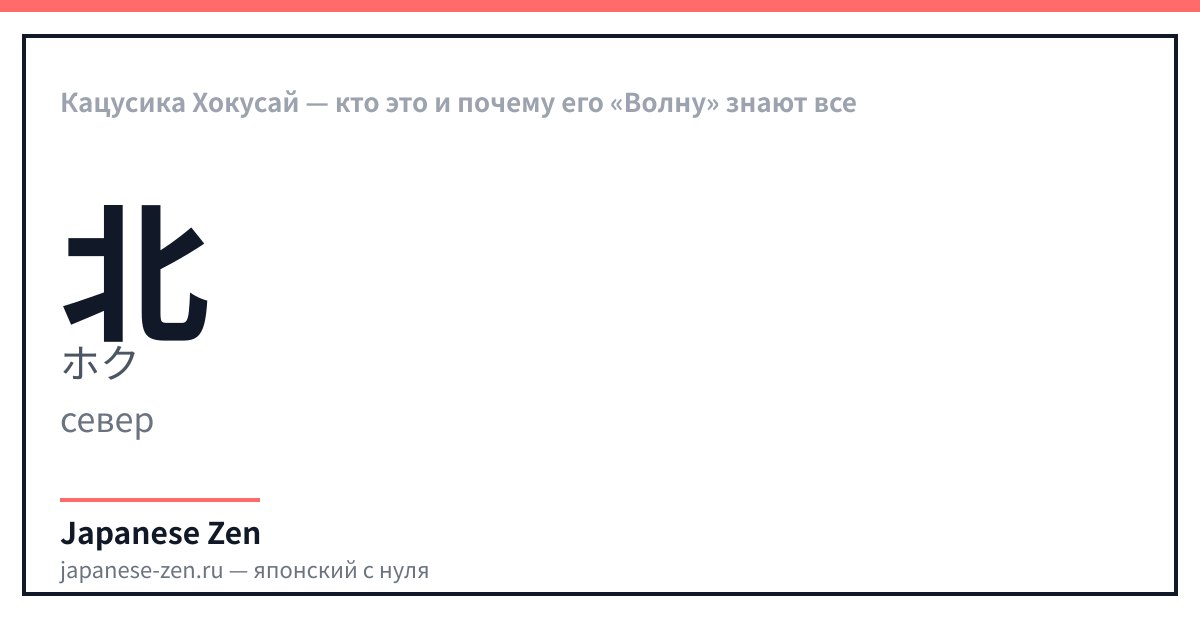
北 — значение: north — онъёми: ホク — кунъёми: きた — 5 штрих(ов). 北 — "north": the first, "star" kanji of Hokusai's name (北斎). The same character is in 北海道 (Hokkaido), "northern sea and path."
| Japanese | Reading | Translation |
|---|---|---|
| 葛飾北斎 | Katsushika Hokusai · Katsushika Hokusai | The artist's full name |
| 北斎漫画 | Hokusai Manga · Hokusai Manga | "Hokusai Manga" — a collection of sketches |
| 冨嶽三十六景 | Fugaku Sanjūrokkei · Fugaku Sanjūrokkei | "Thirty-six Views of Mount Fuji" |
| 画狂老人卍 | Gakyō Rōjin Manji · Gakyō Rōjin Manji | "The Old Man Mad about Painting" — his last signature |
| 漫画 | manga · manga | In Hokusai's usage — "random sketches," not a comic |
That same "manga"?
The word 漫画 in the title "Hokusai Manga" does not mean "comic" in the modern sense: 漫 — "free, random," 画 — "drawing," together — "random sketches," a collection of study sketches without a single plot. The modern meaning of the word "manga" as a story in pictures took hold only in the 20th century, and in that sense Hokusai did not draw manga — calling him the "inventor of manga" is inaccurate, though manga did get its name from him.
Write 北 along the guides — the "star" character from Hokusai's name.
"The Great Wave," "Manga," and faith in one's own growth
Hokusai began "Thirty-six Views of Mount Fuji" at seventy — a solid age for a new key series that became the peak of his career. Its most famous print is "The Great Wave off Kanagawa." Besides it, there is the book series "One Hundred Views of Mount Fuji," and in the series "A Tour of Waterfalls in Various Provinces" he experimented with falling water using the same bold technique.
"At one hundred and ten, every dot will be alive"
In the afterword to the first volume of "One Hundred Views of Mount Fuji" in 1834, Hokusai wrote that he truly began to draw only after seventy, and by one hundred and ten every dot and line under his hand would become alive. Translations of this passage differ in details, but the general meaning — faith that mastery grows without limit with age — is preserved in all versions.
Hokusai in film and in his daughter's work
For the last two decades of his life, Hokusai was helped by his daughter Katsushika Ōi (in older texts — Oei): she lived and worked alongside her father. According to contemporaries, he himself admitted that in portraits of beauties she surpassed him. As an independent artist, Ōi long remained in her father's shadow and gained wide recognition only in our time.
- "Miss Hokusai" (2015, Production I.G, directed by Keiichi Hara) — an adaptation of Hinako Sugiura's manga "Sarusuberi," showing Hokusai's studio through Ōi's eyes.
- "Hokusai" (2020, directed by Hajime Hashimoto) — a four-chapter biopic where the young artist is played by Yuya Yagira and the old man by Min Tanaka.
Hokusai on a banknote and in a passport
Both facts are not legend. The new-style passport introduced in 2020 uses 24 prints from "Thirty-six Views of Mount Fuji" on the pages for entry stamps. The new 1000-yen banknote, issued on July 3, 2024, carries "The Great Wave" on its reverse.
FAQ
- Who is Katsushika Hokusai?
- A Japanese artist and printmaker of 1760–1849, creator of "The Great Wave off Kanagawa" and the series "Thirty-six Views of Mount Fuji." Over his life he changed his creative name more than thirty times and worked until his last months, leaving thousands of prints, drawings, and book illustrations.
- What are Hokusai's most famous works?
- The print "The Great Wave off Kanagawa" and the entire series "Thirty-six Views of Mount Fuji," which it belongs to. Also well known are the book series "One Hundred Views of Mount Fuji" and the multi-volume sketch collection "Hokusai Manga," begun in 1814.
- How long did Hokusai live?
- He was born on October 31, 1760, in Edo and died there on May 10, 1849 — living almost 89 years, a rare age for an artist of that era. He continued working literally until the last months of his life, and began his most famous series, "Thirty-six Views of Mount Fuji," at seventy.
- What does the name "Hokusai" mean?
- 北斎 literally means "northern studio": the name is connected to Hokusai's belief in the Pole Star and the Big Dipper, which in Nichiren Buddhism were revered as the bodhisattva Myōken. Over his life he changed more than thirty other names.
- Is it true that Hokusai invented manga?
- No: with the word 漫画 he titled a collection of random study sketches without a single plot, not stories in pictures in the modern sense. The modern meaning of the word "manga" took hold only in the 20th century, decades after his death.
- How is "Hokusai" written in kanji?
- 葛飾北斎, read as かつしかほくさい. 葛飾 is the old name of an area in the east of modern Tokyo, where he was born, and 北斎 — "northern studio," one of his pseudonyms, connected to the belief in the Pole Star. Over his life the artist signed with dozens of other names as well.
Sources
Updated: 2026-09-14