Edo Period — When It Was and What It Is Known For
The Edo period is the era of rule by the Tokugawa shoguns from 1603 to 1868, when the country was governed not by the emperor but by a military government in the city of Edo, present-day Tokyo. The shogunate kept the daimyo under control with the sankin-kotai system and nearly closed Japan with the sakoku policy, trading with the West only through Dejima island. Edo grew into a city of a million people and gave rise to ukiyo-e, kabuki, and bunraku.
Two and a half centuries without major wars is rare for any country, and for Japan between the fragmented Sengoku and the rapid Meiji it is almost an anomaly. We look at how the Tokugawa shogunate managed to keep hundreds of willful daimyo under control, what lay behind the closed borders, and why both the urban culture of ukiyo-e and the customs recognizable in modern Japan grew out of this time.
When the Edo Period Was and How Long It Lasted
The Edo period (江戸) is the era of rule by the shoguns of the Tokugawa house from 1603 to 1868, when Tokugawa Ieyasu received the title of seii taishogun from the emperor and established a military government in the city of Edo, present-day Tokyo. For two and a half centuries the country lived without major civil wars — a rare case of long internal peace in world history. The Edo period ended in 1867–1868: the last shogun, Tokugawa Yoshinobu, returned power to the emperor, and the victorious forces proclaimed the Meiji Restoration.
| Year | Event |
|---|---|
| 1600 | Battle of Sekigahara — Tokugawa Ieyasu defeats his rivals and becomes the de facto ruler of the country |
| 1603 | Ieyasu receives the title of seii taishogun from the emperor — the formal beginning of the shogunate and the Edo period |
| 1635 | An edict formalizes the sankin-kotai system — daimyo are required to live in Edo every other year, leaving their families as hostages |
| 1639 | The sakoku policy is fully implemented — trade with the West remains only through the Dutch on Dejima island in Nagasaki |
| 1853 | Commodore Perry's squadron, the "black ships," enters Edo Bay, present-day Tokyo Bay, and demands that the country open |
| 1868 | Tokugawa Yoshinobu returns power to the emperor — the Meiji Restoration and the end of the Edo period |
How the Edo Period Differed from Neighboring Eras
What distinguishes the Edo period from the preceding Sengoku era is above all peace: instead of gekokujo, "the low overcome the high," the shogunate built a rigid, almost immobile class hierarchy and kept the provinces under control without constant wars. What distinguishes it from the Meiji that followed is its closedness: Edo-period Japan took almost no part in international trade and until the very end of the era knew neither the telegraph, nor railways, nor permanent diplomatic ties with the West.
How People Lived Under the Tokugawa Shogunate
- Power — the country was governed by the shogun from the Tokugawa house through the military government, the bakufu, in Edo. About 260 provincial daimyo retained their lands but were required to come to serve in the capital every one or two years under the sankin-kotai system.
- Classes — society was divided into warriors, peasants, artisans, and merchants (士農工商). Historians of recent decades, however, consider this hierarchy more an ideological scheme than a literally observed law: by the 18th century, wealthy merchants often lived more prosperously than impoverished samurai.
- Borders — from 1639 the sakoku policy closed the country to foreigners for almost two and a half centuries: an exception was made only for Dutch and Chinese merchants on the artificial island of Dejima in Nagasaki.
- Cities — by the early 18th century Edo exceeded a million inhabitants and became the largest city in the world; there too flourished ukiyo-e woodblock prints, kabuki theater, and bunraku puppet theater.
- Daily life — peacetime and the growth of cities created demand for entertainment and print culture: books, prints, and guides to famous roads circulated throughout the country.
Name and Kanji: 江戸
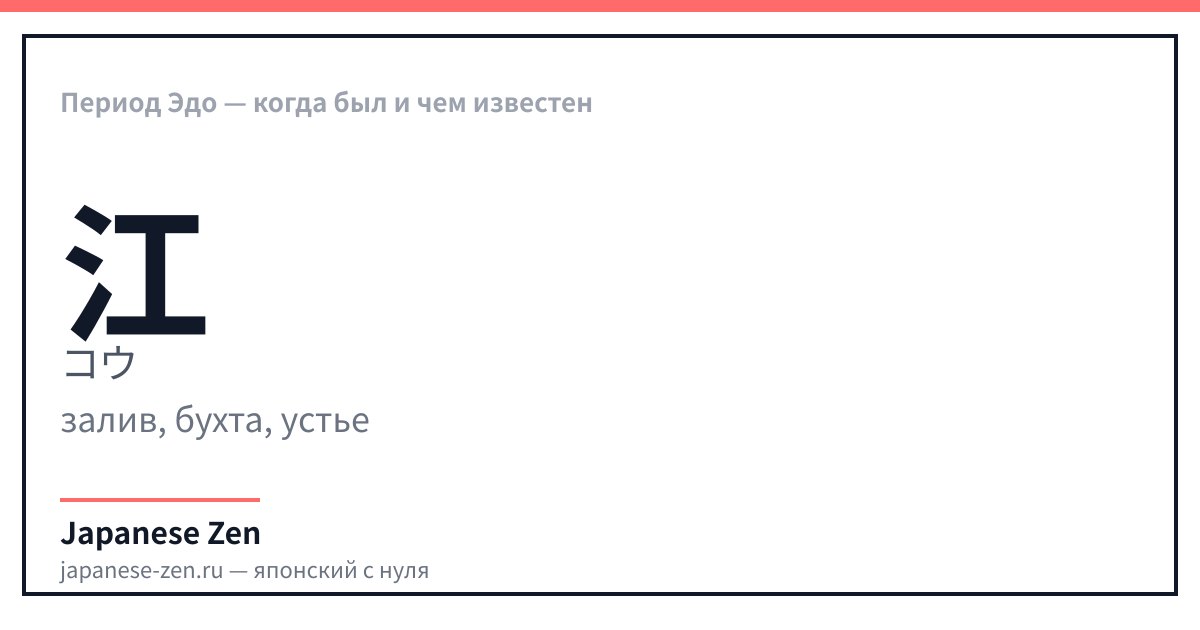
江戸 is read えど (Edo) and literally means "mouth of the bay" or "door at the inlet": 江 — "bay, inlet," 戸 — "door, entrance." The city received the name from its location at the entrance to Tokyo Bay even before Tokugawa Ieyasu made it his capital. After the Meiji Restoration the city was renamed Tokyo (東京), "eastern capital," but the historical period itself is still called by its old name.
江 — значение: bay, inlet, mouth of a river — онъёми: コウ — кунъёми: え — 6 штрих(ов). 江 — "bay, inlet, mouth of a river": 6 strokes. The same character appears in the name Edo (江戸) and in the common word 入り江 (irie, "inlet, cove").
| Japanese | Reading | Translation |
|---|---|---|
| 江戸 | Edo · Edo | The old name of Tokyo and the name of the entire era |
| 江戸時代 | Edo jidai · Edo jidai | The full name — "Edo period" |
| 参勤交代 | sankin kōtai · sankin kōtai | The system of mandatory daimyo journeys to Edo |
| 鎖国 | sakoku · sakoku | The policy of closing the country to the outside world |
| 将軍 | shōgun · shōgun | The military ruler of Japan during this period |
| 浮世絵 | ukiyo-e · ukiyo-e | Woodblock prints — the main art of the Edo era |
Write 江 along the guides — the first character in 江戸, "bay" in the name of the era.
Why the Edo Period Has No Single Era Name
The Edo period, unlike Meiji, Taisho, or Showa, has no single era name for the whole period. Over two and a half centuries more than thirty gengo changed, because emperors had long changed them not only upon a change of ruler but also after disasters or landmark events. The habit of changing the era name in the middle of a reign was abolished already by the next era, Meiji.
Which Anime Take Place in the Edo Period
- "Gintama" (銀魂) — a comedic alternate version of the late Edo period, where aliens have occupied the country, but samurai still carry wooden swords and solve problems with a joke before a fight.
- "Mononoke" (モノノ怪, 2007, Toei Animation) — a series stylized after woodblock prints about a wandering medicine seller who exorcises spirits in the towns and on the roads of the late Edo period.
- "Samurai Champloo" (サムライチャンプルー) — a loose, deliberately anachronistic story about three wanderers on the roads of Edo, where hip-hop coexists with authentic details of the era's daily life.
Periods of Japanese History
The Edo period is only one of many in the Japanese periodization: before it the country went through Jomon, Yayoi, Kofun, Asuka, Nara, Heian, Kamakura, Muromachi, and Azuchi-Momoyama, and after it came Meiji, Taisho, Showa, Heisei, and the current Reiwa. Periods are distinguished from one another either by the ruling house and capital, as with Edo and Kamakura, or by the emperor's era name, as with all eras after Meiji.
FAQ
- When was the Edo period?
- The Edo period lasted from 1603, when Tokugawa Ieyasu became shogun, to 1867–1868, when the last shogun, Tokugawa Yoshinobu, returned power to the emperor. It followed the Azuchi-Momoyama period and ended with the Meiji Restoration.
- How long did the Edo period last?
- About two and a half centuries — from 1603 to 1868. It is the longest period of internal peace in Japanese history: during all that time the country had not a single truly major civil war.
- What happened during the Edo period?
- The Tokugawa shogunate kept the daimyo under control with the sankin-kotai system, closed the country with the sakoku policy, leaving trade with the West only through Dejima island, and peace and the growth of cities allowed ukiyo-e prints, kabuki theater, and bunraku puppetry to flourish.
- How is "Edo period" written in kanji?
- 江戸時代, えどじだい: 江 — "bay," 戸 — "door," 時代 — "period, era." Literally — "the era at the entrance to the bay," from the location of the shogunate's capital city by Tokyo Bay.
- Which anime take place in the Edo period?
- The comedic "Gintama" parodies the late Edo period with an alien invasion, "Samurai Champloo" loosely plays with the era's daily life over hip-hop, and "Demon Slayer" references the demon slayer technique inherited from warriors of this and earlier times.
- What periods of Japanese history are there?
- From the earliest Jomon through Yayoi, Kofun, Nara, Heian, Kamakura, and Muromachi — to Edo, and then to Meiji, Taisho, Showa, Heisei, and the current Reiwa. Periods are named either after the ruling house and capital, or, starting with Meiji, after the emperor's era name.
Sources
Updated: 2026-09-11