The Kamakura Period — When It Was and What It Is Known For
The Kamakura period is the age of Japan's first shogunate: from 1185 (the defeat of the Taira clan) or 1192 (the title of sei-i taishogun granted to Minamoto no Yoritomo) until 1333. The country was ruled in the shoguns' name by regents called shikken from the Hojo clan, and the greatest trial came with two Mongol invasions — in 1274 and 1281, both thwarted by storms that were called kamikaze.
There is no agreement even on the start date of the Kamakura period — historians debate whether to count a military victory or an official title as the starting point. But there is plenty of agreement on the essence: for the first time in Japanese history, power passed from the court nobility to the warrior class and never went back. We look at what happened in 1185 and 1192, who the shikken were, and what two Mongol invasions have to do with it.
When the Kamakura Period Was and How Long It Lasted
The Kamakura period began in 1185, when Minamoto no Yoritomo defeated the Taira clan and received from the imperial court the right to appoint his representatives throughout the country — shugo (守護) in the provinces and jito (地頭) on the estates. Some historians still date the start to 1192, when Yoritomo officially received the title of sei-i taishogun ("great general who subdues the barbarians") — the very title that all subsequent shoguns of the country would bear. Both dates are correct in their own way: 1185 is the moment when military power had already effectively taken shape, 1192 is the moment when it received an official name. The era ended in 1333 with the fall of the shogunate under the blows of the troops of Emperor Go-Daigo.
| Year | Event |
|---|---|
| 1185 | Minamoto no Yoritomo defeats the Taira clan and gains the right to appoint shugo and jito throughout the country |
| 1192 | Yoritomo officially receives the title of sei-i taishogun |
| 1203 | Hojo Tokimasa becomes the first shikken — regent to the shogun |
| 1274 | First Mongol invasion: Kublai Khan's fleet retreats after a storm |
| 1281 | Second Mongol invasion: the fleet is destroyed by a typhoon that was called kamikaze |
| 1333 | Fall of the Kamakura shogunate under the blows of the troops of Emperor Go-Daigo |
How the Kamakura Period Differed from Neighboring Eras
What distinguishes the Kamakura period from the preceding Heian era is the very fact of a military government: power passed for the first time from the court aristocracy of Kyoto to a warrior house. The shogun and his regents ruled from a separate city, Kamakura, leaving the emperor in the capital as a purely ceremonial figure. What distinguishes it from the following Muromachi era is the degree of centralization — the Hojo shikken held the provinces under tighter control than the later weakened Ashikaga shogunate. Another hallmark of the era is new schools of Buddhism addressed not only to the nobility: Zen (the Rinzai and Soto schools), Pure Land teaching, and the teaching of Nichiren spread across all classes during these centuries.
Name and Kanji: 鎌倉時代
鎌倉時代 is read かまくらじだい. The name is taken from the city of Kamakura, where Minamoto no Yoritomo placed his headquarters, not from the name of a clan or an event: 鎌 "sickle", 倉 "storehouse, warehouse", 時代 "era". The combination of the first two characters probably goes back simply to an old name for the locality, whose exact origin is not established.
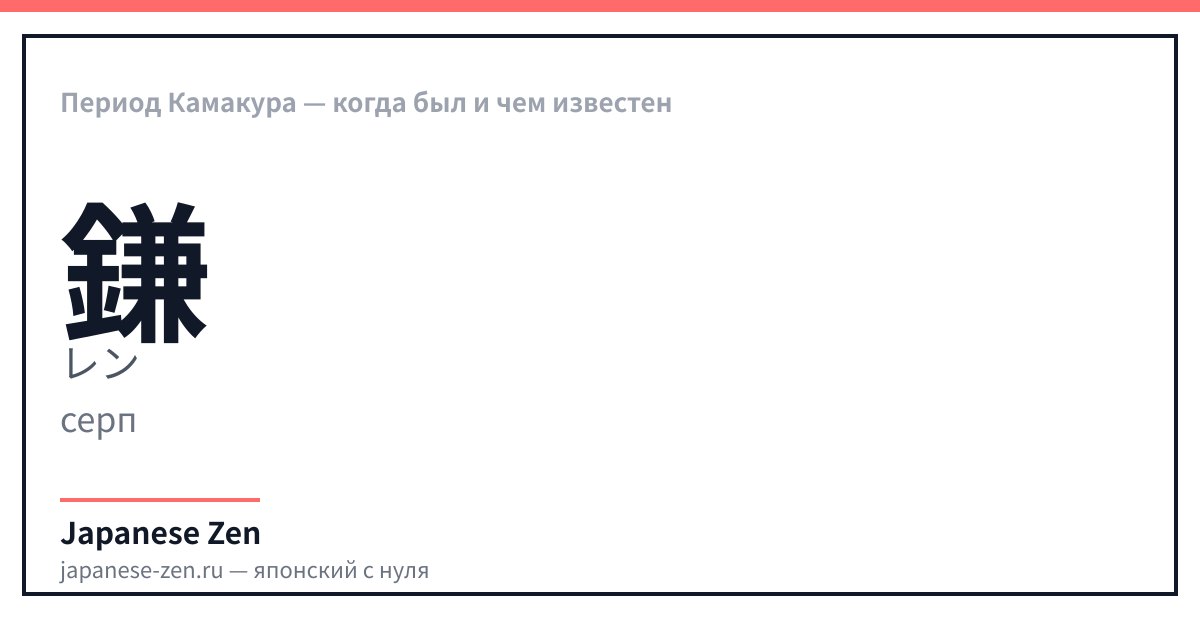
鎌 — значение: sickle — онъёми: レン、ケン — кунъёми: かま — 18 штрих(ов). 鎌 — "sickle": 18 strokes, an N1-level character, rare even for Japanese people outside this place name. It appears almost exclusively in 鎌倉 (Kamakura) and 鎌倉時代 (Kamakura period).
| Japanese | Reading | Translation |
|---|---|---|
| 鎌倉時代 | Kamakura jidai · Kamakura jidai | Kamakura period |
| 幕府 | bakufu · bakufu | Shogunate, military government |
| 執権 | shikken · shikken | Regent to the shogun from the Hojo clan |
| 守護 | shugo · shugo | Military governor of a province |
| 神風 | kamikaze · kamikaze | Divine wind — the typhoon that thwarted the Mongol invasions |
| 禅 | zen · zen | Zen — a school of Buddhism that spread during this era |
Write 鎌 along the guides — the "sickle" character from the name of the city and the Kamakura period.
Why Era Names Changed So Often
In the Kamakura era, the era name (年号) was not yet strictly tied to a change of emperor. It was changed on the occasion of natural disasters, expected misfortunes, or simply to "renew good fortune" — sometimes several times under the same ruler. The current rule of "one emperor — one era" was introduced only in 1868, with the beginning of the Meiji era; before that, the name of the year could change even without a change of ruler on the throne.
Which Anime and Games Are Set in the Kamakura Period
- Angolmois: Record of Mongol Invasion (2018) — a manga and anime about the defense of Tsushima Island in 1274, the first Mongol invasion.
- The Elusive Samurai (逃げ上手の若君, 2024, CloverWorks studio) — about Hojo Tokiyuki, heir of the last rulers of Kamakura, who flees from the troops of Ashikaga Takauji at the end of the era.
- Ghost of Tsushima (2020, Sucker Punch Productions) — a game about the same 1274 invasion as Angolmois, only with a fictional protagonist.
How to Recognize Kamakura on Screen
Several signs give away the Kamakura period on screen. These are Mongol warriors with tetsuhau explosive bombs and composite bows, and Japanese o-yoroi armor — still heavy, designed for mounted archery rather than the mass infantry of later centuries. Another sign is stories about a split within a single samurai clan, the Hojo or the Minamoto, rather than about a war of independent clans, as in the Sengoku period.
FAQ
- When was the Kamakura period?
- 1185 or 1192 — historians disagree. In 1185, Minamoto no Yoritomo defeated the Taira clan and gained the right to appoint governors throughout the country; in 1192, he received the official title of sei-i taishogun. The era ended in 1333 with the fall of the shogunate.
- How long did the Kamakura period last?
- From 141 to 148 years — depending on which start date is taken as the starting point, 1185 or 1192. In both versions the end is 1333: the fall of the shogunate under the blows of the troops of Emperor Go-Daigo.
- Who ruled during the Kamakura period?
- Formally, shoguns from the Minamoto clan, but from 1203 real power was held by regents called shikken from the Hojo clan, who ruled in the name of increasingly nominal shoguns. The imperial court in Kyoto remained a ritual center without real power.
- What happened during the Mongol invasions?
- In 1274 and 1281, Kublai Khan's fleet twice tried to land on Kyushu and both times was destroyed by sudden typhoons that the Japanese called kamikaze — "divine wind". The victory came at a high cost: the defense drained the treasury of the Kamakura shogunate.
- How is "Kamakura period" written in kanji?
- 鎌倉時代, read かまくらじだい: 鎌倉 is the name of the city where the shogun's headquarters was located, 時代 means "era". The character 鎌 ("sickle") appears almost exclusively in this place name.
- Which anime and games show the Kamakura period?
- The manga and anime Angolmois and the game Ghost of Tsushima show the Mongol invasion of Tsushima Island in 1274. The anime The Elusive Samurai unfolds at the end of the era, around the fall of the shogunate and the Hojo clan.
Sources
Updated: 2026-09-11