The Hojo Clan — Who They Were and What They're Famous For
The Hojo clan is actually two different families. The first are the Hojo shikken, regents of the Kamakura shogunate from 1203 to 1333. The second are the Go-Hojo (後北条氏), an independent Sengoku-era clan based in Odawara that ruled the Kanto region from 1493 to 1590, until Toyotomi Hideyoshi defeated them at the Siege of Odawara. There is no direct blood relation between them — only a borrowed name.
Ask about the Hojo clan and you risk getting an answer about two very different families, separated by three centuries and not a drop of shared blood. One ruled from the shadows, behind the shoguns of Kamakura; the other built its own domain in the east of the country and fell to the unifier of Japan. Let's sort out who is who and why both bear the same surname.
Who the Hojo Are — and Why There Are Two
The Hojo clan of the Sengoku era is the Go-Hojo (後北条氏), a family based in Odawara that ruled eight provinces of the Kanto region from 1493 to 1590. It was founded by Ise Shinkuro, known by his posthumous name Hojo Soun. The family adopted the name "Hojo" under Soun's son, Ujitsuna, in 1523–1524 — to draw on the prestige of the earlier Hojo, the shikken of Kamakura (1203–1333). The Go-Hojo have no blood relation to them. In 1590, Hideyoshi defeated the clan at the Siege of Odawara.
| Name | Role | Fate |
|---|---|---|
| Hojo Soun (Ise Soun, c. 1432–1519) | Founder of the family, captured Izu and Odawara | Received the name "Hojo" posthumously, from his son |
| Hojo Ujitsuna (1487–1541) | 2nd head, adopted the name Hojo in 1523–1524 | Expanded the domain across the whole Kanto region |
| Hojo Ujiyasu (1515–1571) | 3rd head, the "Lion of Sagami" | Repelled the sieges of Uesugi Kenshin and Takeda Shingen |
| Hojo Ujimasa (1538–1590) | 4th head, the family's largest domain | Surrendered at the Siege of Odawara, took his own life |
| Hojo Ujinao (1562–1591) | 5th and last head | Surrendered the castle; spared as Ieyasu's son-in-law, exiled to Mount Koya, died in 1591 |
What the Go-Hojo's Power in Kanto Rested On
The Go-Hojo relied not only on their army but also on rare order on the home front. From 1550, under Ujiyasu, a unified tax system called kandaka (貫高制) was introduced, and land surveys covered even the holdings of vassals and monasteries — a rarity for the fragmented Sengoku era. Odawara grew into one of the country's largest fortified cities: the sogamae (総構え) rampart encircled not just the castle but the entire city, which more than once saved the clan from the sieges of Uesugi Kenshin and Takeda Shingen.
The Name and the Kanji: 北条氏
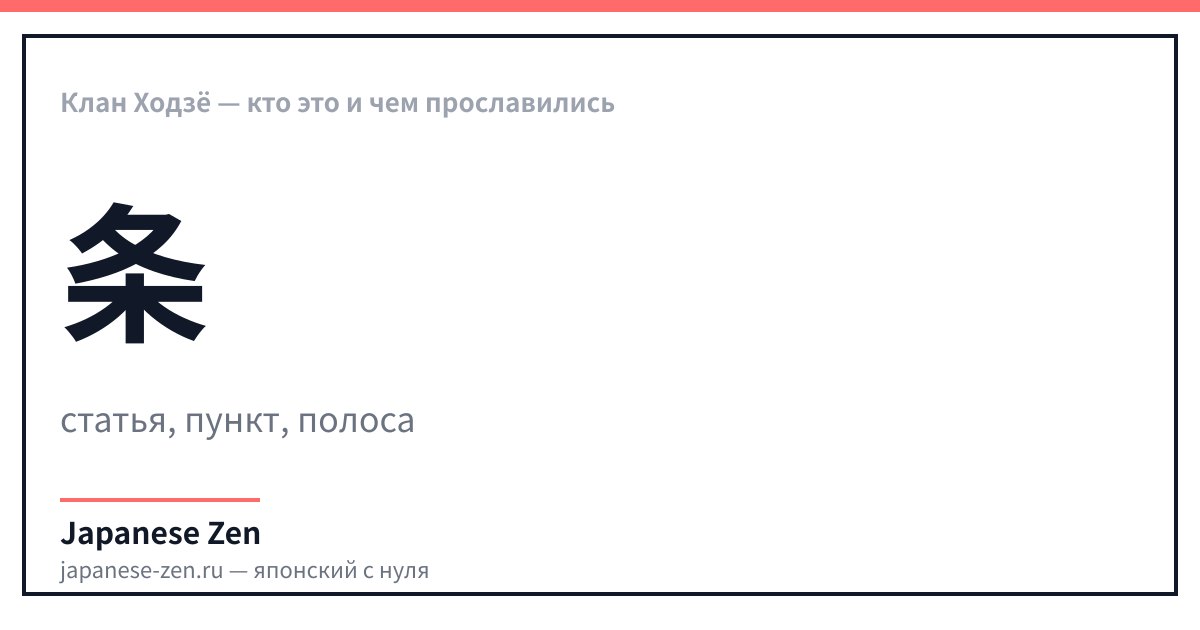
条 — значение: article, clause, strip — онъёми: ジョウ、チョウ、デキ — кунъёми: えだ、すじ — 7 штрих(ов). 条 — "article, clause": 7 strokes. The same character appears in 条約 (jōyaku, "treaty") and 条件 (jōken, "condition"); in the clan name it comes second and points to the family estate in Izu.
| Japanese | Reading | Translation |
|---|---|---|
| 北条氏 | Hōjō-shi · Hōjō-shi | The name of the clan |
| 小田原 | Odawara · Odawara | The capital and main castle of the Go-Hojo |
| 五代 | godai · godai | "Five generations" — the way the history of the Go-Hojo is described |
| 大名 | daimyō · daimyō | Provincial ruler — the title of the Go-Hojo heads |
| 執権 | shikken · shikken | Regent — the title of the Kamakura-era Hojo, not to be confused with the Go-Hojo |
Why the Name "Hojo" Was Not Inherited by Blood
Hojo Soun himself most likely never called himself Hojo — contemporaries knew him as Ise Shinkuro. The family name was changed from Ise to Hojo by his son Ujitsuna in 1523–1524, retroactively securing for his father the posthumous name Hojo Soun. The calculation was based on prestige: the earlier Hojo, regents of the Kamakura shogunate, had ruled the same lands three centuries before. The association with their name gave the new family weight in the eyes of its neighbors — even though there is no blood relation between the two Hojos.
How the Go-Hojo Story Ended
In 1590, Hideyoshi besieged Odawara with a force of about 200,000 against roughly 50,000 for the Go-Hojo, who had bet on the impregnability of their fortifications rather than a pitched battle. The siege dragged on for three months and went down in history as an example of the "Odawara council" (小田原評定) — a byword for endless debate without resolution, which the clan's leadership supposedly used to respond to it. Ujimasa and his brother took their own lives, Ujinao surrendered the castle and was spared as Ieyasu's son-in-law, and the Go-Hojo lands in Kanto passed to the Tokugawa — the very family that thirteen years later founded the last shogunate of Japan. Of the clan that ruled Kanto for a whole century, nothing remained — no lands, no heirs — only a once-borrowed name.
FAQ
- "Hojo clan": what family is this?
- This name hides two different families: the Hojo shikken, regents of the Kamakura shogunate from 1203 to 1333, and the Go-Hojo — an independent Sengoku-era clan based in Odawara that ruled Kanto from 1493 to 1590. There is no direct blood relation between them.
- When did the Go-Hojo rule?
- The Go-Hojo controlled Kanto from 1493, when Hojo Soun captured Odawara Castle, until 1590, when Toyotomi Hideyoshi defeated the clan at the Siege of Odawara. Over a hundred years, five clan heads succeeded one another — from Soun to Ujinao.
- What does the name 北条 (Hojo) mean?
- 北条 is read ほうじょう and is made up of 北 "north" and 条 "article, strip." This was the name of the family estate of the earlier Hojo, the regents of Kamakura, in Izu Province; the Go-Hojo borrowed this name centuries later for prestige, without any blood relation.
- What are the Go-Hojo famous for?
- The Go-Hojo built one of the most orderly administrative systems of the Sengoku era: a unified kandaka tax and land surveys. They turned Odawara into the country's largest fortified city and repelled the sieges of Uesugi Kenshin and Takeda Shingen before falling to Hideyoshi.
- Where does the Hojo clan appear in games?
- The Go-Hojo are one of the playable factions in Total War: Shogun 2. Hojo Ujiyasu is a playable character with his own storyline in Samurai Warriors 4. The clan also regularly appears in strategy games of the Nobunaga no Yabou series as one of the major houses of Kanto.
- How do the Go-Hojo differ from the Hojo of the Kamakura period?
- By direct blood relation: the Go-Hojo were self-proclaimed successors who took the name for prestige nearly three centuries after the fall of the Kamakura shikken. The Kamakura Hojo ruled the country as regents under the shoguns from 1203 to 1333; the Go-Hojo were an independent Sengoku-era clan that perished in 1590 at Hideyoshi's hands.
Sources
Updated: 2026-09-11