Onna-bugeisha — who they were and what they did
Onna-bugeisha were women of Japan's warrior class, trained from childhood to use weapons to defend the home while the men were away on campaign. The term 女武芸者 itself became established mainly in Western popular literature; in Japanese sources a woman with a weapon was more often called 女武者 (onna-musha) or simply by name. Their weapons were the naginata, the kaiken and the bow; the most famous of them is Tomoe Gozen.
Ask about onna-bugeisha and the first image that comes up is a warrior woman equal to any male samurai. The reality is more modest and more interesting: this was not a post or a rank, but a household skill of women from warrior families, one that only a handful of times proved useful in earnest. Let's look at where the word itself came from, what girls from bushi families were actually taught, and how five recognizable names stand behind this word — from Tomoe Gozen to Nakano Takeko.
Who the onna-bugeisha were and what they did
Onna-bugeisha were women from families of the bushi warrior class, trained from childhood to use weapons for one practical purpose: to defend the home while the men were away on campaign, in service to their lord, or at court. The word 女武芸者 itself is not a strict historical term but a label that became established mainly in Western popular literature. In Japanese sources a woman with a weapon was more often called 女武者 (onna-musha) or simply by name — Tomoe Gozen, Hangaku Gozen. This skill gave no separate post or stipend: it remained part of household upbringing, not a career.
- Duties — to defend the home, family and castle while the men were away on campaign, in service to their lord, or at court; in a siege, to hold the defense alongside the guards.
- Weapons — the naginata for fighting at a distance: its long shaft compensated for the difference in height and strength against a male opponent. In close combat and to defend her honor — the kaiken, a short dagger a girl received at coming of age or marriage. Less often — the bow.
- Status — weapons training did not change class status: a woman remained part of her father's or husband's household and did not receive a separate post or income.
How they became one
Training began in childhood, alongside their brothers: daughters of samurai houses were taught the naginata as part of ordinary upbringing, not by the girl's personal choice. At coming of age or marriage a girl received a kaiken — this dagger was to be carried at all times, in the folds of the obi or in the sleeve of the kimono. The word 女武芸者 also has a narrow historical meaning: in the Edo period it referred to female instructors and bodyguards who served in the women's quarters of daimyo households — they were also called 別式 (besshiki). This is a specific 17th-century post, not a general name for all women from warrior families in earlier centuries.
The real women behind the term
| Name | When | What she is known for |
|---|---|---|
| Tomoe Gozen | Genpei War, 12th century | Companion of Minamoto no Yoshinaka, described in the Heike Monogatari as a skilled archer and horsewoman. Her historicity is not proven: her name does not appear in the official chronicle Azuma Kagami. |
| Hangaku Gozen | Kennin Rebellion, 1201 | Defended Torisaka Castle with accurate archery, was wounded in the thigh and taken prisoner. Unlike Tomoe, she is mentioned in the Azuma Kagami: the wounded captive was married to a vassal of the shogun. |
| Ii Naotora | Sengoku period, 16th century | According to tradition, a woman who took the head of the Ii clan when there were no male heirs. Modern historians dispute this: the monastic name Jiro-hoshi may have concealed a man. |
| Nakano Takeko | Boshin War, 1868 | Led a volunteer women's unit during the defense of Aizu, fought with a naginata and died from a bullet at the age of 21 — after asking her sister to cut off her head so it would not fall to the enemy. |
| Tsuruhime of Oshima | 1541 | According to island legend, she repelled an attack by the Ouchi clan's fleet on the Oyamazumi shrine. No reliable sources from her era survive — she became known through 20th-century literature. |
The range of dates and degrees of reliability here is deliberate — from a semi-legendary heroine of a literary classic to a documented death in 1868. And one more important caveat: onna-bugeisha is not the same as kunoichi (a female ninja). Different classes and different tasks: the kunoichi belonged to the world of the shinobi, not to a bushi household. Women's participation in actual combat is remembered precisely because it was the exception — the vast majority of those trained in weapons never once raised them against a living opponent, but kept the skill for a contingency that might never come.
The word and the kanji: 女武芸者
How it is read and what it literally means
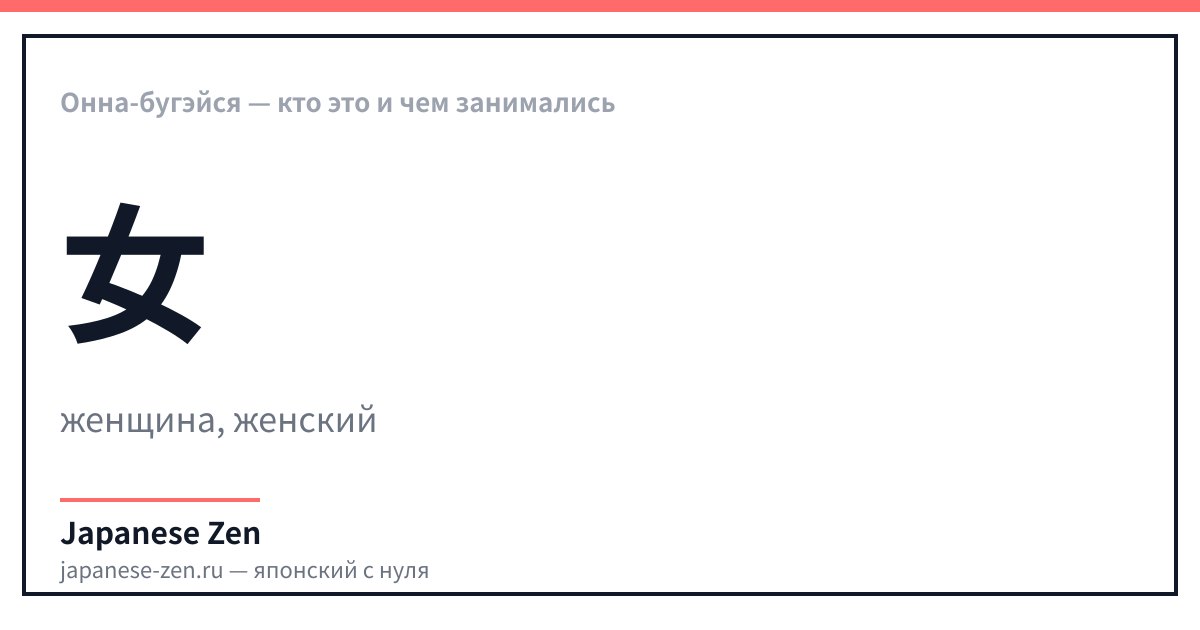
女武芸者 is read おんなぶげいしゃ (onna bugeisha). The word consists of three parts: 女 (onna) — 'woman', 武芸 (bugei) — 'martial arts' (武 'military' + 芸 'art, skill'), 者 (sha) — a suffix for a person, the same as in 医者 (isha, 'doctor') or 忍者 (ninja). The character 者 is not in the basic stroke set, so the card below breaks down 女.
女 — значение: woman, female — онъёми: ジョ、ニョ、ニョウ — кунъёми: おんな、め — 3 штрих(ов). 女 — 'woman': 3 strokes, one of the basic N5 characters. Paired with 武者 (musha, 'warrior') it gives 女武者 (onna-musha) — a word encountered in Japan itself more often than the 女武芸者 in the title of this page.
武 is read differently depending on the word: 'bu' in 武芸者 and in 武士, but 'mu' in 武者 — most kanji have several on readings. Because of this, 女武芸者 (onna-bugeisha) and 女武者 (onna-musha) look like close relatives in writing, but it was the second word that was in use in Japan itself for a woman who took up weapons.
| Japanese | Reading | Translation |
|---|---|---|
| 女武芸者 | onna-bugeisha · onna-bugeisha | The word this page is about |
| 女武者 | onna-musha · onna-musha | The more common word in Japan for the same phenomenon |
| 武士 | bushi · bushi | The warrior class to which their families belonged |
| 薙刀 | naginata · naginata | Their main weapon — a polearm blade for fighting at a distance |
| 懐剣 | kaiken · kaiken | A short dagger for close combat that was carried on one's person |
| 弓 | yumi · yumi | The bow — the weapon of Hangaku Gozen and Tsuruhime |
Listen to how onna-bugeisha and related words sound, and repeat aloud.
Are there onna-bugeisha today
The bushi class was abolished by the Meiji reforms in the 1870s, and with it disappeared the very reason to teach women weapons for defending the home: the army became conscript-based rather than class-based. The naginata, however, did not disappear — it moved from combat training into the school curriculum. By 1926 it had been made a compulsory part of physical education in Japanese girls' schools, but as a way to cultivate character and discipline, not to prepare for defending an estate.
After World War II, Japanese martial arts federations revised the practice and formalized gendai budo 'atarashii naginata' (現代なぎなた) — a modern sport with competitions, separate from the old koryu (古流) schools. Today the naginata in Japan is practiced mainly by women, though dojo are open to all: it is a civilian sport with rules and a federation, not a direct continuation of the onna-bugeisha class.
Onna-bugeisha in anime and dramas
- 'Onna Joshu Naotora' (おんな城主 直虎, 2017) — an NHK taiga drama in 50 episodes about Ii Naotora, who took the head of a warrior house at the height of the Sengoku period.
- 'Yae no Sakura' (八重の桜, 2013) — an NHK taiga drama about Niijima Yae, who in 1868 defended Aizu with a rifle in her hands — in the same battle where Nakano Takeko's women's unit fell.
- The Samurai Warriors (Sengoku Musou) game series — Ii Naotora is playable with her own weapon and fighting style; in the series naginata are named after Tomoe Gozen, but the heroine herself is not among the fighters.
What film exaggerates
NHK taiga dramas rely on archives and stay closer to what is known about real people — that is how the genre works. Game and fantasy adaptations are freer: in the anime 'Sengoku Otome', for example, all the famous Sengoku commanders, including Oda Nobunaga, were turned into girls in a fictional world without men. This is a genre convention, not a version of the real onna-bugeisha — those had their own, far less fantastical names and fates.
FAQ
- Who were the onna-bugeisha?
- Onna-bugeisha were women from families of the bushi warrior class, trained from childhood to use weapons to defend the home. The word itself is more often found in Western popular literature; in Japanese sources a woman with a weapon is called 女武者 (onna-musha) or simply by name.
- What did the onna-bugeisha do?
- They defended the home, family and castle with weapons — the naginata, the kaiken, sometimes the bow — while the men were away on campaign. Real cases of combat are documented for only a handful of women: for the vast majority this remained a just-in-case skill, not participation in battles on equal terms with men.
- How is the word 'onna-bugeisha' written in Japanese?
- 女武芸者, read おんなぶげいしゃ. 女 (onna) — 'woman' (N5), 武芸 (bugei) — 'martial arts', 者 (sha) — a suffix for a person, as in 医者 (isha, 'doctor'). The more common word in Japan for the same phenomenon is 女武者 (onna-musha).
- How do onna-bugeisha differ from kunoichi?
- By class and task. Onna-bugeisha were women of a bushi household, trained in weapons for defending the estate. Kunoichi were shinobi women engaged in reconnaissance, surveillance and sabotage. These are two different worlds of medieval Japan that popular culture often confuses with each other.
- Are there onna-bugeisha today?
- As a class — no: it was abolished by the Meiji reforms along with the entire bushi warrior class. The naginata remained: since 1926 it has been a subject of physical education in Japanese schools, and today it is a separate sport, gendai budo, practiced mainly by women.
- Where do onna-bugeisha appear in anime and dramas?
- The NHK taiga dramas 'Onna Joshu Naotora' (2017) and 'Yae no Sakura' (2013) are based on real biographies. In the Samurai Warriors games, Ii Naotora is playable. But 'Sengoku Otome', where generals are turned into girls, has nothing to do with the real onna-bugeisha.
Sources
Updated: 2026-09-11