Yuki-onna — who she is in Japanese mythology
Yuki-onna ("snow woman") is the spirit of the snowstorm in Japanese mythology: she appears to travelers in a blizzard as a pale beauty in white and brings deadly cold, and in some versions kills with her icy breath. The most famous literary version of the legend was recorded in 1904 by Lafcadio Hearn for the collection "Kaidan" — from the words of a farmer from Musashi Province. In some stories, yuki-onna not only destroys but is also capable of love and compassion.
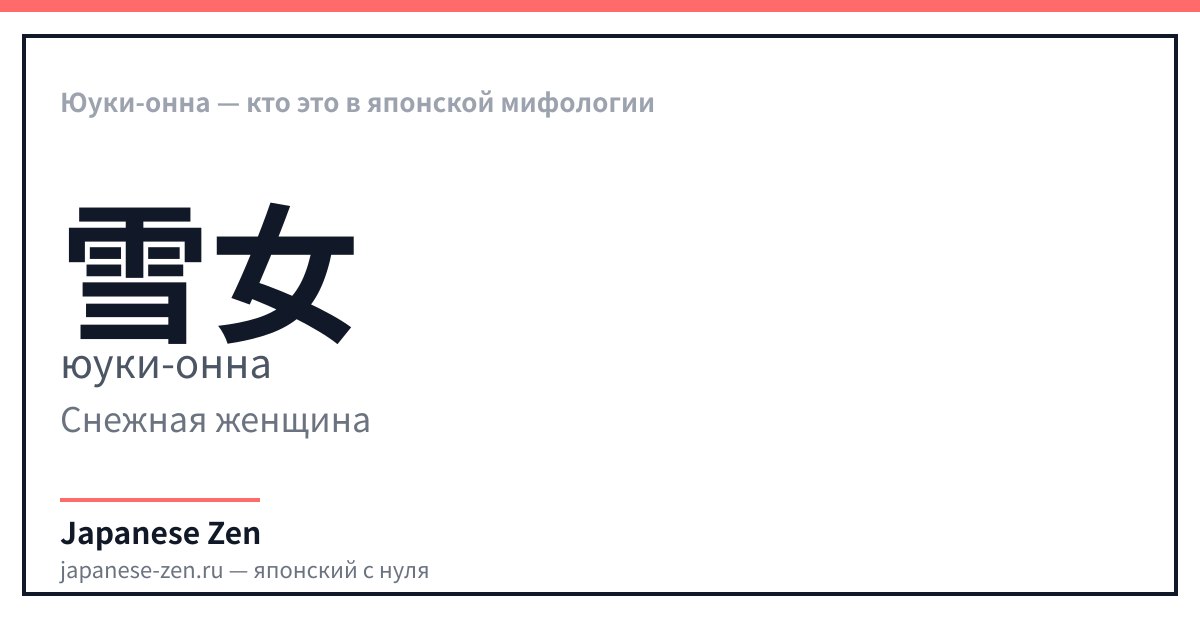
Of all Japanese yokai, yuki-onna is a rare case of a spirit told about so differently that in one village she kills a husband, while in the next she marries him and raises children until the truth is revealed.
Yuki-onna — the beauty you'd rather not meet in a blizzard
Yuki-onna ("snow woman", 雪女) is the spirit of the snowstorm: a tall, pale woman in a white kimono who appears to travelers in a blizzard, most often in the mountains or on a deserted road. Different regions of Japan tell of her differently. In some places she lures people in and freezes them to death with her icy breath; in others she simply frightens and disappears. In the most famous version, recorded by Lafcadio Hearn, yuki-onna marries a woodcutter she herself saved and lives with him for years as an ordinary woman — until the husband breaks the promise he made to her.
- Signs: unnaturally pale skin, black hair, a white or semi-transparent kimono, often leaving no tracks in the snow.
- Method of killing: icy breath or a touch that freezes the traveler on the spot.
- Where she appears: mountain passes, deserted winter roads, blizzards — her element and cover.
- Regional names: in Miyagi she is called yuki-bamba, in Yamagata — yuki-joro, in southern Kyushu — yuki-bajo.
Kills or falls in love — the version depends on the storyteller
Folklore gives no single answer: in some records yuki-onna is pure threat, freezing her victim without hesitation; in others she is capable of tenderness and even marriage to a man if he catches her fancy. Hearn's version deliberately balances between these poles: first the death of one traveler, then years of quiet family happiness with another.
雪女 — "snow woman" with no hidden meaning
| Japanese | Reading | Translation |
|---|---|---|
| 雪女 | yuki-onna · yuki-onna | Snow woman |
| 雪 | yuki · yuki | Snow |
| 吹雪 | fubuki · fubuki | Blizzard, snowstorm |
| 雪だるま | yukidaruma · yukidaruma | Snowman — literally "snow daruma" |
| 怪談 | kaidan · kaidan | A collection of supernatural tales — where the yuki-onna story is also recorded |
Why "snow" and "woman", and no further hints
雪女 is read ゆきおんな and is made up without any trickery from the two most basic characters: 雪 "snow" and 女 "woman" — a rare case where a yokai's name hides no wordplay or double meaning, as is often the case with Japanese spirits. The blizzard during which she appears is 吹雪 (fubuki) in Japanese, "blown-in snow": the same character 雪, but paired with the character for "blow".
雪 — значение: snow — онъёми: セツ — кунъёми: ゆき — 11 штрих(ов). 雪 — "snow": 11 strokes, with the "rain" radical 雨 on top — snowflakes fall beneath it. The same radical appears in 雲 (cloud) and 電 (lightning).
Write 雪 along the guides and study the stroke order.
From Hearn to Froslass: yuki-onna beyond folklore
- "Kaidan" (1904) by Lafcadio Hearn — the most famous literary version of the legend, heard by him from a farmer from Chofu in Musashi Province.
- "Kaidan" (1964) — Masaki Kobayashi's film based on Hearn's collection; one of the episodes is called "Yuki-onna"; the film won a Special Jury Prize at the Cannes Film Festival.
- The Pokémon Froslass (Japanese: Yukimenoko) — a direct reference to yuki-onna: the kimono, the icy "horns", and a silhouette reminiscent of a kokeshi doll.
- Yokai ensemble anime occasionally introduce yuki-onna as a seasonal winter spirit.
Where the most famous version of the legend came from
Hearn honestly named his source: a farmer from a village near Chofu in Musashi Province told him this story as a local legend. It was this literary version that spread around the world, overshadowing dozens of simpler, purely threatening regional variants.
Yuki-onna and yurei: where the yokai ends and the ghost begins
| Trait | Yuki-onna | Yurei |
|---|---|---|
| Nature | a yokai — a supernatural being of its own kind | the spirit of a specific dead person |
| Element | snow, blizzard, mountains in winter | any place connected with death |
| Appearance | white kimono, icy beauty | white burial shroud, long black hair |
| Origin | not necessarily ever human | always a formerly living person with a name and a story |
The confusion is understandable: both are pale women in white. The difference is in their nature: a yurei is the ghost of a specific dead person stuck between worlds, while yuki-onna is an independent spirit of the elements who, in most versions, was never an ordinary human.
FAQ
- Who is yuki-onna in Japanese folklore?
- Yuki-onna ("snow woman") is the spirit of the blizzard in Japanese mythology: a pale woman in white who appears to travelers in snowfall. Some legends make her a killer, others — capable of love for a human.
- What does yuki-onna look like during a blizzard?
- Like a young beauty with unnaturally pale skin, black hair, in a white or semi-transparent kimono — often her presence is betrayed only by cold, not by tracks in the snow.
- How do you write "yuki-onna" in Japanese?
- 雪女, read ゆきおんな — literally "snow" plus "woman", with no hidden meaning. The blizzard during which she appears is 吹雪 (fubuki) in Japanese.
- Does yuki-onna always kill?
- No: in some regional versions she freezes travelers to death, in others she can marry a man she saved and live with him an ordinary life until the promise made to her is broken.
- Where did the most famous version of the legend come from?
- It was recorded by Lafcadio Hearn in the collection "Kaidan" (1904) from the words of a farmer from Musashi Province. This version formed the basis of the 1964 film of the same name and most later retellings.
- Where does yuki-onna appear outside folklore?
- In the Pokémon Froslass, whose Japanese name directly references yuki-onna, and occasionally in yokai anime as a seasonal winter character.
Sources
Updated: 2026-09-09