Japanese Spirits: Yokai, Yurei, Oni and Kami — Who's Who
Japanese spirits are not one list but four different words that got lumped together in translation. Yokai (妖怪) are supernatural beings in general, yurei (幽霊) are ghosts of specific dead people, oni (鬼) are horned giants from hell, and kami (神) are Shinto deities. Tengu and kappa are yokai, Hanako-san is a yurei, and a house spirit that brings good luck is closer to a kami. Once you sort out these four words, the rest of the bestiary reads itself.
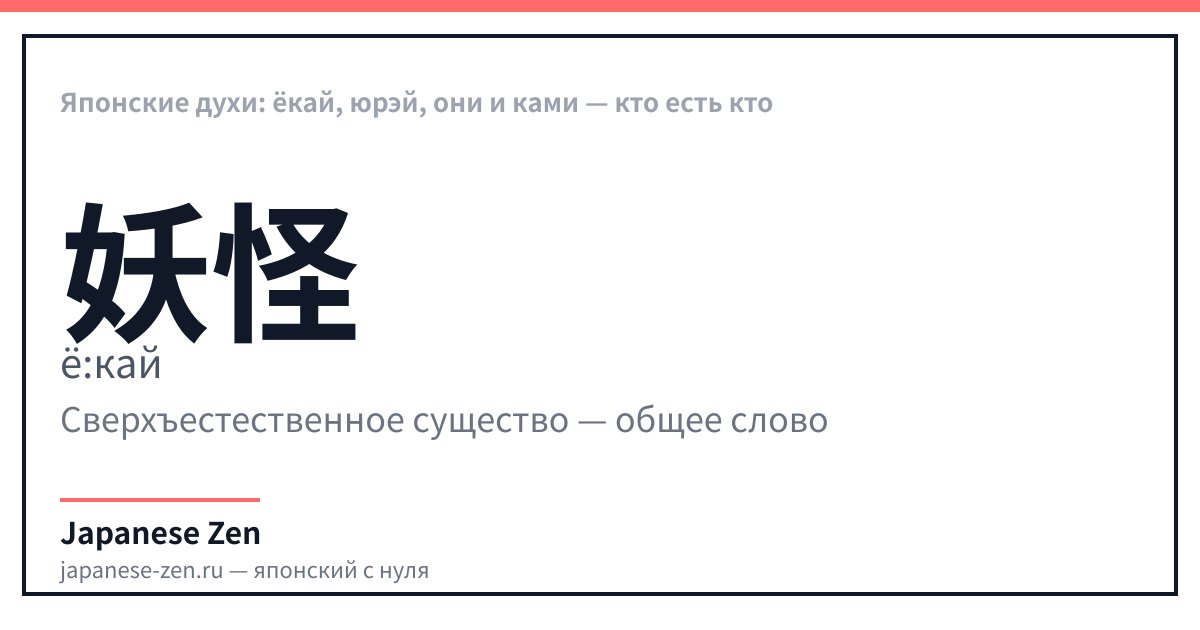
The English word "spirit" covers four Japanese concepts at once, which is why in articles about Japan a tengu ends up being either a demon or a deity. It's easier to sort out the words once than to guess every time.
Four words that get translated the same way
Japanese has no single word equivalent to English "spirit." There are several concepts with different boundaries, and confusion starts where a translator picks one English word for all cases. The difference is simple: yokai is about the nature of the being, yurei is about the fact that it was once human, oni is about a specific appearance, and kami is about status in worship.
| Word | Writing | Who it is | Example |
|---|---|---|---|
| Yokai | 妖怪 (ようかい) | any supernatural being: a shapeshifter, an animated object, a mountain spirit | tengu, kappa, nekomata |
| Yurei | 幽霊 (ゆうれい) | the ghost of a dead person — with a name and unfinished business | Hanako-san, O-Iwa |
| Oni | 鬼 (おに) | a horned man-eating giant, in Buddhism a guardian of hell | the oni of the Setsubun festival |
| Kami | 神 (かみ) | a Shinto deity: from Amaterasu to the spirit of a stone | Inari, the kami of a mountain |
| Tsukumogami | 付喪神 (つくもがみ) | an object that has lived a hundred years and gained a soul | the karakasa umbrella |
| Obake | お化け (おばけ) | colloquial for "shapeshifter," literally "that which has changed" | bakeneko, tanuki |
The boundaries between them are fluid
One being can fall into different categories in different sources. For centuries the tengu was either an evil mountain yokai or a deity with its own shrine. A yurei whose grudge is not appeased becomes an onryo and comes closer to a yokai. This is a property of living folklore: it was assembled over centuries without a single editor.
Bestiary: who you should know by sight
| Name | Writing | What it's known for |
|---|---|---|
| Tengu | 天狗 | a mountain spirit with a long nose, a master of the sword |
| Yuki-onna | 雪女 | a snow woman who freezes travelers in a blizzard |
| Kappa | 河童 | a river dweller with a water-filled dish on its head |
| Nekomata | 猫又 | a cat with a forked tail that has lived to old age |
| Bakeneko | 化け猫 | a shapeshifting cat that takes on the form of its owner |
| Rokurokubi | ろくろ首 | a woman whose neck stretches out at night |
| Tsukumogami | 付喪神 | objects that come to life at a hundred years old |
| Nurarihyon | ぬらりひょん | an uninvited guest who drinks tea in someone else's house |
| Gashadokuro | がしゃどくろ | a giant skeleton made of the bones of those who starved to death |
| Zashiki-warashi | 座敷童子 | a child spirit that brings good luck to a house |
| Kuchisake-onna | 口裂け女 | a woman in a mask — a 1979 rumor |
| Hanako-san | 花子さん | a girl from a school toilet |
| Ayakashi | あやかし | a sea spirit at the side of a ship |
| Kyubi | 九尾 | a nine-tailed fox from Chinese books |
Who to start with
- Tengu — the most recognizable: a mask with a long nose hangs in every souvenir shop.
- Kappa — the number one children's character, drawn on road signs near water.
- Yuki-onna — through her it's easiest to understand how kaidan, the Japanese scary story, works.
- Kuchisake-onna and Hanako-san — 20th-century urban legends that live by the rules of old folklore.
妖 and its relatives: words you'll meet in any article
| Japanese | Reading | Translation |
|---|---|---|
| 妖怪 | yōkai · yōkai | A supernatural being — the general word |
| 幽霊 | yūrei · yūrei | The ghost of a dead person |
| お化け | obake · obake | A shapeshifter; colloquial for "ghost" |
| 物の怪 | mononoke · mononoke | An evil spirit — an archaic word from classical literature |
| 怪談 | kaidan · kaidan | A scary story about an encounter with the supernatural |
| 神 | kami · kami | A Shinto deity |
Why 妖怪 is read "yōkai," not "yokai"
In the spelling ようかい the first syllable is long: よう stretches over two beats, hence the macron in romanization. The spelling "yokai" without the macron loses the length. Both characters speak of one thing: 妖 means "bewitching," 怪 means "strange, suspicious."
妖 — значение: bewitching, enchanting, evil spirit — онъёми: ヨウ — кунъёми: あや.しい、なま.めく、わざわ.い — 7 штрих(ов). 妖 — "bewitching, enchanting": on the left is the radical "woman" 女. Seven strokes, N1 level.
Write 妖 along the guides and work through the stroke order.
Where these creatures are recognized in anime
- Mizuki Shigeru's "GeGeGe no Kitaro" — the main source of modern ideas about yokai: the manga brought forgotten creatures back into popular culture.
- "Natsume's Book of Friends" — almost an encyclopedia: yokai appear one per episode, each with its own rules.
- "Spirited Away" — a bathhouse where kami from all over the country come to wash.
- "Princess Mononoke" — the title refers to 物の怪, an evil spirit from old literature.
FAQ
- How is a yokai different from a yurei?
- A yurei was once human: it has a name, the circumstances of its death, and unfinished business. A yokai is a being of a different nature: a mountain spirit, a shapeshifting beast, or an animated object. Simply put, a yurei is a dead person, a yokai is not human at all.
- How many Japanese spirits are there in total?
- There is no exact number. Toriyama Sekien's 18th-century compendium describes more than two hundred beings, but every province added its own, and the 20th century brought urban legends. The bestiary keeps growing.
- Are oni Japanese demons?
- The word "demon" is imprecise here: oni are closer to man-eating giants and to guardians of Buddhist hell than to the fallen angels of European tradition. They are bought off with beans at the Setsubun festival, not exorcised with prayer.
- How do you write "Japanese spirits" in Japanese?
- The general word is 妖怪 (ようかい, yōkai). If you mean specifically the ghosts of the dead, you need 幽霊 (ゆうれい, yūrei), and the colloquial "ghost" is お化け (おばけ, obake).
- Where should I start learning about this topic?
- Take five figures — tengu, kappa, yuki-onna, kitsune, and oni — and remember the category of each. After that, new names fall into place on their own: folklore follows a repeating pattern.
Sources
Updated: 2026-09-09