Kaidan — what it means and where this tradition comes from
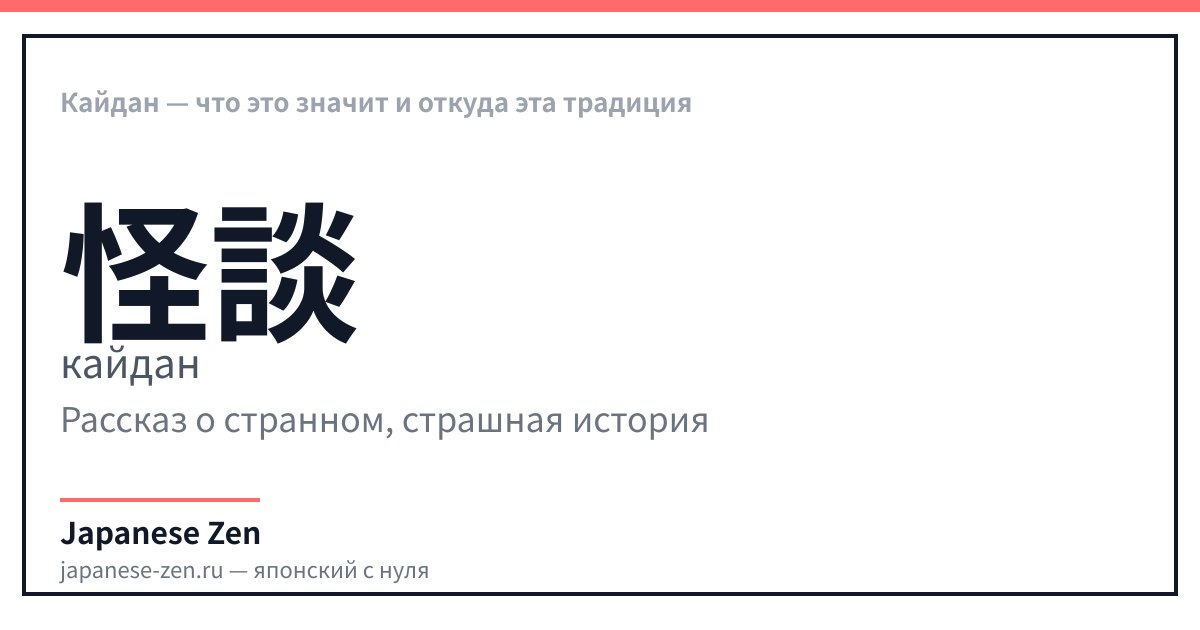
Kaidan (怪談) literally means "a tale of the strange": in Japan it refers both to stories of encounters with the supernatural and to a whole literary tradition of such stories. The word became known in the West through Lafcadio Hearn's 1904 book "Kwaidan." They are not told year-round: in Japan kaidan is traditionally associated with summer — the chill of a story is said to ward off the heat.
"Tell me something scary" — in Japanese this is not a request for entertainment but an invitation into a genre with a history older than horror cinema: it has its own ritual, its own seasonality, and its own list of classics.
"A talk of the strange" — what lies behind these words
Kaidan (怪談) literally means "a talk of the strange": 怪 — "strange, inexplicable," 談 — "conversation, tale." The word refers both to a single eerie story and to a whole literary tradition of such stories — from old scrolls to modern anthologies. The genre is broader than "ghost stories": it includes encounters with any kind of supernatural being, inexplicable incidents, and legends about cursed places, not necessarily with a ghost in the leading role.
Is kaidan a whole genre or just a real-life incident?
Both at once. "I have a kaidan" is what someone says about an incident that happened to them personally, while "a collection of kaidan" refers to a published book of other people's stories. The word works equally well for a casual tale over tea and for literary classics.
| Japanese | Reading | Translation |
|---|---|---|
| 怪談 | kaidan · kaidan | A tale of the strange, a scary story |
| 百物語 | hyakumonogatari · hyakumonogatari | "One hundred stories" — a ritual of group kaidan telling |
| 肝試し | kimodameshi · kimodameshi | "Test of courage" — a nighttime walk to a scary place |
| 実話怪談 | jitsuwa kaidan · jitsuwa kaidan | "True-story kaidan" — stories presented as non-fiction |
| 涼む | suzumu · suzumu | To cool off, to enjoy the cool air |
怪 — значение: strange, inexplicable, suspicious — онъёми: カイ、ケ — кунъёми: あや.しい、あや.しむ — 8 штрих(ов). 怪 — "strange, inexplicable": on the left is the "heart" radical 忄, meaning anxiety is born from within. The second character of the word, 談, means "conversation" — together 怪談 literally means "a talk of the strange."
Write 怪 along the guides and work through the stroke order.
One hundred candles, snuffed out one by one for fear
The classic format of a group kaidan is hyaku-monogatari, "one hundred tales": participants take turns telling scary stories by the light of one hundred lit candles or lanterns, and after each story one flame is put out. The room grows darker with every tale, and according to belief, once the last candle goes out, something real appears in the darkness. That is why not everyone dared to play to the end.
How kaidan lives beyond books
- Summer TV and radio shows with supernatural stories — a seasonal tradition that repeats year after year, not a one-off fad.
- Kimodameshi, the "test of courage," — a group walk to a scary place, usually at night and usually in summer, on school trips.
- Rakugo performers have a separate subgenre in their repertoire, kaidan-banashi: the same stories told professionally, with pauses and facial expressions.
- The modern jitsuwa-kaidan genre — stories that authors present as having actually happened, not made up for a book.
Three stories that make up the canon of the genre
The genre has its own minimal required set — the "three great kaidan," without which no serious discussion of the tradition is complete.
- "Yotsuya Kaidan" — the story of O-Iwa, betrayed and poisoned by her husband; the most famous revenge-from-beyond-the-grave tale in Japan.
- "Botan Dōrō," "The Peony Lantern," — a woman's ghost returns to her lover at the clatter of wooden geta sandals.
- "Banchō Sarayashiki" — the servant girl O-Kiku, who died because of a broken plate from a precious set, counts the plates in the well at night.
What all three stories have in common
In all three, the core is not a monster but injustice done to a woman: deception, punishment for something she did not do, a husband's jealousy. The horror works through sympathy for the victim, not through the creature's appearance — an emphasis rare in world horror of the same period.
What people most often get wrong about kaidan
- "Kaidan is the same as a horror film." The format predates cinema by centuries: it is equally an oral tradition, literature, and a rakugo repertoire.
- "Kaidan is definitely fiction." The jitsuwa-kaidan genre claims the opposite: the stories are published as things that actually happened, not made up.
- "The West only learned about kaidan recently." As early as 1904, Lafcadio Hearn's book "Kwaidan" was published with retellings of Japanese stories, including "Yuki-onna" and "The Story of Mimi-Nashi-Hōichi."
- "All classic kaidan are about monsters." All three textbook stories are built on human injustice, not on the appearance of a monster.
FAQ
- What is kaidan in Japan?
- Kaidan (怪談) — "a talk of the strange": both a single story of an encounter with the supernatural and a whole literary tradition of such stories, known in Japan for centuries.
- Is kaidan always fiction?
- No: alongside fiction there is the jitsuwa-kaidan genre — stories that authors present as having actually happened, not made up for a book.
- How is "kaidan" written in kanji?
- 怪談 (かいだん): 怪 "strange, inexplicable" plus 談 "conversation, tale." Literally, it comes out as "a talk of the strange."
- What do the candles of hyaku-monogatari have to do with it?
- It is the classic format of a group kaidan: one hundred stories, one hundred candles, and after each story one candle is put out. The room grows darker along with the number of stories told.
- Which stories are considered classics of the genre?
- The "three great kaidan": "Yotsuya Kaidan," "Botan Dōrō," and "Banchō Sarayashiki." All three are about injustice done to a woman, not about the appearance of a monster.
- Why is kaidan associated specifically with summer?
- The practical reason is simple: the chill of a scary story replaced a fan in the heat. The season also coincides with Obon — a holiday when, according to belief, spirits are especially close.
Sources
Updated: 2026-09-09