Reading the air — what the Japanese phrase "kūki o yomu" means and where "KY" comes from
"Reading the air" is a literal translation of the Japanese expression 空気を読む (kūki o yomu): sensing the unspoken mood of a situation and understanding what is expected of you without waiting for direct words. The opposite, "not reading the air," is called 空気が読めない, and the abbreviation of the first Latin letters of that phrase — KY — became youth slang in the 2000s and was nominated for the 2007 "Word of the Year" award.
It is easy to label this expression as exotic Japanese telepathy, though in essence it is the same ability that English speakers sometimes call "reading the room," just with its own established name. Let's look at the exact meaning of the expression, the history of the abbreviation KY, and the 1977 book after which Japan began to seriously discuss the power of "air" over people's decisions.
"Kūki o yomu" — the ability to sense the general mood
空気を読む (kūki o yomu) literally means "to read the air": 空気 "air, atmosphere" and 読む "to read." This is the ability to understand from silence, pauses, and facial expressions what is expected of you in a particular situation and to act accordingly, even if no one has said it directly. The opposite situation is 空気が読めない, "to be unable to read the air": to fail to notice the mood of the group and say or do something out of place.
Not telepathy, but attention to context
There is nothing mystical about this ability: it is built on ordinary social signals — tone of voice, long pauses, glances, the order in which people of different status speak. Similar ideas exist in other languages — for example, the English "read the room" — it's just that Japanese has its own established expression for it, which became the subject of separate discussion.
KY — the abbreviation that became a youth label
KY is an abbreviation of the phrase 空気が読めない (kūki ga yomenai), "cannot read the air": the first letters of the Latin transliteration were taken — Kuuki and Yomenai. In the 2000s, teenagers and young people began to call those who fail to sense the mood of the group this way — sometimes in a friendly way, sometimes as an insulting label.
A "Word of the Year" nominee, but not a winner
In 2007, KY was among the nominees for the annual "Word of the Year" award (新語・流行語大賞), though it did not make the final top ten — the award went to other expressions that year. By then the slang had already spread through schools and youth magazines as one of many similar letter abbreviations.
Yamamoto Shichihei and the book that started the talk about "air"
People began talking about "air" as a force after the book by critic Yamamoto Shichihei, "「空気」の研究" ("A Study of 'Air'," 1977). Yamamoto wrote that in Japan decisions are sometimes made not by law or calculation, but by the atmosphere that has formed in the room. His most famous example is the voyage of the battleship Yamato in 1945: according to participants in the meeting, no other decision was possible — "such was the air."
One book, not the only explanation
Yamamoto's book became the starting point for the very conversation about "air" as a force, rather than a proven theory for all occasions: the phrase 空気を読む itself had existed in everyday life before, just without such public resonance. To consider the 1977 book the sole cause of the fashion for "reading the air" would be an exaggeration.
読: reading text and reading the air
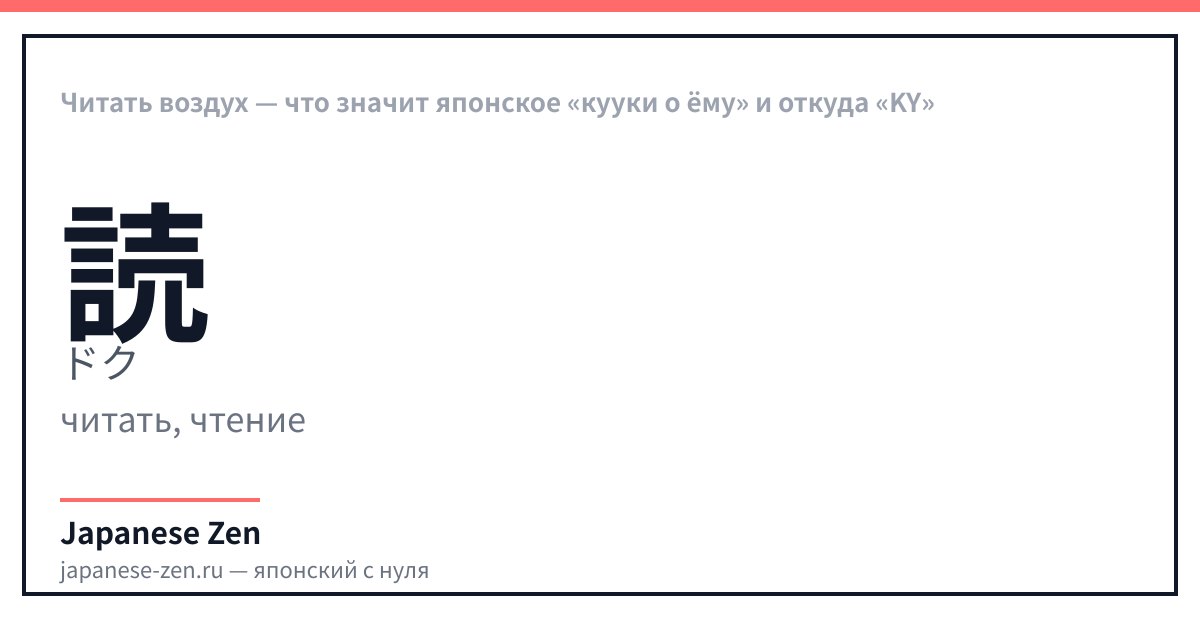
読 — значение: to read, reading — онъёми: ドク、トク、トウ — кунъёми: よ.む、-よ.み — 14 штрих(ов). 読 — "to read": the same character appears in the much more everyday 読む (yomu) "to read" in the general sense, and in 読書 (dokusho) "reading books." In the expression "reading the air," it is used almost literally — the air here is read like a text.
Kun and on readings of the same character
The kun reading of 読 is よむ (yomu), "to read"; the on readings are ドク (doku), トク (toku), and トウ (tō), and each is fixed to its own set of words: 読書 (dokusho) "reading," 読点 (tōten) "comma in Japanese text." In 空気を読む itself, the kun reading よむ is used — just as in the ordinary "to read a book."
| Japanese | Reading | Translation |
|---|---|---|
| 空気を読む | kūki o yomu · kūki o yomu | Reading the air — sensing the mood of a situation |
| 空気が読めない | kūki ga yomenai · kūki ga yomenai | Not reading the air — failing to notice the general mood |
| 読む | yomu · yomu | To read |
| 読書 | dokusho · dokusho | Reading books |
Write 読 along the guides — the character "to read," with which the Japanese "kūki o yomu" begins.
FAQ
- What does the expression "reading the air" mean in Japanese?
- 空気を読む (kūki o yomu) — literally "to read the air": the ability to understand from silence, pauses, and facial expressions what is expected of you in a particular situation without waiting for direct words. The opposite is 空気が読めない, to fail to sense the general mood and say or do something out of place.
- How is "kūki o yomu" written in kanji?
- 空気を読む, read as くうきをよむ: 空気 "air, atmosphere" and 読む "to read." The particle を simply marks the object — what is being read. The negative form, "not reading the air," is written 空気が読めない.
- What does the abbreviation KY mean?
- KY is an abbreviation of the phrase 空気が読めない (kūki ga yomenai), "cannot read the air": the letters are taken from the Latin transliteration Kuuki and Yomenai. In the 2000s, this was how people referred to those who fail to sense the mood of the group, and in 2007 the abbreviation was nominated for the "Word of the Year" award.
- Who started the discussion about "reading the air" in Japan?
- The discussion of "air" as a force began with the book by critic Yamamoto Shichihei, "「空気」の研究" (1977): he showed how decisions are made not by calculation or rule, but by the general atmosphere in the room. The everyday expression 空気を読む had existed before, and the abbreviation KY became fashionable in the 2000s.
- Is it true that "not reading the air" is an insult?
- It depends on who says it: among peers, KY can sound almost friendly, but it can also be used as an insulting label that pins a reputation for awkwardness on a person. The expression 空気が読めない itself is neutral and simply describes what happened, without necessarily mocking.
- Are there similar expressions in other languages?
- Yes, for example the English "read the room" describes almost the same ability to sense the mood of those gathered. The difference is more in frequency of use and in the fact that Japanese has its own established abbreviation KY for the idea, which became a separate slang word.
Sources
Updated: 2026-09-15