Tatemae and Honne — the Public Facade and True Feelings in Japanese Communication
Tatemae (建前) and honne (本音) are a paired set of words about Japanese communication. Tatemae is the position a person shows to others; honne is what they actually think and feel. The first word originally referred to assembling the frame of a house, while the second literally means "true sound." The pair describes not a lie, but the difference between a polite facade and one's inner world.
It is easy to mistake this pair of words for confirmation of the stereotype that "Japanese people never tell the truth," though the meaning works differently: a conversation has a level of polite position and a level of personal feeling, and Japanese simply names each with its own word. Let's look at the origin of tatemae and honne, the situations where the difference between them is especially noticeable, and how psychiatrist Takeo Doi placed this pair within a broader picture of Japanese communication.
A house facade that became a facade of character
Tatemae and honne describe two sides of the same person in communication. Tatemae (建前) is what is said and shown in public, the official and polite position; honne (本音) is what a person truly thinks and feels but does not always say aloud. Neither side is considered "fake": both parts of the pair are equally real, just intended for different situations.
Where the construction term 建前 came from
建前 is made up of 建 "build" and 前 "front, front side." The first dictionary meaning is construction-related: assembling the main frame of a house (posts, beams, ridge) and the celebration for that occasion, also known as 上棟式. The second meaning is "official position, principle in words." Dictionaries do not explain how one shifted into the other, so charming stories about carpenters are best treated as guesses. 本音, "true sound" — 本 "true, fundamental" plus 音 "sound, voice" — is defined by dictionaries as sincere feelings that one does not always dare to voice.
"I'll think about it" and other tatemae phrases
Tatemae is especially noticeable in formal communication — in negotiations, at work, when politely declining an offer. A classic example is the phrase 検討します (kentō shimasu), "I'll think about it": the listener often understands it as a soft "no," spoken without the word "no" itself. This is not deception but an accepted form of politeness that both sides of the conversation usually recognize in the same way.
When honne is spoken aloud
Honne is usually heard by close people — family, old friends — and it also tends to surface more where there is less formal hierarchy: at a table after work, in a one-on-one conversation, in anonymous discussion. None of these situations guarantees complete candor — it is simply that the chance of hearing honne there is higher than at a meeting.
Takeo Doi: the face and the reverse of Japanese communication
Psychiatrist Takeo Doi, best known for his study of the concept of amae, analyzed the pair 建前 and 本音 in his book 表と裏 ("Omote and Ura," 1985). The title itself suggests his approach: tatemae and honne are a particular case of the broader Japanese pair "front side and back side." Behind the different words, in his view, lies a single structure: the side turned toward others and the side turned inward.
Honne does not mean "more honest"
It is easy to conclude from the pair that honne is the truth and tatemae is pretense, but researchers themselves do not frame the question that way. Tatemae is not an attempt to deceive but an agreed-upon way of behaving in society; honne does not cancel it out but exists alongside it. The separation of position and feeling is found not only in Japan, but it is in Japanese that a distinct, stable pair of words was found for it.
建: the character that begins the word "tatemae"
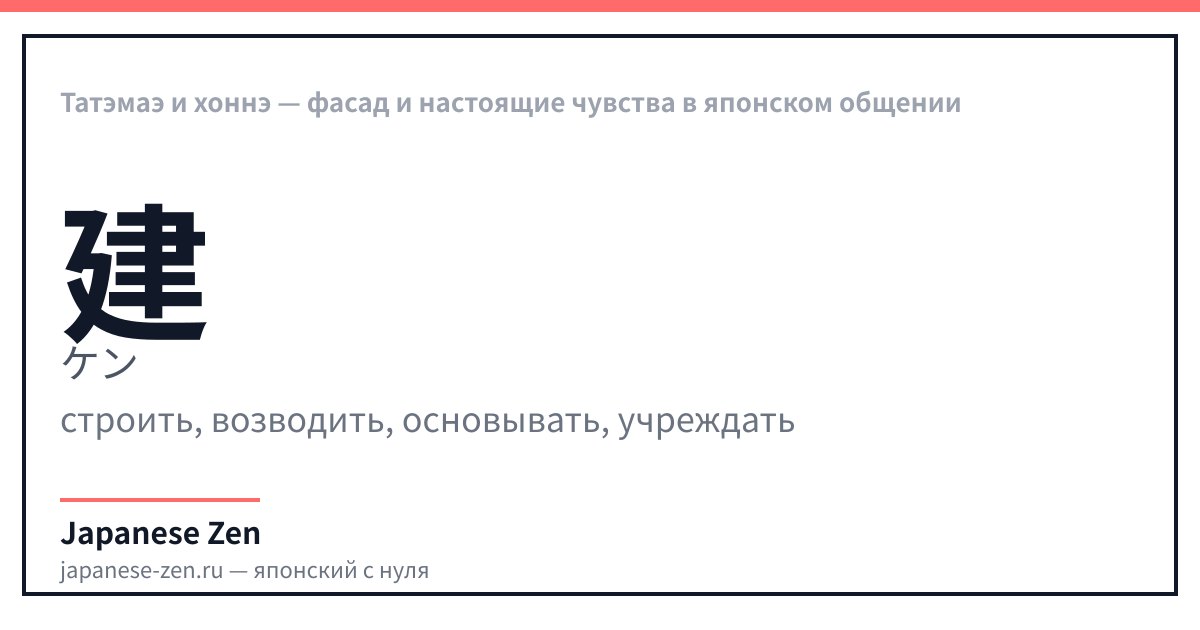
建 — значение: to build, to erect, to found, to establish — онъёми: ケン、コン — кунъёми: た.てる、た.て、-だ.て、た.つ — 9 штрих(ов). 建 — "build": the same character appears in the much more literal word 建物 (tatemono) "building." In the word 建前 it recalls the literal, construction-related sense that tatemae once had.
One character — construction, nation, and founding an enterprise
The on'yomi of the character are ケン and, less often, コン; the kun'yomi is たてる, "to build." Outside 建前, the same root is heard in 建国 (kenkoku) "founding of a nation" and 建設 (kensetsu) "construction, erection" — in all cases 建 means not merely "to stack a wall" but "to create something whole from scratch."
| Japanese | Reading | Translation |
|---|---|---|
| 建前 | tatemae · tatemae | The position one shows in public |
| 本音 | honne · honne | True feelings, what one actually thinks |
| 本音と建前 | honne to tatemae · honne to tatemae | A set expression — the whole pair together |
| 建前上 | tatemae-jō · tatemae-jō | Formally, in words |
Write 建 along the guides — the character "build," with which the word "tatemae" begins.
FAQ
- What do the words "tatemae" and "honne" mean?
- Tatemae (建前) is the position a person shows in public: polite, socially acceptable, but not necessarily matching what is in their heart. Honne (本音) is what they truly feel and think, and what usually only close people know. Together the pair describes two sides of one person, not a lie and a truth.
- How are "tatemae" and "honne" written in kanji?
- Tatemae — 建前, read たてまえ: 建 "build" and 前 "front, front side." Honne — 本音, read ほんね: 本 "true, fundamental" and 音 "sound, voice." Both words together are often written as one set expression — 本音と建前.
- Is tatemae a form of lying?
- No. Tatemae is a polite social position, not an attempt to deceive: the listener usually understands that they are hearing tatemae and perceives it as part of a shared agreement about polite communication, not as concealment of the truth.
- In what situations is tatemae heard especially often?
- Primarily in formal communication — in negotiations, at work, when politely declining an offer. The phrase "I'll think about it" (検討します, kentō shimasu) is a classic example: the listener often reads it as a soft "no," said without the word "no" itself.
- Which researchers studied the pair tatemae and honne?
- Psychiatrist Takeo Doi, author of the concept of amae, analyzed it in his book 表と裏 ("Omote and Ura," 1985). For him, tatemae and honne are a particular case of the general pair "front side and back side": one is turned toward other people, the other inward.
- Where did the word "tatemae" come from?
- The first meaning of 建前 is construction-related: assembling the main frame of a house and the celebration for that occasion, also called 上棟式. The meaning "position in words, official principle" is also long-standing, but dictionaries do not explain exactly how one shifted into the other.
Sources
Updated: 2026-09-15