Japanese Mentality: Key Concepts of Japanese Society Without Stereotypes
"Japanese mentality" is not a single character trait but a network of several specific concepts about how a person in Japan is connected to the group and to the people around them: tatemae and honne, giri, amae, seken, murahachibu, omotenashi, karoshi. Each has its own Japanese word and its own limits of applicability, not a catch-all cliché.
The phrase "Japanese society" too often turns into a set of ready-made labels — "collectivists," "never say no." In reality, behind it are studied and differently structured concepts, each with its own history and its own limits of applicability. Let's look at eight of them in one table, the difference between "insiders" and "outsiders," and three common opinions about the Japanese character that do not hold up to research.
Japanese Mentality as a Network of Concepts, Not a Single Trait
The phrase "Japanese mentality" has no strict scientific definition: it is not a single character trait but a network of specific concepts about how relationships between a person and the group and the people around them are structured in Japan. Each concept has its own Japanese word, which should be examined separately rather than reduced to a single label.
Eight Concepts Often Confused with Stereotypes
| Concept | In Japanese | Meaning in a Nutshell |
|---|---|---|
| Tatemae and Honne | 建前と本音 | The facade of words and true feelings |
| Kuuki (reading the air) | 空気を読む | Sensing the group's mood without words |
| Giri | 義理 | The duty to repay kindness or respect |
| Amae | 甘え | The right to rely on another's indulgence |
| Seken | 世間 | The circle of people whose opinion weighs more than rules |
| Murahachibu | 村八分 | Collective boycott of a rule-breaker |
| Omotenashi | おもてなし | Care for a guest without request or reward |
| Karoshi | 過労死 | Death from chronic overwork |
These are not a set of laws but tools of description, and each is suited to one side of life. Seken and murahachibu are about the gaze of outsiders, giri and amae are about obligations and trust, tatemae and honne are about the language of politeness, and omotenashi and karoshi are about attitudes toward guests and work.
内 and 外: Insiders and Outsiders at the Base of Japanese Communication
内 (uchi) — "insiders": family, company, close circle of communication. 外 (soto) — "outsiders," everyone else. This boundary determines not only the politeness of speech — one speaks more modestly about one's own in public than about outsiders — but also with whom one maintains emphasized distance and with whom one does not.
Anthropologist Nakane Chie's Model: "Place" Matters More Than Personal Qualities
In 1967, anthropologist Nakane Chie proposed a model in her book "Human Relations in a Vertical Society" (タテ社会の人間関係). Japanese groups are held together not so much by similarities among people — profession, interests — as by a shared "frame," a place: the same company, the same faculty, the same village. Hence, according to her model, both the strong division into "insiders" and "outsiders" and the rigid vertical hierarchy within the group itself. This was a theory from the late 1960s, not a set of rules for all time — later research has repeatedly refined and challenged it.
Collectivism, the Silent "No," and Homogeneity: Three Opinions Under Scrutiny
Three common claims about the Japanese character easily sound like laws of nature, but upon examination they turn out to be either controversial or greatly oversimplified.
"Japanese People Are Born Collectivists"
Psychologist Takano Yotaro of the University of Tokyo analyzed dozens of empirical studies comparing Japanese and Americans on the level of collectivism, and in most of them no difference was found, while in some studies Americans turned out to be more collectivist. According to his conclusion, the myth of Japanese collectivism took hold after the war under the influence of American anthropology, not empirical data.
"Japanese People Never Say 'No' Directly"
A direct refusal in Japan is heard in the circle of family and close friends without any evasions. Softened forms of refusal — through tatemae, polite turns of phrase, hints — are typical primarily of formal, polite settings, where the concern not to hurt the interlocutor comes to the fore, rather than a ban on the word "no" itself.
"Japanese Society Is Homogeneous — It Has No Minorities"
The 2019 law for the first time at the level of Japanese law recognized the Ainu, the indigenous people of northern Japan and primarily Hokkaido, as an indigenous (先住民族) people of the country. This fact alone is enough to see that the idea of a completely homogeneous Japan without internal minorities does not hold up even to current legislation.
共: The Commonality Behind the Word "Society"
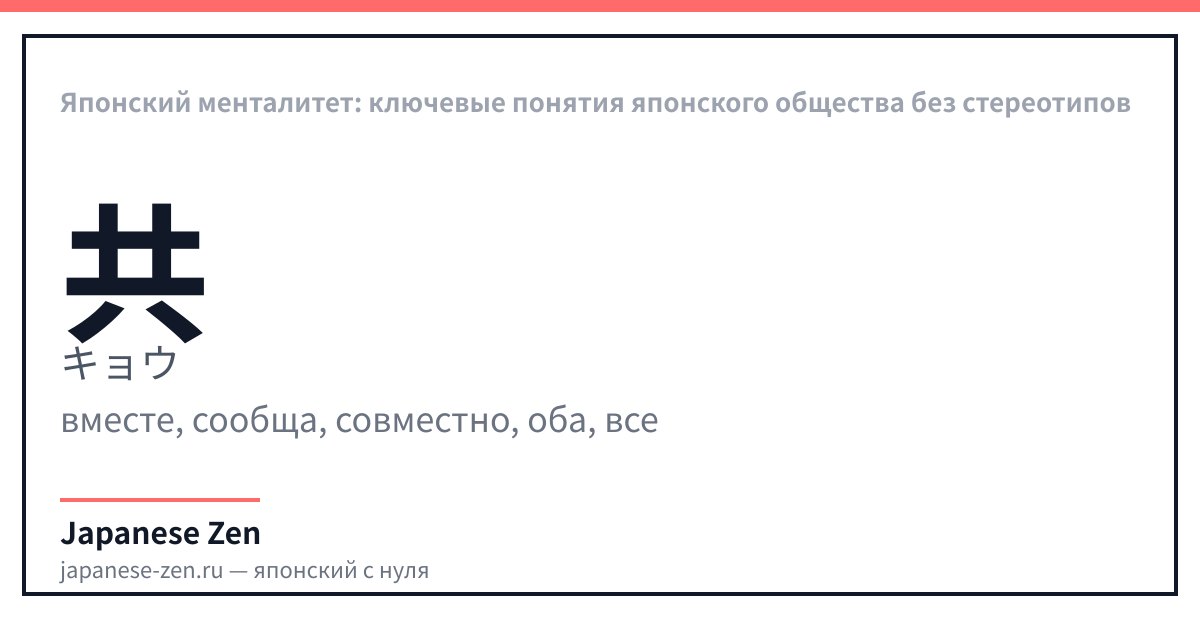
共 — значение: together, jointly, in common, both, all — онъёми: キョウ — кунъёми: とも、とも.に、-ども — 6 штрих(ов). 共 — "together": it is not in 日本社会, but it conveys the very idea of society — living not alone. The same character appears in 共同体 (kyōdōtai) "community" and 公共 (kōkyō) "public, communal."
What Makes Up the Word "Nihon Shakai"
日本社会 (Nihon shakai), "Japanese society," is composed of 日本 "Japan" and 社会 "society," and 社会, in turn, of 社 "association, shrine" and 会 "meeting, gathering." The character 共 is not in this word, but it is precisely the one that conveys the common meaning of all the concepts discussed: not "Japanese people are such-and-such," but the specific ways in which people live and negotiate together.
| Japanese | Reading | Translation |
|---|---|---|
| 共に | tomoni · tomoni | Together, jointly |
| 共同体 | kyōdōtai · kyōdōtai | Community, commune |
| 公共 | kōkyō · kōkyō | Public, communal |
| 日本社会 | Nihon shakai · Nihon shakai | Japanese society |
Write 共 along the guides — the character for "together" that stands behind the very idea of society.
FAQ
- What is Japanese mentality in simple words?
- This phrase has no strict scientific definition. Instead of one common character trait, it is a set of specific concepts about how relationships between a person and the group are structured in Japan: tatemae and honne, giri, amae, seken, and others. Each has its own Japanese word and its own limits, not a catch-all label.
- How does 内 (uchi) differ from 外 (soto)?
- 内 — "insiders": family, company, close circle, while 外 — "outsiders," everyone else. This boundary changes the manner of speech and the degree of openness: one speaks more modestly about one's own in public than about outsiders, and polite distance is maintained precisely with strangers.
- Is it true that Japanese people are collectivists by nature?
- A systematic review of empirical studies — the work of psychologist Takano Yotaro of the University of Tokyo — did not confirm a stable difference between Japan and the United States in the level of collectivism, and in some comparisons Americans turned out to be more collectivist. He attributes the notion of innate Japanese collectivism to the postwar influence of Western anthropology, not to facts.
- Is it true that Japanese people never say "no" directly?
- No, that is an exaggeration. A direct refusal is heard in conversation with family and close ones without any evasions. Softened forms of refusal are typical precisely of formal, polite settings — it is a matter of context and level of politeness, not an absolute ban on the word itself.
- Are there national minorities in Japan?
- Yes: the 2019 law for the first time at the level of Japanese law recognized the Ainu, the indigenous people of the country's north and primarily Hokkaido, as an indigenous (先住民族) people of Japan. The idea of a completely homogeneous Japanese society without minorities does not hold up even to current legislation.
- Who proposed the model of Japanese society built on "place" rather than personal qualities?
- Anthropologist Nakane Chie — in her book "Human Relations in a Vertical Society" (タテ社会の人間関係, 1967). According to her model, Japanese groups are held together by a shared "frame" — one company, one faculty, one village — rather than by similarities of interests or professions among the people within them. This was a theory of its time, later repeatedly refined and challenged.
Sources
Updated: 2026-09-15