Seken — "the society that watches": why Japanese people fear "what others will say"
Seken (世間) is not the state or the law, but a specific circle of people: neighbors, relatives, coworkers, and acquaintances of acquaintances, whose opinion of a person feels weightier than any rule. Historian Abe Kin'ya showed that this concept is older and far more concrete than the bookish word "society," shakai (社会), which entered Japanese only in the Meiji era as a translation of the Western term.
"What will seken say" keeps people's actions in check no less than the police: damaging relations with this circle of people is scarier than breaking a formal rule. Let's look at how seken differs from "society" in the Western sense, what sekentei — "face before people" — is, and how this word gave rise to ordinary small talk and the title of a long-running family drama.
Seken: a circle of people whose opinion weighs more than rules
世間 (seken) is made up of 世 "world, era" and 間 "interval, space between." It does not refer to the state or all of humanity, but to a specific circle of people around a person: neighbors, relatives, coworkers, acquaintances of acquaintances. These are the people who know about you and whose judgment is felt immediately, without any trial.
Seken and shakai: two different words for "society"
Historian Abe Kin'ya in his book "What Is Seken" (1995) showed the difference between the two words. 社会 (shakai) is a bookish word that entered Japanese in the Meiji era as a translation of the Western concept "society": it names an abstract society of separate individuals. Seken, on the contrary, is a word from colloquial language, known long before Meiji: it names not an abstract sum of people with personal dignity, as in the West, but a given into which a person is embedded even before their own choice.
Sekentei: how seken sees your family
世間体 (sekentei) — literally "appearance before seken": how a person's action or position looks in the eyes of others, not how they themselves feel about it. The phrase "sekentei ga warui," "looks bad before seken," concerns not law or morality in general, but reputation in this specific circle.
Concern for reputation, not universal law
Concern for sekentei is visible in everyday decisions: how to arrange a wedding or funeral, whether to tell neighbors about a divorce or job loss. This is not a rigid rule without exceptions — the strength of sekentei depends on age, region, and the specific family, and urban anonymity weakens it far faster than rural life in full view of everyone.
Seken in conversation: from "small talk" to a long-running drama
Several other expressions are formed from the word 世間 in everyday life. 世間話 (sekenbanashi) — "talk about seken," ordinary chatter about news, rumors, and trifles with no connection to personal gain. 世間知らず (seken shirazu) — "not knowing seken," that is, a person naive in everyday matters, not understanding how relationships work outside the narrow circle they are used to.
"Wataru seken wa oni bakari" — a title turned upside down
The long-running TBS family drama "Wataru seken wa oni bakari" (渡る世間は鬼ばかり) aired from 1990 to 2011. The title deliberately turns inside out the proverb "渡る世間に鬼はない" — "in the world you pass through, there are no demons," that is, most people around you are kind. The series flips it on its head: "in the world you pass through, there are only demons" — an irony about how hard it is to get along even with your own large family.
世 in the word seken: from "generation" to the people around you
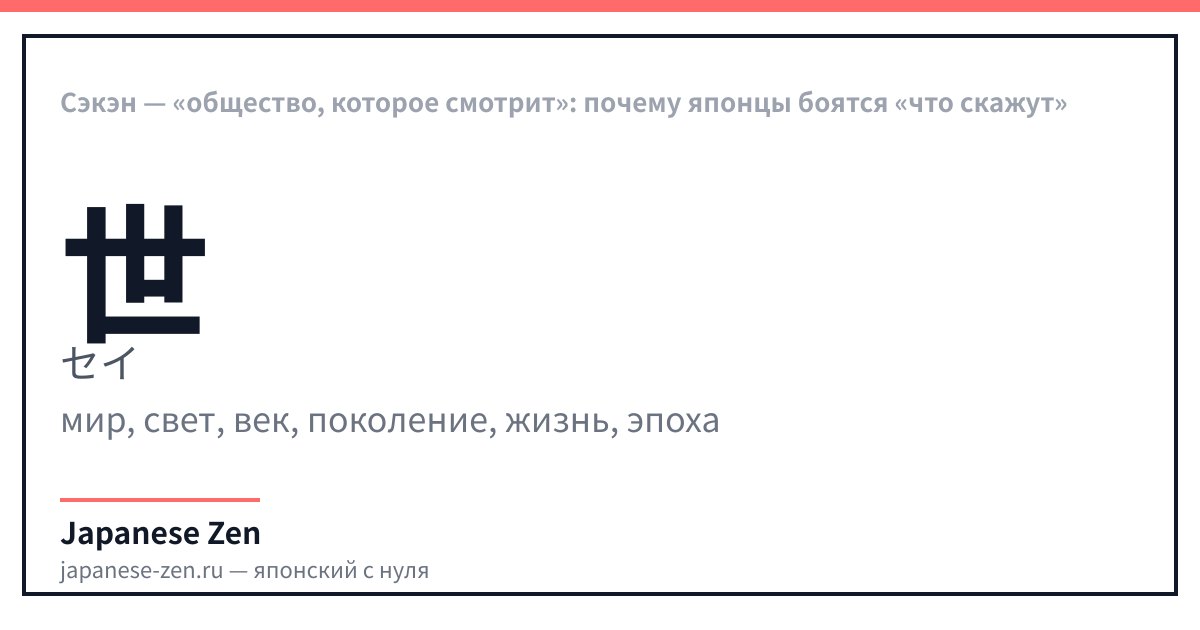
世 — значение: world, society, era, generation, life, age — онъёми: セイ、セ、ソウ — кунъёми: よ — 5 штрих(ов). 世 — "world, era, generation": in 世間 (seken) it names not the state, but the circle of people around a person. The same character is in 世界 (sekai) "world, universe" and 出世 (shusse) "to go out into the world," that is, to make a career.
From "thirty years" to "the world around"
In the old form, 世 was drawn as three connected signs for "ten" — presumably "thirty years," the conventional length of one generation. From "generation" the meaning expanded to "era," and then to the people of that era who surround a person here and now. The second part of the word, 間, adds the sense "interval, space between" — seken literally refers to the space between people where shared life takes place.
| Japanese | Reading | Translation |
|---|---|---|
| 世間 | seken · seken | The circle of people around a person, the society that watches |
| 世間体 | sekentei · sekentei | Face, reputation before this circle of people |
| 世間話 | sekenbanashi · sekenbanashi | Ordinary chatter, small talk |
| 世間知らず | seken shirazu · seken shirazu | A person naive in everyday matters |
| 出世 | shusse · shusse | To go out into the world — to make a career, to succeed |
Write 世 along the guides — the character for "world," from which the word seken is built.
FAQ
- What does the Japanese word "seken" mean?
- It refers to the people who know a person and whose judgment of them means more than any official rule: neighbors, colleagues, relatives, acquaintances of acquaintances. It is not all of society as a whole, but precisely the circle before which it is awkward to appear "not as one should."
- How does seken differ from the word "shakai" — "society"?
- "Shakai" (社会) entered Japanese in the Meiji era as a translation of the Western "society" — a society of separate individuals. Seken is far older and more concrete: it is not an abstract sum of people, but a given into which a person is embedded from birth, long before any choice — as historian Abe Kin'ya explained the difference.
- What does the expression "sekentei" mean?
- 世間体 — how a person's action or position looks in the eyes of seken, not what they themselves think of them. The phrase "sekentei ga warui," "looks bad before seken," concerns reputation in a specific circle of acquaintances, not law or morality in general — and its weight varies in different families and cities.
- What does "seken shirazu" mean?
- 世間知らず literally "not knowing seken" — it refers to a person naive in everyday matters, not understanding how relationships work outside the narrow circle they are used to. The word is not about lack of education, but about inexperience in dealing with people.
- Is it true that the title of the drama "Wataru seken wa oni bakari" is a Japanese proverb?
- No, it is a deliberate rearrangement of one. The proverb "渡る世間に鬼はない" means "in the world you pass through, there are no demons" — that is, most people are kind. The title of the long-running TBS family series (1990–2011) turns its meaning upside down, playing on the difficulties of life within one large family.
- How do you say "empty chatter, small talk" in Japanese?
- 世間話 (sekenbanashi) — literally "talk about seken": an exchange of news, rumors, and small observations with no connection to business or personal gain. Such a conversation is not preparation for a request or a social obligation, but simply a way to maintain connection with the people around you.
Sources
Updated: 2026-09-15