Murahachibu — the village boycott in Japan: what it is and where the word comes from
Murahachibu (村八分) is a village boycott in Japan: a collective decision by the community to cut ties with a family that broke the village's unwritten rules. The practice is known from the Edo period and survived into the 20th century. The familiar explanation — "eight of ten kinds of help were withdrawn, leaving only funerals and fire" — is considered folk etymology by philologists: the word most likely comes from verbs meaning "to exclude."
Behind this short word lies an entire system of village life, where relations with neighbors were not a matter of taste but a condition of survival. Let's look at how a community decided to declare a boycott, why the famous "eight out of ten" arithmetic is more likely a later pretty invention than the word's origin, and how the word lives on today, far from any village.
Murahachibu: a collective decision by an entire village
村八分 (murahachibu) was a private punishment practiced in Japanese villages from the Edo period, and isolated cases reached the courts even in the 20th century. If a family broke the village's unwritten rules (村のおきて), the whole community, by common consent, cut ties with it. The decision was made not by authorities or by a single offended neighbor, but by the village assembly itself.
How the whole community made the decision
In a tight agrarian community, where rice fields, irrigation, festivals, and construction depended on shared labor, cutting ties with neighbors was not an insult but a real disaster: surviving without others' help was almost impossible. That is why the threat of a boycott worked as one of the strongest measures for enforcing order within the village, and not merely as a silent grudge.
Eight parts out of ten — the explanation everyone knows
The best-known explanation goes like this: village life rested on ten occasions for mutual help — coming of age, weddings, funerals, house building, illness, fire, flood, travel, childbirth, and memorial services. The ostracized family was denied eight of them — hence "hachibu," "eight parts" — and help was given only at funerals and in fires, because those concerned the whole village. Even the lists of the "eight" differ from author to author.
What philologists consider the word's origin
Philologists more often trace "hachibu" to verbs meaning "to exclude from one's own" — はぶく "to throw out, to omit," はじく "to repel" — whose sound was distorted over time. An old spelling, 撥撫, with the sense of "rejecting a person," is also found. And the "eight out of ten" arithmetic is considered folk etymology: it was invented later to explain an incomprehensible word.
Murahachibu today: a word without a village
As a village practice, murahachibu belongs primarily to the Edo period, though isolated cases were heard in courts even in the 20th century. But the word itself outlived the village: today it is used figuratively — for any collective exclusion of a person from a group, whether a school class, a workplace, or an online community.
From a village custom to any exclusion from a group
The figurative meaning preserved the main feature of the original word: it is not a quarrel between one person and another, but a coordinated decision by a group to keep someone at a distance. It is precisely the mass nature and the unspoken common consent that distinguish murahachibu from an ordinary falling-out — and make the word a convenient label for the bullying that news reports talk about without naming specific people.
The knife that divides: the kanji 分 in the word hachibu
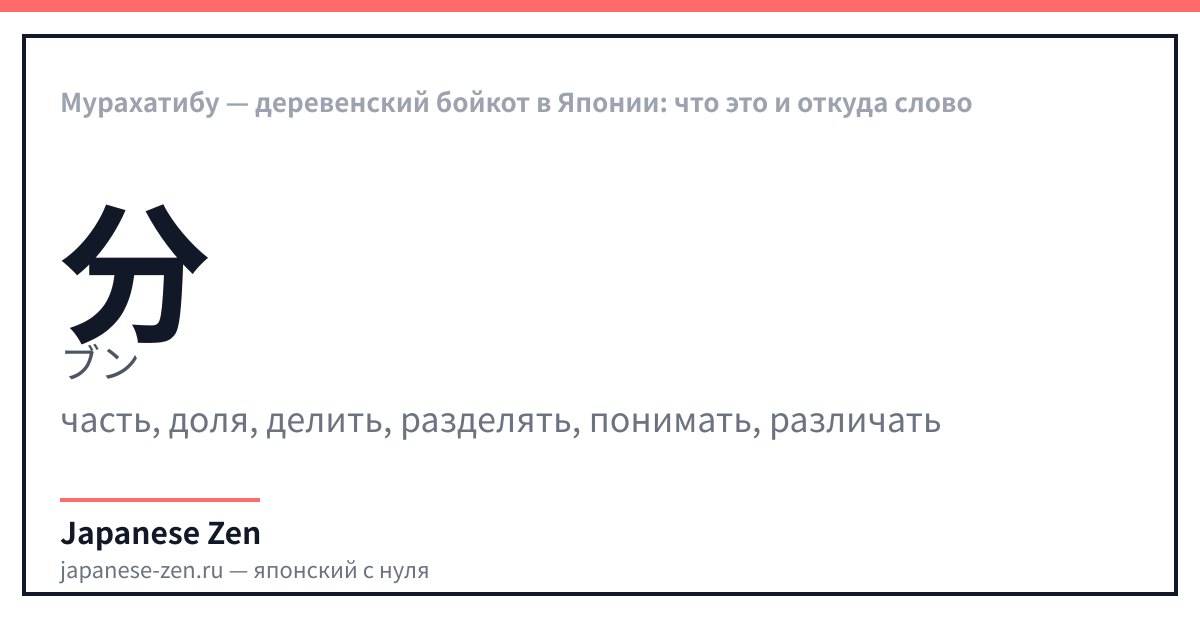
分 — значение: part, share, to divide, to separate, to understand, to distinguish — онъёми: ブン、フン、ブ — кунъёми: わ.ける、わ.け、わ.かれる、わ.かる、わ.かつ — 4 штрих(ов). 分 — "to divide, part": in 八分 (hachibu) it gives the word the second half of its meaning, "parts." The same character appears in 気分 (kibun) "mood" and 分ける (wakeru) "to divide."
From knife to "share" and "percent"
分 is composed of 八, an image of lines spreading apart (in this role, "to divide in half"), and 刀 "knife": together, a knife dividing a thing into parts. From this image grew the character's other meanings as well — from "share" and "percent" to the verb 分ける, "to divide," and even the unit of time "minute."
| Japanese | Reading | Translation |
|---|---|---|
| 村八分 | murahachibu · murahachibu | Village boycott of a rule-breaker |
| 八分 | hachibu · hachibu | Eight parts (out of ten) |
| 仲間外れ | nakama hazure · nakama hazure | Exclusion from a group |
| 絶交 | zekkō · zekkō | Breaking off relations |
| 掟 | okite · okite | Unwritten rule of the community |
Write 分 along the guides — the character for "share" from the word "hachibu."
FAQ
- What is murahachibu?
- Murahachibu (村八分) is a village boycott: a collective decision by the whole community to cut ties with a family that broke the village's unwritten rules. The practice is known from the Edo period and survived into the 20th century, and today the word refers to any group exclusion of a person from a circle.
- Why does the word murahachibu mention "eight"?
- The popular answer is that the family was denied eight of ten kinds of mutual help, leaving only funerals and firefighting. But philologists consider this folk etymology: more likely, "hachibu" is a distortion of verbs meaning "to exclude," such as はぶく and はじく, and the number was fitted in later.
- Why were exceptions made specifically for fire and funerals?
- This is how the popular version explains it: an unextinguished fire threatened to spread to neighboring houses, and an unburied body affected the sanitary and spiritual interests of the whole village. These cases concerned the community as a whole, so help in them, as the story goes, was maintained even during a boycott.
- Is murahachibu only a historical phenomenon?
- As a village practice, mostly yes: its heyday was in the Edo period, though isolated cases were heard in courts even in the 20th century. But the word itself lives on: today it refers to any collective exclusion of a person from a group — bullying at school, at work, or in an online community — and not only to a village custom.
- How does murahachibu differ from an ordinary refusal to communicate?
- Murahachibu is not a personal grudge of one neighbor, but a decision by the whole community at once: a coordinated, collective breaking of relations by common unspoken consent. It is precisely the mass nature and organization that distinguish it from a domestic quarrel or a silent boycott by one person.
Sources
Updated: 2026-09-15