Gyaru: What This Style Is and Where the Word Came From
Gyaru (ギャル) is the look of young Japanese women with bright or bleached hair, a tan or, conversely, deliberately pale skin, and heavy makeup. Since the early 1990s the term referred to tanned high-school girls known as kogyaru, and later to members of extreme styles like ganguro and yamamba. The word itself is a rendering of English slang gal, 'girl': it has appeared in dictionaries since 1928, but only in the nineties did it come to mean a recognizable look.
The word is both very old and quite new: as a label for a 'young woman' it has lived in Japanese for almost a hundred years, but as the name of a recognizable street fashion only since the nineties. Let's look at what stood behind kogyaru, ganguro and yamamba, what the Shibuya district and the 109 building have to do with it, how the gyaru look was elevated by Amuro Namie and Ayumi Hamasaki — and what, according to Japanese press reports, happened to it afterward.
A Bright Look, Not Just One Hairstyle
Gyaru (ギャル) is a recognizable look of young Japanese women: bleached or bright hair, a tan or deliberately pale skin, eye-focused makeup, platforms and miniskirts. The word itself is not an invention of the nineties. The English slang gal ('girl', short for girl) was explained in a Sanseido English-Japanese dictionary as early as 1928. Around the same time, at the start of the Showa era, a fashionable word entered Japanese, written as ギャール — a slightly dismissive term for a young woman. The narrow meaning — a specific look with makeup, a tan and shared rules — only took hold in the 1990s, along with the kogyaru trend.
Gyaru Is About the Look, Not Just Age
It is a mistake to think of gyaru as purely a teenage fashion with no continuation: the trend included both high-school kogyaru and adult women who dressed just as brightly after marriage. What they shared was not age but deliberate brightness and a rejection of the unobtrusiveness that had long been the norm for Japanese schoolgirls and office workers.
Kogyaru, Ganguro, Yamamba and Other Trends
| Trend | In Japanese | When It Was Noticeable |
|---|---|---|
| Kogyaru | コギャル | from 1993 — tanned high-school girls, short skirts and baggy socks |
| Ganguro | ガングロ | from the second half of the 1990s to the early 2000s — dark tan and light makeup; the word comes from 'gangan kuro', 'pitch black' |
| Yamamba | ヤマンバ | 1999–2000 — an extreme version of ganguro: almost white bleached hair and light outlines around the eyes |
| Age-jo | age嬢 | 2006–2011 — voluminous hairstyles and bright makeup, named after the magazine 小悪魔ageha |
Why the List Doesn't End with These Four
Within gyaru culture there were dozens of trends — from the 'sisterly' one-gyaru, which appeared in 2000 along with the magazine S Cawaii!, to kuro-gyaru with a pronounced tan — but not all of them are equally documented, and some lasted less than a season. The four listed above were the most noticeable and left traces in the Japanese press and fashion magazines of the time.
Shibuya, the 109 Building and Gyaru Icons
The 109 building in Shibuya opened on April 28, 1979, as the 'Fashion Community 109' shopping center. The name is a play on numbers: 10 and 9 are read 'to' and 'kyu', together giving 'Tokyu', the name of the owning company. It was opened for women aged twenty-five to forty. In the second half of the 1990s it was redeveloped for youth gyaru brands, and it became the showcase of the trend — '109 style' and the gyaru look then meant roughly the same thing. Nearby stood the magazine egg, the main print voice of gyaru culture: it launched in 1995, closed in 2014, returned online in 2018, and since 2019 has been printed again.
What Amuro Namie and Ayumi Hamasaki Have to Do with It
In the mid-1990s the main reference point for kogyaru was the singer Amuro Namie: her light tan and bleached hair were copied so massively that her imitators were nicknamed 'Amura' (アムラー). In 1996 the word made it into the list of 'words of the year'. Around 2000 the tan began to go out of fashion, and it was replaced by the 'white gyaru' image — here the reference point became Ayumi Hamasaki, with pale skin and bleached hair. The Japanese press called both of them 'gyaru icons' — just of different periods.
It is hard to say for certain what happened to gyaru culture afterward: there is no clear 'end' date. According to Japanese press reports, in 2014 several prominent gyaru fashion magazines closed, including egg, and the publisher of several others went bankrupt — a coincidence that commentators took as a symbolic milestone rather than the disappearance of the phenomenon itself.
渋 — The Astringent Character of Shibuya
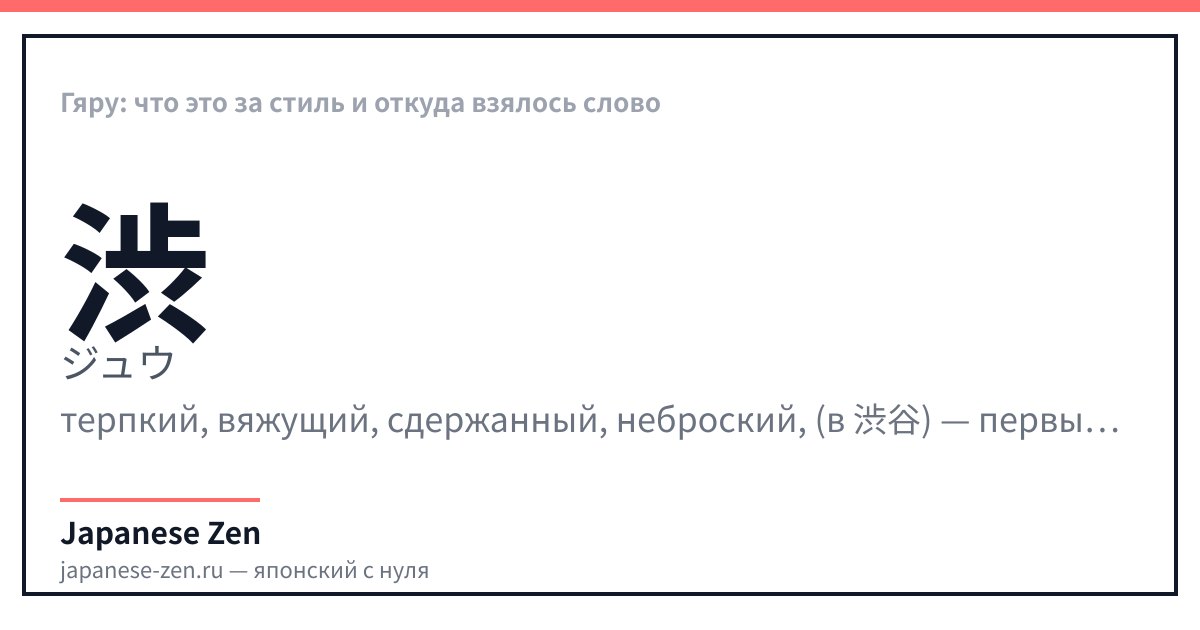
渋 — значение: astringent, puckery, restrained, understated, (in 渋谷) — the first character of Shibuya — онъёми: ジュウ、シュウ — кунъёми: しぶ、しぶ.い、しぶ.る — 11 штрих(ов). 渋 is the first character of the Shibuya district (渋谷), with which the whole gyaru story is associated. The character also has a separate, purely linguistic meaning: 'astringent' — that is how the taste of an unripe persimmon is described — and the adjective 渋い (shibui) describes a restrained, understated beauty, almost the opposite of gyaru brightness.
How 渋 Is Read and Why ギャル Is Written in Katakana
The on readings of 渋 are ジュウ and シュウ, the kun reading is しぶ, in the adjective 渋い (shibui) 'astringent, restrained'. The word ギャル (gyaru), unlike 渋, is written in katakana — the alphabet for foreign borrowings and sound symbolism. Katakana immediately shows that this is not a native Japanese word but an English one adapted to local pronunciation — the same happens with the words ドラマ (dorama) and アニメ (anime).
| Japanese | Reading | Translation |
|---|---|---|
| ギャル | gyaru · gyaru | Gyaru — the bright look of a young Japanese woman |
| 渋谷 | Shibuya · Shibuya | Shibuya — a district of Tokyo |
| 渋い | shibui · shibui | Restrained, tasteful (of a person or thing) |
| 茶髪 | chapatsu · chapatsu | Bleached, brown hair |
| コギャル | kogyaru · kogyaru | Kogyaru — a 1990s schoolgirl with the gyaru look |
Write 渋 along the guides — the first character of Shibuya, the district with which the whole gyaru story is associated.
FAQ
- What does the word 'gyaru' mean?
- Gyaru (ギャル) is the look of a young Japanese woman with bright or bleached hair, a tan or deliberately pale skin, and heavy makeup. The word is a rendering of English slang gal, 'girl', and the narrow meaning of a specific look only became attached to it in the 1990s.
- Where did the word 'gyaru' come from?
- Gyaru goes back to English slang gal, short for girl. In this broad sense of 'young woman' the word was recorded in Japanese dictionaries as early as 1928, but it only came to denote the recognizable look with makeup and a tan with the emergence of kogyaru in the early 1990s.
- How does kogyaru differ from ganguro?
- Kogyaru is the general name for tanned high-school girls with the gyaru look, noticeable from 1993: short skirts, baggy socks, makeup. Ganguro is a darker tan and especially light makeup within the same circle, not a separate subculture: one was part of the other.
- What do the Shibuya district and the 109 building have to do with it?
- The 109 shopping center in Shibuya opened in 1979, and in the second half of the 1990s it was redeveloped for youth gyaru brands. The building became the showcase of the trend, and for a time '109 style' and the gyaru look meant roughly the same thing.
- Who was considered an icon of the gyaru look?
- In the mid-1990s the main reference point was the singer Amuro Namie — with her light tan and light hair. Around 2000 the tan began to go out of fashion, and Ayumi Hamasaki with pale skin and bleached hair came to the fore. The press called both of them 'gyaru icons' — just of different periods.
- Does gyaru culture still exist?
- It never had a clear 'end', but in 2014 several prominent gyaru magazines closed, including egg, and the publisher of some others went bankrupt. Commentators read this as a symbolic milestone rather than the disappearance of the phenomenon: the same egg returned — online in 2018, and in print again from 2019.
Sources
Updated: 2026-09-15