Harajuku: a Tokyo district, not a clothing style
Harajuku is not a clothing style but a Tokyo neighborhood in Shibuya ward: a station, the cramped shopping street Takeshita-dori, and the wide Omotesando boulevard nearby. "Harajuku style" is a label coined not by Japan but by foreign press and guidebooks: over half a century, different fashions succeeded one another on these streets — takenoko-zoku, Lolita, Ura-Hara, decora — rather than a single recognizable aesthetic.
The name is older than all fashion movements combined: 原宿 means "post station in a field" and was given to the neighborhood long before the first fashion storefront. Let's look at how Takeshita-dori differs from Omotesando and which movements really succeeded one another on these streets. Also — where the neighborhood's name came from and how America arrived here after the war, bringing the first boutiques.
The station and two unlike streets of Harajuku
Harajuku (原宿) is a neighborhood in Tokyo's Shibuya ward, not the name of a single fashion. Its core is Harajuku Station on the Yamanote line and the alleys around it. Takeshita-dori is a short pedestrian street with cheap shops and stalls, aimed at teenagers and tourists. Omotesando is a wide boulevard lined with keyaki trees and boutiques of global fashion houses, leading to Meiji Shrine. These are two places with different spirits, two minutes apart on foot, and both are called by the single word "Harajuku."
Where the phrase "Harajuku style" came from
Outside Japan, the word "Harajuku" came to mean bright street fashion in general — bold colors, layered outfits, anime character costumes. This is a simplification. At different times, different, unrelated movements were visible on these streets, and none of them called itself "Harajuku style." The label was born in foreign journalism and guidebooks that needed one word for an entire neighborhood.
Which movements really succeeded one another on these streets
| Movement | In Japanese | When and where it was visible |
|---|---|---|
| Takenoko-zoku | 竹の子族 | 1979 — early 1980s, peak in 1980; on Sundays on the car-free street by Yoyogi Park |
| Ura-Hara | 裏原系 | from the early 1990s to the early 2000s, in the alleys north of Omotesando |
| Lolita | ロリータ・ファッション | from the mid-1990s, in shops like MILK and the Laforet mall |
| Decora | デコラ | from around 1998, on and around Takeshita-dori |
| Gyaru and ganguro | ギャル・ガングロ | more noticeable nearby in Shibuya, but they also came to the streets of Harajuku |
Why this is not one style
These movements have different origins and different audiences: Lolita grew out of brands like MILK and Pink House, Ura-Hara out of street shops by young designers. Gyaru and ganguro are mainly associated with neighboring Shibuya. What they all share is only geography: sooner or later each of them also appeared on the streets of Harajuku. It is also said that the era of Harajuku street fashion ended with FRUiTS magazine. It ran from 1997 and photographed local fashion people, but in the mid-2010s it stopped appearing: founder Shoichi Aoki explained that there was no one left to photograph. This is one person's observation, not an official end date — the magazine was later revived.
The post station in a field that became a fashion district
The name 原宿 is several centuries older than all fashion movements: the toponym goes back to a post station on the Kamakura-kaido road, which in the Middle Ages led from Sagami Province north toward Oshu. In the Edo period, here, south of the Koshu-kaido road, stood the barracks of samurai from Iga: they were settled here to defend the city. The neighborhood became busy only after Meiji Shrine was built nearby.
Harajuku Station on the Yamanote line opened on October 30, 1906 — at first it was a modest freight hub, not a busy place. The real turning point came after World War II: on the site of a former military parade ground grew Washington Heights, a housing complex for American military personnel and their families. By 1964, when Tokyo was preparing for the Olympics, the land was returned to Japan, and Japanese youth flocked to the nearby streets where Americans had once strolled — that is how the first boutiques and cafes appeared here.
Hokoten — the car-free street that gathered the first crowd
From 1977, on Sundays traffic near Yoyogi Park was closed for hokoten, a "pedestrian paradise": the roadway was given to pedestrians, and dancing street groups like the takenoko-zoku flocked there. On the best Sundays, up to a hundred thousand people gathered here, and on August 31, 1998, the hokoten in Harajuku was closed. But it was precisely this that gathered the first noticeable crowd, for which fashion shops began to open in Harajuku.
宿 — lodging that gave the neighborhood its name
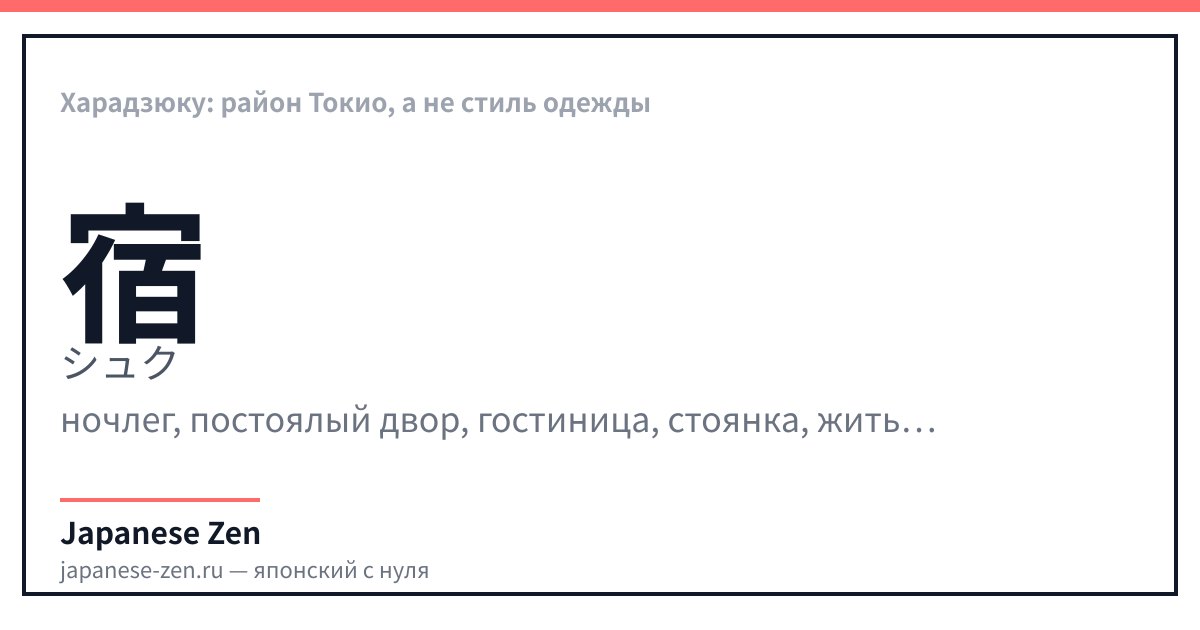
宿 — значение: lodging, inn, hotel, stopover, to live, to stay — онъёми: シュク — кунъёми: やど、やど.る、やど.す — 11 штрих(ов). 宿 — the second character in 原宿: "lodging, inn." This is what a roadside station where travelers stopped for the night was called. The same character appears in 宿題 "homework" and 民宿 "private inn."
How 宿 is read and in which words it appears
The on'yomi of 宿 is シュク (shuku), the kun'yomi are やど (yado) and the verb やどる (yadoru) "to stay overnight, to lodge." The on'yomi appears in 宿題 (shukudai) "homework," 民宿 (minshuku) "private inn, like a guesthouse," and 下宿 (geshuku) "a rented room with meals, where students used to live." The first character of the word, 原 (gen, kun'yomi — hara), means "plain, field" — together 原宿 reads literally as "post station in a field."
| Japanese | Reading | Translation |
|---|---|---|
| 原宿 | Harajuku · Harajuku | Harajuku |
| 宿題 | shukudai · shukudai | Homework |
| 民宿 | minshuku · minshuku | Private inn, guesthouse |
| 下宿 | geshuku · geshuku | Rented room with meals |
| 竹下通り | Takeshita-dōri · Takeshita-dōri | Takeshita-dori — the neighborhood's shopping street |
| 表参道 | Omotesandō · Omotesandō | Omotesando — the boulevard with boutiques |
Write 宿 along the guides — the character for "lodging" that gave the Harajuku neighborhood its name.
FAQ
- Is Harajuku a district or a clothing style?
- Harajuku is a neighborhood in Tokyo's Shibuya ward, not a single fashion: there is no official "Harajuku style" with a shared list of features. On the local streets — Takeshita-dori and Omotesando — different movements succeeded one another over half a century, from takenoko-zoku to Lolita, and each lived by its own rules.
- Where did the name "Harajuku" come from?
- 原宿 literally means "post station in a field": the toponym goes back to a stop on the medieval Kamakura-kaido road, which led from Sagami Province north. The railway station itself opened on this site in 1906, long before the neighborhood became fashionable.
- How does Takeshita-dori differ from Omotesando?
- Takeshita-dori is a cramped pedestrian street with cheap shops and stalls, aimed at teenagers. Omotesando is a wide boulevard lined with trees and boutiques of global fashion houses, leading to Meiji Shrine. These are two places with different spirits, two minutes apart on foot.
- What is hokoten in Harajuku?
- Hokoten, a "pedestrian paradise," was the Sunday closing of the street near Yoyogi Park to pedestrians: from 1977, dancing street groups like the takenoko-zoku flocked there. On the best Sundays, up to a hundred thousand people gathered there, and on August 31, 1998, the hokoten was closed — but it was precisely this that made Harajuku a noticeable meeting place for youth.
- Why did Harajuku become a fashionable district?
- The push came from the postwar Washington Heights — a housing complex for American officers on the site of a former military parade ground. By 1964, when the land was returned to Japan before the Olympics, Japanese youth flocked to the nearby streets where Americans had once strolled — that is how the first boutiques and cafes appeared here.
- How is "Harajuku" written and read in Japanese?
- 原宿, read はらじゅく. 原 (hara) means "plain, field," 宿 (shuku, yado) — "lodging, inn": together it gives "post station in a field." The second character, 宿, also appears in a couple of other everyday words — 宿題 "homework," 民宿 "private inn."
Sources
Updated: 2026-09-15