Okinawa Island: the Ryukyu Kingdom, its own languages, and a very different Japan
Okinawa Island is the largest in the Ryukyu archipelago in southern Japan; until 1879 it was an independent kingdom with its own court and trade links across Asia. The name 沖縄 probably goes back to oki, "open sea," and a word meaning "fishing grounds," though there is no single agreed version. On the island people speak not a dialect of Japanese but distinct Ryukyuan languages, which UNESCO classifies as endangered.
Let's look at the origins of the names "Okinawa" and "Ryukyu" — they sound different for a reason. We'll follow the island's path from a trading kingdom through the invasion by the Satsuma samurai in 1609 and annexation by Japan in 1879 to the battle of 1945 and nearly three decades under U.S. administration. And we'll see why the Ryukyuan languages are not dialects but a separate branch.
沖縄 and 琉球: two names for one archipelago
沖縄 is read おきなわ (Okinawa) and divides into 沖 "open sea, shore" and 縄 "rope." The most common version links the second part to the word naba — "fishing grounds, fish market" — so the whole name is understood as "fishing in the open sea." This is still only the main version, not a proven fact: linguists have not reached a consensus.
The earliest mention — centuries before 沖縄
As early as 753, if we trust the biography of the monk Ganjin written in 779, ships sailing with him from China put in at an island written there with the characters 阿児奈波島. The modern characters 沖縄 appeared later and, like many place names, were chosen for their sound rather than the meaning of the original word.
Ryukyu — the name given by China
琉球 is a Chinese name: in the 7th-century Suishu chronicle a country "流求" is mentioned, though historians debate whether it referred to Okinawa or Taiwan. By the 15th century at the latest the name was attached specifically to the Ryukyu archipelago, when a unified kingdom formed here, and since then Okinawa and Ryukyu have not diverged in texts.
Not just a resort: climate, cuisine, and a language vanishing before our eyes
Okinawa lies in the subtropics and differs noticeably from the rest of Japan in climate and cuisine: here bitter melon goya and pork are cooked more often than anywhere else in the country, and winter is almost nonexistent. But the island's main difference is not in weather or food, but in language.
Ryukyuan languages — not dialects, but relatives of Japanese
On the Ryukyu islands people speak not dialects of Japanese but distinct Ryukyuan languages — close relatives of Japanese in the same language family, but not mutually intelligible with it without special study. The language of Okinawa Island is commonly called Uchinaguchi, while neighboring islands have their own names and their own languages of the same group.
UNESCO: six languages under threat
In 2009 UNESCO added six Ryukyuan languages to the Atlas of the World's Languages in Danger: Amami, Kunigami, Okinawan, and Miyako are classified as "definitely endangered," while Yaeyama and Yonaguni are "severely endangered." The main reason is that after annexation by Japan, only Japanese was established in schools and daily life for decades.
From the trading kingdom of Ryukyu to reunification with Japan in 1972
From the 15th to the 19th century the Ryukyu Kingdom lived by maritime trade. Its ships sailed to China, Korea, Southeast Asia, and Japan itself, and the royal court at Shuri Castle maintained relations simultaneously with the Chinese emperor and with neighboring Japanese domains. In 1609 a force of 3,000 from the Satsuma domain invaded the islands, took Shuri within a month, and carried King Shō Nei away as a captive — from that moment the kingdom lost its independence, though it formally survived for another two and a half centuries.
1879: the end of the kingdom
On March 27, 1879, representatives of the Japanese government with an armed detachment arrived at Shuri Castle and announced the abolition of the Ryukyu Kingdom and the creation of Okinawa Prefecture. The last king, Shō Tai, was forced to move to Tokyo — thus the islands finally became part of Japan.
1945 and nearly three decades under U.S. administration
From March 26 to June 23, 1945, one of the heaviest battles of the Pacific War was fought on Okinawa. American troops landed on the islands, and the fighting claimed, by various estimates, about 200,000 lives, including a significant portion of the civilian population. After Japan's capitulation the islands passed under U.S. administration for 27 years and returned to Japanese sovereignty only on May 15, 1972; U.S. military bases on Okinawa remain in operation today.
琉 — the "precious stone" that survives only in the name Ryukyu
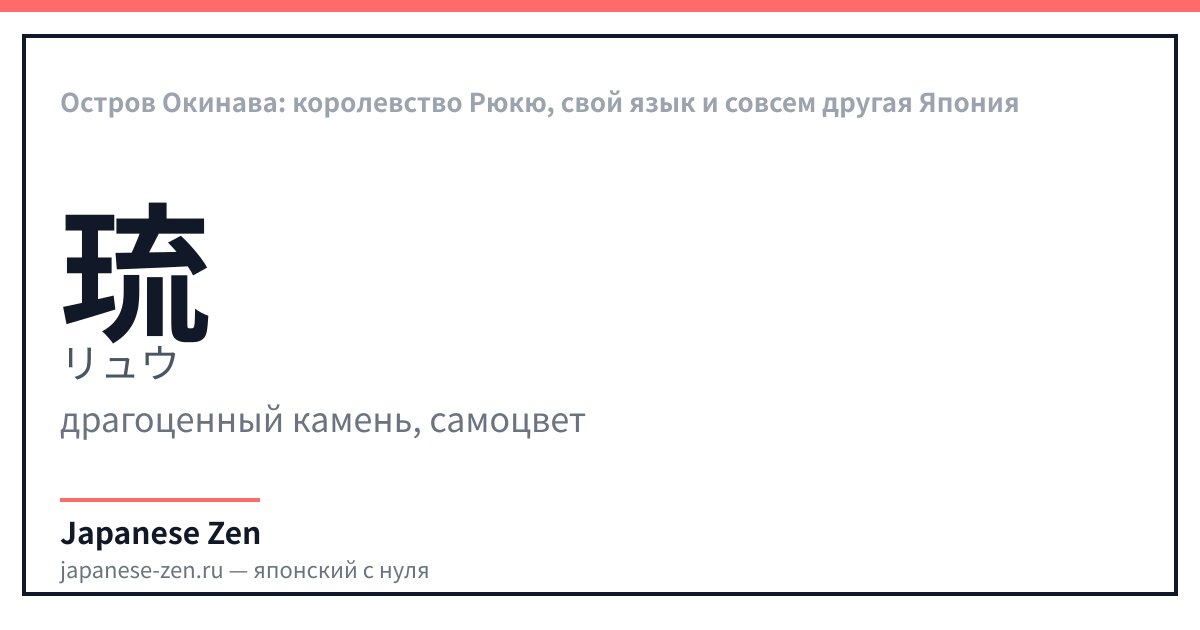
琉 is read ryu in the on'yomi — it has practically no other reading in the modern language — and by itself means "precious stone, gem." This meaning has nothing to do with the Ryukyu archipelago: the character was chosen for the Chinese name 琉球 for its sound, not its meaning.
琉 — значение: precious stone, gem — онъёми: リュウ、ル — 11 штрих(ов). 琉 — "precious stone, gem": in the modern language the character almost never appears apart from the words 琉球 "Ryukyu" and 琉球王国 "Ryukyu Kingdom." It became the character for this page, though the Okinawa islands lie in the name Ryukyu only by sound, not by meaning.
沖 and 縄 — what dictionaries say about the name "Okinawa" itself
沖 in ordinary words means "open sea, shore," and 縄 means "rope, cord": both characters still live in the language separately from the island's name. Dictionaries link 縄 in 沖縄 not to "rope" but to the old word naba — "fishing grounds" — though the spelling was fixed by sound, as in most old place names.
| Japanese | Reading | Translation |
|---|---|---|
| 沖縄 | Okinawa · Okinawa | Okinawa — the name of the island and prefecture itself |
| 琉球 | Ryūkyū · Ryūkyū | Ryukyu — the Chinese name of the archipelago and kingdom |
| 琉球王国 | Ryūkyū Ōkoku · Ryūkyū Ōkoku | The Ryukyu Kingdom, independent until 1879 |
| うちなーぐち | Uchināguchi · Uchināguchi | Uchinaguchi — the Okinawan language, literally "Okinawan speech" |
| 首里 | Shuri · Shuri | Shuri — the former royal capital on the island |
| 沖 | oki · oki | Open sea — the first character in the name "Okinawa" |
Write 琉 along the guides — the character that in Japanese lives almost only in the name Ryukyu.
FAQ
- What does the name "Okinawa" mean in Japanese?
- 沖縄 divides into 沖 "open sea" and 縄, which dictionaries most often link to the old word naba — "fishing grounds." The most common version reads the whole name as "fishing in the open sea," but linguists have no consensus: no written evidence of the original Ryukyuan word survives.
- How does "Ryukyu" differ from the island "Okinawa"?
- "Ryukyu" is a Chinese name: in a 7th-century Chinese chronicle a country "流求" is mentioned, though historians debate whether it referred to Okinawa or Taiwan. By the 15th century at the latest the name was attached specifically to the archipelago, when a unified kingdom with its capital at Shuri Castle formed here.
- When did the Ryukyu Kingdom lose its independence?
- Formally it happened in two stages. In 1609 the army of the Japanese Satsuma domain invaded the islands and subjugated the royal court, but the kingdom continued to exist for another two and a half centuries. It finally disappeared on March 27, 1879, when the Japanese authorities announced the creation of Okinawa Prefecture.
- What happened on Okinawa in 1945?
- From March 26 to June 23, 1945, one of the heaviest battles of the Pacific War between Japanese and American forces was fought on the island. The fighting and its aftermath claimed, by various estimates, about 200,000 lives, including a significant portion of the islands' civilian population.
- Are the Ryukyuan languages dialects of Japanese?
- No, they are distinct languages of the same family as Japanese, but not mutually intelligible with it without special study. In 2009 UNESCO added six Ryukyuan languages, including Okinawan, to the Atlas of the World's Languages in Danger.
- How long was Okinawa under U.S. administration?
- 27 years: after Japan's capitulation in 1945 the islands passed under American military administration and returned to Japanese sovereignty only on May 15, 1972. U.S. military bases on Okinawa remain one of the island's main features today.
Sources
Updated: 2026-09-15