Shisa — Okinawan Guardian Lions: Why One Mouth Is Open
Shisa are stone and ceramic guardian lions placed in pairs on roofs, gates, and entrances in Okinawa. The lion with the open mouth is believed to ward off evil spirits, while the one with the closed mouth keeps good fortune inside the home. The name comes from the word 獅子 "lion," and the tradition links shisa to mainland komainu and Chinese stone lions at gates.
Shisa are not tourist souvenirs but active talismans: pairs of guardians are still molded right during roof-laying. Let's look at where the Okinawan word "shisa" came from, how these lions differ from mainland komainu, where the oldest surviving statue stands, and what the cinematic King Caesar has to do with it.
Shisa: An Okinawan Lion from Far Away
The word "shisa" is the Okinawan pronunciation of 獅子 ("lion"). It is believed that the name and the image itself trace through China to ancient Near Eastern depictions of lions — the same root explains Japanese komainu 狛犬 and Chinese stone lions at gates. There is also a theory of the shisa's dog origin, but researchers more often lean toward the lion one — due to Okinawa's close ties with China and the sound of the word itself.
Why One Mouth Is Open and the Other Closed
Shisa are often placed in pairs, like the Buddhist a-un 阿吽 pair — with an open and a closed mouth. According to one interpretation, the open mouth belongs to the "male" and drives away evil spirits, while the closed one belongs to the "female" and keeps good fortune inside the home. Researchers do not confirm a definitive link between sex and mouth shape, so this should be considered an interpretation rather than a strict rule.
Shisa differ from mainland komainu primarily in placement. Komainu guard the entrance to a Shinto shrine and are most often made of stone or bronze, while shisa are an Okinawan custom where figures are also molded from roof tiles and lime right on the roof of a house.
From Royal Tombs to the Roofs of Ordinary Houses
The oldest lion images in Okinawa are on the stone casket of King Eiso in the Urasoe yodore mausoleum, presumably created between the late 13th and 15th centuries. Such "palace lions" were placed in royal tombs and shrines, not at ordinary homes.
Village Shisa and the Oldest Surviving Statue
From the late 17th century, "village lions" began to be placed in Okinawan villages — protection not from thieves but from fires and disasters. According to the court chronicle "Kyūyō," in 1689 the residents of the Tomimori district were plagued by frequent fires. A geomancer advised placing a stone lion facing Mount Yaese-dake, which was considered the source of the trouble — thus appeared the oldest surviving village shisa, the Tomimori stone lion.
Shisa appeared on the roofs of ordinary houses much later: during the Ryukyu Kingdom, commoners were not allowed to roof their houses with tiles, and molded lions above gates remained a privilege of temples, nobility, and village communities. Shisa moved en masse onto the roofs of ordinary dwellings only after tiled roofs were permitted for commoners in the Meiji era.
Shisa Today: From Roof to Movie Screen
Today shisa are placed on gates, roofs, and entrances to homes, shops, and even airports — made of ceramics and concrete. Traditional roof figures are still molded from red roof tiles and lime right during roof-laying.
Shisa in Cinema: King Caesar
In 1974, the kaiju King Caesar appeared in Toho's film "Godzilla vs. Mechagodzilla" — a giant standing on its hind legs, inspired by Okinawan guardian lions — this is also heard in his Japanese name キングシーサー.
屋 — The Sign That Brought Shisa to the Roof
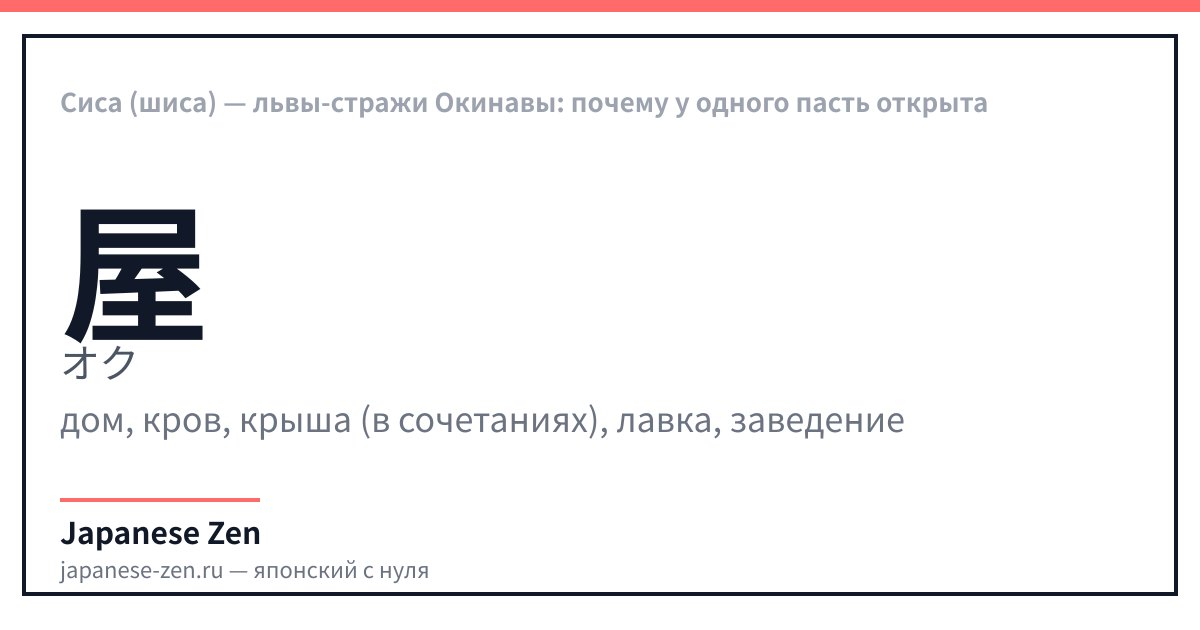
屋 — значение: house, shelter, roof (in compounds), shop, establishment — онъёми: オク — кунъёми: や — 9 штрих(ов). 屋 — "house, shelter": the same character appears in 屋根 "roof" (the very place where shisa most often stands), 部屋 "room," and 屋上 "rooftop."
Why シーサー Is Written in Katakana
The word シーサー is written in katakana — it is an Okinawan, not a general Japanese, pronunciation. Dictionaries link it to 獅子, which in standard Japanese is read "shishi," but in Okinawan sounds different, closer to "shisa."
The same root 獅子 is seen in 獅子舞 "lion dance" — a New Year performance where dancers enact a lion to drumbeats. Shisa and 獅子舞 are related but distinct traditions of venerating the same beast.
| Japanese | Reading | Translation |
|---|---|---|
| シーサー | shīsā · shīsā | Shisa, the guardian lion of Okinawa |
| 獅子 | shishi · shishi | Lion — the word from which "shisa" derives |
| 屋根 | yane · yane | Roof — where shisa is most often placed |
| 狛犬 | komainu · komainu | A pair of stone guardians at Shinto shrines on the mainland |
| 阿吽 | a-un · a-un | "Beginning and end" — the Buddhist meaning of the open and closed mouths |
| 琉球 | Ryūkyū · Ryūkyū | The Ryukyu Kingdom, where the shisa tradition took shape |
Write 屋 along the guides — the character for "roof," on which shisa most often stands.
FAQ
- What is a shisa in Okinawa?
- A shisa is an Okinawan talisman in the form of a pair of lions, molded from stone, ceramics, or roof tiles with lime and placed on roofs, gates, and entrances to homes. The tradition traces through China to ancient Near Eastern depictions of lions — the same root as Japanese komainu.
- Why does one shisa have an open mouth and the other a closed one?
- A pair of shisa is often designed after the Buddhist a-un pair — with an open and a closed mouth. According to one interpretation, the open mouth drives away evil spirits, while the closed one keeps good fortune inside the home, but researchers do not confirm a strict link of this feature to the sex of the statues.
- How does a shisa differ from a komainu?
- Komainu guard the entrance to Shinto shrines on the mainland and are most often made of stone or bronze. Shisa are an Okinawan custom: they are placed not only at shrines but also on the roofs of ordinary houses, and they are also molded from roof tiles and lime right during roof-laying.
- Where are shisa placed?
- Today they can be seen on house roofs, on gates, at shop entrances, and even in Okinawan airports. Historically, village shisa were placed not for decoration but for protection from a specific trouble — for example, from fires, facing the mountain considered their source.
- Where did the word "shisa" come from?
- It is the Okinawan pronunciation of the word 獅子 "lion," which in standard Japanese sounds like "shishi." Through China, the image of the guardian lion traces back to ancient Near Eastern depictions of lions — the same source as Japanese komainu.
- How is "shisa" written in Japanese?
- シーサー, in katakana — this emphasizes that the word is Okinawan, not general Japanese. It is based on the kanji word 獅子 "lion," which in Japanese itself is read "shishi," but in Okinawa is pronounced differently.
Sources
Updated: 2026-09-15