Momochi Tanba — head of one of the "three houses" of Iga
Momochi Tanba was a warrior of the late 16th century, called one of the "three upper houses" (上忍三家) of Iga Province alongside Hattori and Fujibayashi. In 1581 he defended the last fortress of Iga, Kashiwara Castle, and his true biography is almost indistinguishable from later legend — down to the name "Momochi Sandayu," by which he is most often remembered.
More is said about Momochi Tanba than is known for certain: documents about his life amount to a few lines in old diaries, and the rest comes from military chronicles and theater of much later times. Let's sort out what the sources confirm, what he did in the war with Oda Nobunaga, and where the legend came from that he taught the future bandit Ishikawa Goemon.
Momochi Tanba: a warrior known by document and by legend
The name Momochi Tanba first appears in the diary "Tamon-in nikki," kept by the monks of Kofuku-ji: an entry from 1579 names him as the land steward of that monastery's holdings in Yamato Province. The Momochi clan came from an area on the border of Iga and Yamato and by the Sengoku period had become local landowners there. Tanba is traditionally counted among the "three upper houses" (上忍三家) of Iga Province alongside Hattori and Fujibayashi. But this division into three houses appears in sources noticeably later than his lifetime, and exactly when it took shape is not established.
What is known about him for certain, and what is not
The exact date of Tanba's birth is unknown, and the genealogies of his descendants disagree even on the name of the clan's first ancestor. The fortress-estate that sources call his holding can today be found as a castle site near the modern city of Iga; sources give Tanba's true personal name as 正西, but they do not provide its reading.
The defense of Kashiwara Castle in the war of 1581
The military chronicle "Iranki," compiled in the 17th century, names Tanba among the warriors of Iga who in 1579 repelled an attack by Oda Nobukatsu's commanders at a mountain pass. In 1581, in the second Tensho Iga War, the same chronicle lists him among the defenders of Kashiwara Castle, the last fortress to hold out until the end of hostilities. According to the same lines, Tanba fought bravely with a bow in hand.
What became of him after the surrender
The chronicle breaks off his trail at the defense of Kashiwara. According to family tradition, Tanba survived, later returned home under the name Shinzaemon, and died in 1640 at the age of 85, while his descendants remained on the ancestral land in Yamato and were village headmen there. There is no other confirmation for this story, so it is a version, not a fact.
Momochi Sandayu and the teacher of Ishikawa Goemon
Under the name "Momochi Sandayu," Tanba is remembered more often than under his real one: that is what he is called in adventure books and on stage, while in documents of his era this name does not appear at all. One version links Sandayu to Tanba's grandson, who supposedly inherited his grandfather's name and work; another, far more modest in evidence, considers Sandayu and Tanba himself to be one person under different names.
The legend of the bandit pupil
A popular story makes Momochi Sandayu the ninjutsu teacher of the bandit Ishikawa Goemon, executed in 1594. Sources of his era know nothing of this instruction: the connection was born in kabuki and adventure literature of the 18th–19th centuries, two centuries after the supposed meeting of teacher and pupil.
There is also a third version: that Fujibayashi Nagato, head of northern Iga, and someone from the Momochi — sources name either Tanba or Sandayu — are actually one person. The argument in its favor is the almost identical posthumous Buddhist names on the gravestones of both in different temples. Because documents about Fujibayashi are so scarce, this version remains a guess, not an accepted fact.
The character 百 in the surname Momochi and in ordinary words
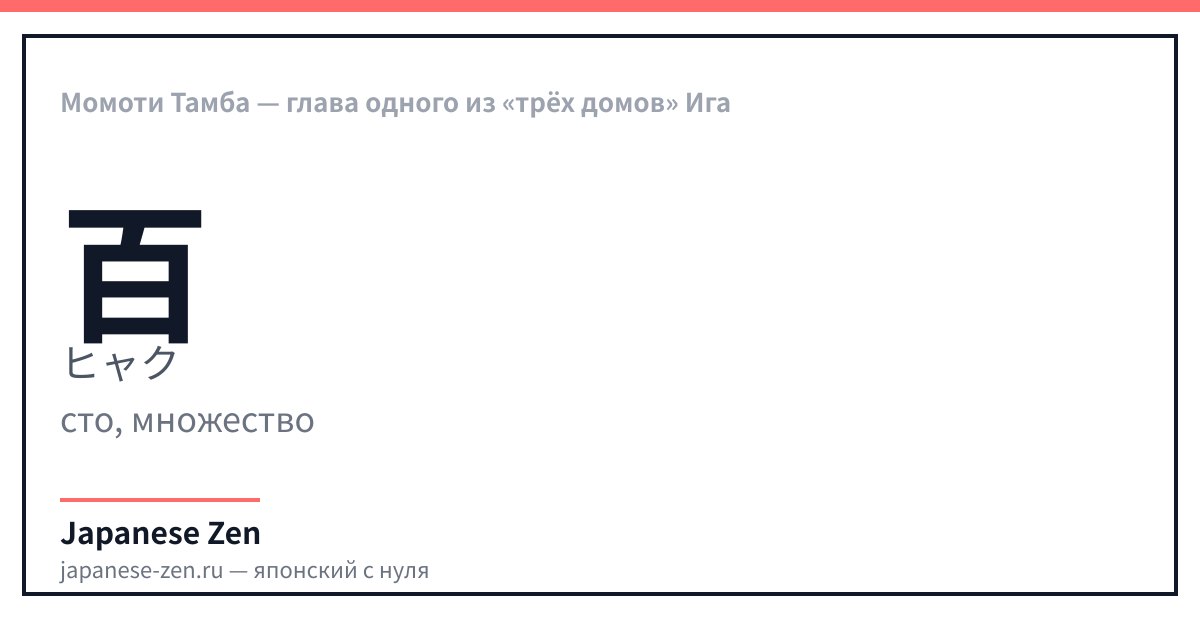
百 — значение: hundred, multitude — онъёми: ヒャク、ビャク — кунъёми: もも — 6 штрих(ов). 百 — the first character of the surname Momochi (百地): "hundred," and figuratively "multitude." The second character, 地, means "earth"; together they yield a conjectural interpretation of the surname — "many lands" — rather than a strict etymology.
百地 is read ももち: the character 百 here carries the old Japanese reading もも — "hundred," "multitude." In ordinary words it is pronounced according to the Chinese model, ヒャク, as in 百円 "one hundred yen" and 百科事典 "encyclopedia," literally "a compendium of a hundred branches of knowledge."
"Momo" — a rare reading of the character for "hundred"
The reading もも has survived mainly in old surnames and place names like Momochi, and in modern speech it is almost never encountered outside proper names. The second element of the name, "Tanba" (丹波), is not part of the surname but the name of Tanba Province, which samurai of that era often added to their name as an honorary title, without implying real authority over that land.
| Japanese | Reading | Translation |
|---|---|---|
| 百地丹波 | Momochi Tanba · Momochi Tanba | Full name |
| 百地 | Momochi · Momochi | Surname — "hundred" plus "earth" |
| 丹波 | Tanba · Tanba | Tanba Province — as an honorary title in the name |
| 百 | momo · momo | "Hundred" in the old Japanese reading — as in the surname Momochi |
| 百円 | hyakuen · hyakuen | One hundred yen — an ordinary word with the same character |
| 百科事典 | hyakka jiten · hyakka jiten | Encyclopedia |
Write 百 along the guides — the first character of the surname Momochi and of the word "hundred."
FAQ
- Who is Momochi Tanba?
- Momochi Tanba was a warrior of Iga Province in the late 16th century, called one of the "three upper houses" of that land alongside Hattori and Fujibayashi. Little is known about him for certain: his name appears in a monastery diary of 1579 and in a military chronicle of the defense of Kashiwara Castle in 1581.
- Are Momochi Tanba and Momochi Sandayu the same person?
- Sources disagree. Documents and chronicles know only the name Tanba; "Momochi Sandayu" is a later name from adventure literature, and one version makes Sandayu his grandson, who inherited his grandfather's work, rather than Tanba himself under another name.
- What did Momochi Tanba do during the war with Nobunaga?
- According to the military chronicle "Iranki," in 1579 he took part in repelling an attack by Oda Nobukatsu's commanders, and in 1581, in the second Tensho Iga War, he defended Kashiwara Castle — the last fortress of Iga to hold out until the end of hostilities.
- Is it true that he taught Ishikawa Goemon?
- This is a legend from kabuki and adventure books of the 18th–19th centuries, not a fact confirmed by sources of his era. In these stories, the teacher of the bandit Ishikawa Goemon is called Momochi Sandayu — a later name linked to Tanba only by conjecture.
- What does "Tanba" mean in his name?
- Tanba (丹波) is not a surname or a personal name, but the name of a province that samurai of the Sengoku period often added to their name as an honorary title. It did not imply real authority over that land — the same device was used, for example, by Fujibayashi Nagato with the word "Nagato."
- How is "Momochi Tanba" written in kanji?
- 百地丹波, read ももちたんば. 百地 (Momochi) is a surname made of the characters for "hundred" and "earth"; 丹波 (Tanba) is an honorary title from the name of Tanba Province, not part of the clan name.
Sources
Updated: 2026-09-15