The Tenshō Iga War — How Oda Nobunaga Crushed Iga in 1581
The Tenshō Iga War is the name for two — or, by some historians' count, three — campaigns by Oda Nobunaga against the league of Iga lands between 1579 and 1582. The first, in 1579, was lost by his son Oda Nobukatsu without his father's permission; in the second, in 1581, Nobunaga's army of several tens of thousands crushed Iga and burned the province. After that, the warriors of Iga dispersed into the service of other lords.
The single Tenshō Iga War actually breaks down into two devastating campaigns and one later uprising, and its most famous details come from a chronicle written a century after the events. Let's look at how Nobunaga's son's failed attempt in 1579 ended, how the father finished the job in 1581, and what role the neighbors from Kōga played in this story.
The First Campaign of 1579 and Oda Nobukatsu's Insolence
Oda Nobukatsu, Nobunaga's second son, had already begun building Maruyama Castle in Iga in 1578, preparing the ground for seizing the province. The warriors of the Iga league attacked the construction site ahead of schedule and routed the garrison. In September 1579, Nobukatsu, without asking his father's permission, led about ten thousand men into Iga in three detachments.
Why Nobunaga was enraged at his own son
The warriors of Iga met the army with night raids, torch maneuvers, and sudden attacks on terrain they knew well, and within two or three days put Nobukatsu's detachments to flight, killing one of his commanders in battle. Upon learning of the unauthorized campaign and the rout, Nobunaga flew into a rage and threatened in a letter to disown his son.
The Second Campaign of 1581: The Rout and the Siege of Kashiwara
In 1581, two residents of Iga came to Nobunaga and offered to guide his army. Nobunaga again appointed Nobukatsu as commander, but this time gave him a far larger force — sources give different numbers, most often converging on around fifty thousand men. The army entered Iga in six detachments and, by all accounts, burned villages and temples along the way.
Where We Know the Details From: A Chronicle a Century Later
The main source of details is the Iranki (伊乱記), a military chronicle with no named author; modern historians associate it with a local scholar named Kikuoka Nyōgen, whose postscript is dated 1679 — nearly a hundred years after the events themselves. As with most such chronicles, every figure in the Iranki is checked: a late storyteller may have embellished for dramatic effect.
The warriors of Iga held out in several fortresses and repeatedly struck the besiegers at night, but in the end all retreated to Kashiwara Castle — the last stronghold. After negotiations through an intermediary, the garrison was spared in exchange for surrendering the castle, and with that organized resistance in Iga came to an end.
What Happened to the People of Iga After the Rout
The surviving warriors of Iga scattered: some were left without a master, some hired on with other daimyo, and some entered the service of Tokugawa Ieyasu. After Nobunaga's death at Honnōji in the summer of 1582, some residents of Iga briefly rose again — historians call this episode the third Tenshō Iga War, but in scale it no longer compares to the rout a year earlier.
Tokugawa's Crossing Through the Mountains of Iga and Kōga
In that same year, 1582, fleeing after Nobunaga's death, Tokugawa Ieyasu traveled to his home province through the mountains of Iga and Kōga accompanied by Hattori Hanzō, who, according to legend, gathered men of Iga for this purpose. Some researchers believe that most of the route went through Kōga lands, so Ieyasu was helped by people from two neighboring regions at once.
The Character 乱 in the War's Name and in Other "Upheavals" of History
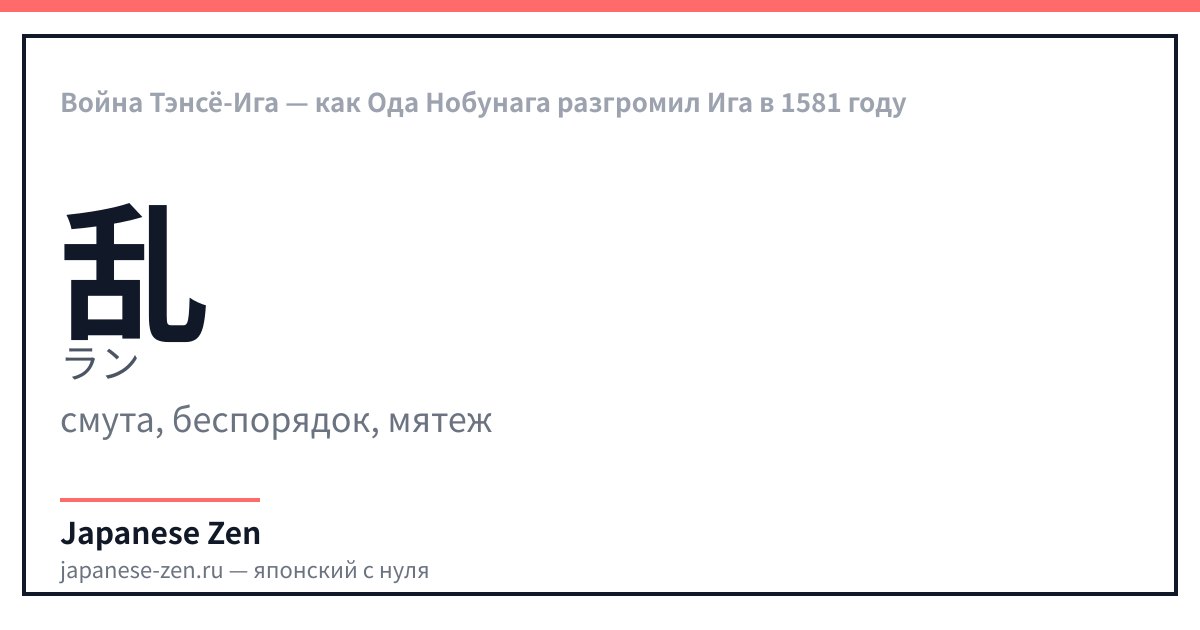
乱 — значение: upheaval, disorder, rebellion — онъёми: ラン、ロン — кунъёми: みだ.れる、みだ.る、みだ.す、みだ、おさ.める、わた.る — 7 штрих(ов). 乱 — "upheaval, disorder," the last character in the name 天正伊賀の乱. The same character is used in Japanese historiography for many internal wars, not just this one.
天正伊賀の乱 is made up of three parts: 天正 — the era name of 1573–1592, 伊賀 — Iga, 乱 — "upheaval." The era name in the title is not decoration but a way to date the event: Japanese sources traditionally name wars and uprisings after the era in which they occurred, adding the place and the word "upheaval" rather than "war."
Why "Wars" in Japanese History Are Often Called "Upheavals"
The same word 乱 is used, for example, for the famous Ōnin Rebellion (応仁の乱, 1467–1477), which destroyed the power of the Ashikaga shogunate — an event far larger than a local campaign against Iga, yet described in Japanese with the same word. It points to the internal nature of the conflict, not its scale.
| Japanese | Reading | Translation |
|---|---|---|
| 天正伊賀の乱 | Tenshō Iga no ran · Tenshō Iga no ran | The name of the event — "the Tenshō-era upheaval in Iga" |
| 天正 | Tenshō · Tenshō | Era name of 1573–1592 |
| 乱 | ran · ran | "Upheaval, disorder" — a common character in the names of wars |
| 伊賀越え | Iga-goe · Iga-goe | "The Crossing of Iga" — Tokugawa Ieyasu's route in 1582 |
| 応仁の乱 | Ōnin no ran · Ōnin no ran | The Ōnin War — another "upheaval" in Japanese history |
| 柏原城 | Kashiwara-jō · Kashiwara-jō | The castle — Iga's last stronghold in the second war |
Write 乱 along the guides — the character for "upheaval" in the name of the Tenshō Iga War.
FAQ
- What is the Tenshō Iga War?
- The Tenshō Iga War is the collective name for two — or, according to some historians, three — campaigns by Oda Nobunaga against the league of Iga lands between 1579 and 1582. The decisive one was the second campaign of 1581, when Nobunaga's huge army crushed Iga and burned the province.
- Why did Nobunaga attack Iga?
- Iga remained a self-governing land on the borders of Nobunaga's domains and recognized no one's authority over itself. The first campaign of 1579 was launched without permission by his son Oda Nobukatsu and was lost, and in 1581 Nobunaga sent an army several times larger against Iga.
- How did the Tenshō Iga War end?
- The second, decisive campaign of 1581 ended with the surrender of Iga's last fortress, Kashiwara Castle, on the condition that the garrison's lives be spared. The province lost its independence, and the surviving warriors dispersed into the service of various lords.
- How many Tenshō Iga Wars were there?
- Most often two are mentioned: the failed campaign of 1579 and the decisive rout of 1581. Some historians add a third episode — a short uprising in the summer of 1582, immediately after Nobunaga's death at Honnōji — but in scale it does not compare to the rout a year earlier.
- What happened to the ninja of Iga after the war?
- The survivors scattered: some were left without a master, some hired on with other daimyo, and some entered the service of Tokugawa Ieyasu. In 1582, men of Iga and Kōga guided Ieyasu through the mountains after Nobunaga's death, and later warriors from Iga were recruited into the "Iga unit" — the guard of Edo Castle.
- How is "Tenshō Iga" written in kanji?
- 天正伊賀の乱, read as てんしょういがのらん. 天正 is the era name of 1573–1592, 伊賀 is the name of Iga Province, 乱 means "upheaval": the same word is used in Japanese history for other internal wars, such as the Ōnin Rebellion.
Sources
Updated: 2026-09-15