The Genpei War — What Happened Between the Taira and the Minamoto
The Genpei War was an armed conflict from 1180 to 1185 between the Taira and Minamoto clans that ended the Heian period and brought the first shogunate to power. The name is composed of the on'yomi readings of the kanji of the two clans — 源 (gen, Minamoto) and 平 (hei, Taira). The key battles took place at Uji, Ichi-no-Tani, Yashima, and Dan-no-ura, where the young Emperor Antoku died, and the victor Minamoto-no-Yoritomo founded a shogunate in Kamakura.
The Genpei War lasted only five years, but it decided the fate of an entire era: after it, the court in Kyoto ceased to be the sole center of power in Japan. Below is the dry course of events and what legend later embellished for the sake of a good story.
What Happened
The Genpei War (源平合戦) was fought from 1180 to 1185 between two warrior houses of the late Heian period — the Taira, who by then effectively controlled the court, and the Minamoto, who had been removed from power after the Hogen (1156) and Heiji (1159) disturbances. The formal pretext was the rebellion of Prince Mochihito in 1180; the result was the complete destruction of the Taira clan and the transfer of real power to the Minamoto house.
- 1180 — Prince Mochihito and Minamoto-no-Yorimasa raise a rebellion against the Taira clan and send a call to arms across the country (the same Yorimasa who, according to legend, shot the nue monster with an arrow a year earlier).
- 1180 — Battle of Uji: the rebellion is suppressed, Yorimasa dies, but the call is heard throughout the country.
- 1180–1183 — Minamoto-no-Yoritomo and his relatives raise their own troops against the Taira in various provinces.
- 1184 — Battle of Ichi-no-Tani: Minamoto-no-Yoshitsune defeats the Taira with a surprise attack from a mountain slope.
- 1185 — Battle of Yashima: the Taira lose their stronghold on the island of Shikoku.
- 1185 — Naval Battle of Dan-no-ura: the Taira fleet is destroyed, and the young Emperor Antoku perishes with it.
- 1185 (according to another version, 1192) — Minamoto-no-Yoritomo receives supreme power and founds a shogunate in Kamakura; the Heian period ends.
Why It Came to This
By the end of the Heian period, the regency of the Fujiwara clan was weakening, and cloistered emperors relied on warrior houses as a source of military force. The Hogen (1156) and Heiji (1159) disturbances first brought the Taira and Minamoto to the forefront of court politics — and even then set them against each other. Taira-no-Kiyomori prevailed over the Minamoto house, executed its head, and exiled or spared his young sons, among whom were Yoritomo and Yoshitsune. By 1180, personal enmity and the redistribution of power at court were ready to spill into open war — only a pretext was needed, and it came in the form of Prince Mochihito's rebellion.
源平 — Two Clans in One Word
The name 源平合戦 (げんぺいかっせん, Genpei kassen) is assembled from the on'yomi readings of the kanji of the two clans: 源 (gen) — Minamoto, 平 (hei, in combination — pei due to voicing) — Taira, plus 合戦 'battle, clash of sides.' The clans themselves owe their Sino-Japanese names to the same principle: 源氏 (Genji) and 平氏 (Heishi) — the same clan kanji with the suffix 'clan.'
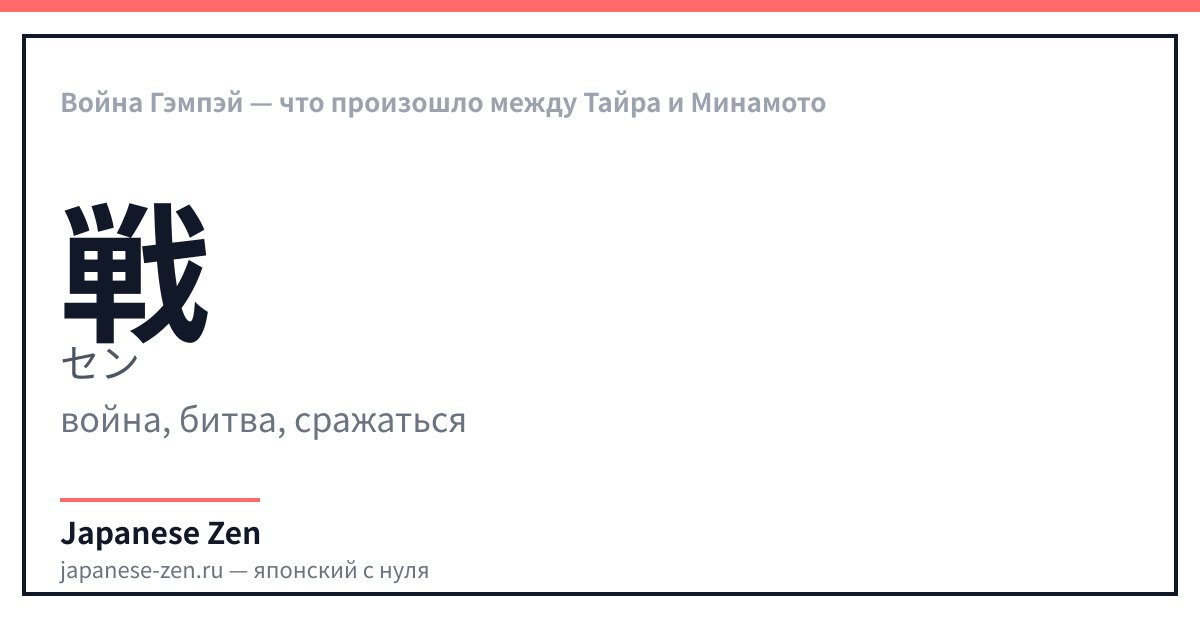
戦 — значение: war, battle, to fight — онъёми: セン — кунъёми: いくさ、たたか.う、おのの.く、そよ.ぐ、わなな.く — 13 штрих(ов). 戦 — 'war, battle, to fight': 13 strokes, an N3-level character. The same root appears in 戦争 (sensō, 'war') and 挑戦 (chōsen, 'challenge, attempt') — in the name of the war, it means 'battle' itself.
What the Japanese Themselves Call This War
In Japanese sources, alongside 源平合戦, the variant 源平の争乱 ('Genpei disturbance') appears just as often — a more neutral word than 'war' in the Western sense, since the fighting was not a single front but scattered campaigns across the country. The banner colors of the two houses — white for the Minamoto, red for the Taira — outlived the war itself: the red-and-white division is still used in Japan for team competitions, from school sports days to the New Year's TV contest 'Kōhaku Uta Gassen.'
| Japanese | Reading | Translation |
|---|---|---|
| 源平合戦 | Genpei kassen · Genpei kassen | The Genpei War |
| 源氏 | Genji · Genji | The Minamoto clan |
| 平氏 | Heishi · Heishi | The Taira clan |
| 壇ノ浦 | Dan-no-ura · Dan-no-ura | Site of the decisive naval battle |
Listen and repeat the name of the war and the key words of the topic.
'The Tale of the Heike' and What Was Distorted for the Sake of the Story
The main source on the Genpei War is 'The Tale of the Heike' (平家物語), a compilation assembled by the early 13th century that was not read silently for centuries but listened to: wandering blind monks, biwa-hōshi, chanted it to the accompaniment of the biwa lute. This is a genre of epic recitation, not a chronicle in the strict sense, so the numbers of troops, the speeches of commanders, and individual duels in the text are often stylized and dramatized for oral performance.
- Major battles in 'The Tale of the Heike' are often reduced to vivid duels of individual warriors — this is more convenient for oral performance, although real battles were fought by troops.
- The famous duel between Benkei and Yoshitsune on Gojō Bridge is not an episode of 'The Tale of the Heike': it is taken from the later compilation 'Gikeiki' and only merged with the story of the war into a single plot in retellings.
- But the scene where the archer Nasu-no-Yoichi, while galloping, shoots a fan off the side of an enemy ship at Yashima is a genuine, most-quoted episode of the text of 'The Tale of the Heike' itself, an example of how a monument can be both a source and literature.
Where the Kōhaku Colors Came From
On the battlefields of the Genpei War, the Minamoto house raised white banners, the Taira house — red: white was associated with Shinto purity and a connection to the imperial line, red — with strength and the patronage of the sun goddess, to whom the Taira clan traced itself. This pair of colors outlived both participants in the war and became a nationwide symbol of team competition — from sumo bouts to the simple division of a class into 'reds' and 'whites' at any school festival.
FAQ
- What is the Genpei War?
- The Genpei War was an armed conflict from 1180 to 1185 between the Japanese Taira and Minamoto clans for control of the country. It ended with the complete destruction of the Taira house and the transfer of real power to Minamoto-no-Yoritomo, who founded the first shogunate in Kamakura — thus the Heian period also ended.
- Where did the name 'Genpei' come from?
- The name 源平合戦 is composed of the on'yomi readings of the kanji of the two clans: 源 (gen) — Minamoto, 平 (hei) — Taira, plus 合戦 'clash of sides.' Simply put, 'Genpei' literally means 'Minamoto and Taira,' not a separate proper name of the war.
- Who won the Genpei War?
- The Minamoto house won. The decisive event was the naval Battle of Dan-no-ura in 1185, where the Taira fleet was destroyed and the young Emperor Antoku perished with it. The victor Minamoto-no-Yoritomo received supreme power and founded a shogunate in Kamakura.
- Which battles were key in the Genpei War?
- Uji (1180) — the start of open hostilities; Ichi-no-Tani (1184) and Yashima (1185) — victories of Minamoto-no-Yoshitsune that deprived the Taira of their land strongholds; Dan-no-ura (1185) — the final naval battle in which the Taira clan was destroyed.
- How do we know about the Genpei War?
- The main source is 'The Tale of the Heike' (平家物語), an epic compilation of the early 13th century that was chanted to the biwa lute for centuries. It is not a strict chronicle but a literary genre, so individual scenes and duels in it are stylized for oral performance.
- Is it true that the Japanese kōhaku colors came from this war?
- Yes. The Minamoto house fought under white banners, the Taira house under red; this pair of colors outlived the war and became a nationwide symbol of team competition — it is still used at school sports days and in the New Year's TV contest 'Kōhaku Uta Gassen.'
Sources
Updated: 2026-09-10