Minamoto no Yoshitsune — the commander who won the war and lost to his brother
Minamoto no Yoshitsune was a commander of the late Heian period who won the Genpei War for his older brother, but paid for it with his life. After winning the decisive battles at Ichinotani, Yashima, and Dan-no-ura in 1184–1185, he fell out with Minamoto no Yoritomo, fled north under the protection of the Fujiwara clan, and in 1189 died in Hiraizumi, betrayed by the son of his patron.
Of all the commanders of the Genpei War, Yoshitsune is the most retold: a man whose victories decided the outcome of the war, and whose fate became wrapped in legends faster than the memory of the actual battles could cool. The chronicle Azuma Kagami and the semi-legendary Gikeiki tell of him somewhat differently — below, the two voices are kept apart.
Who Yoshitsune was and what he is famous for
Minamoto no Yoshitsune (源義経, 1159–1189) was the younger brother of Minamoto no Yoritomo, and in childhood bore the name Ushiwakamaru. When his father and clan were defeated in the Heiji Disturbance, the infant Yoshitsune was spared and sent to be raised in a monastery; when he grew up, he joined his brother, who had launched the Genpei War against the Taira clan. It was Yoshitsune as a commander who won the war: the victories at Ichinotani (1184), Yashima, and Dan-no-ura (both 1185) are recorded in the Azuma Kagami, the official chronicle of the Kamakura shogunate.
| Year | Event |
|---|---|
| 1159 | Birth; childhood name — Ushiwakamaru |
| 1184 | Victory at Ichinotani |
| 1185 | Victories at Yashima and Dan-no-ura — end of the Genpei War |
| 1185 (after the victory) | Break with his brother Yoritomo, flight to the north |
| 1189 | Death in Hiraizumi, betrayed by Fujiwara no Yasuhira |
Why his brother turned against him
After his victories, Yoshitsune accepted court titles directly from the imperial court in Kyoto — bypassing Yoritomo, who was just then building a military government in Kamakura independent of the court. To Yoritomo this looked like a willful step away from the clan's common line, and he declared his brother an outlaw. Yoshitsune fled to Hiraizumi, to his patron Fujiwara no Hidehira, but after Hidehira's death his son Yasuhira, under pressure from Yoritomo, betrayed his guest and attacked his residence at Koromogawa — there Yoshitsune took his own life in 1189.
源 — the sign of the Minamoto clan
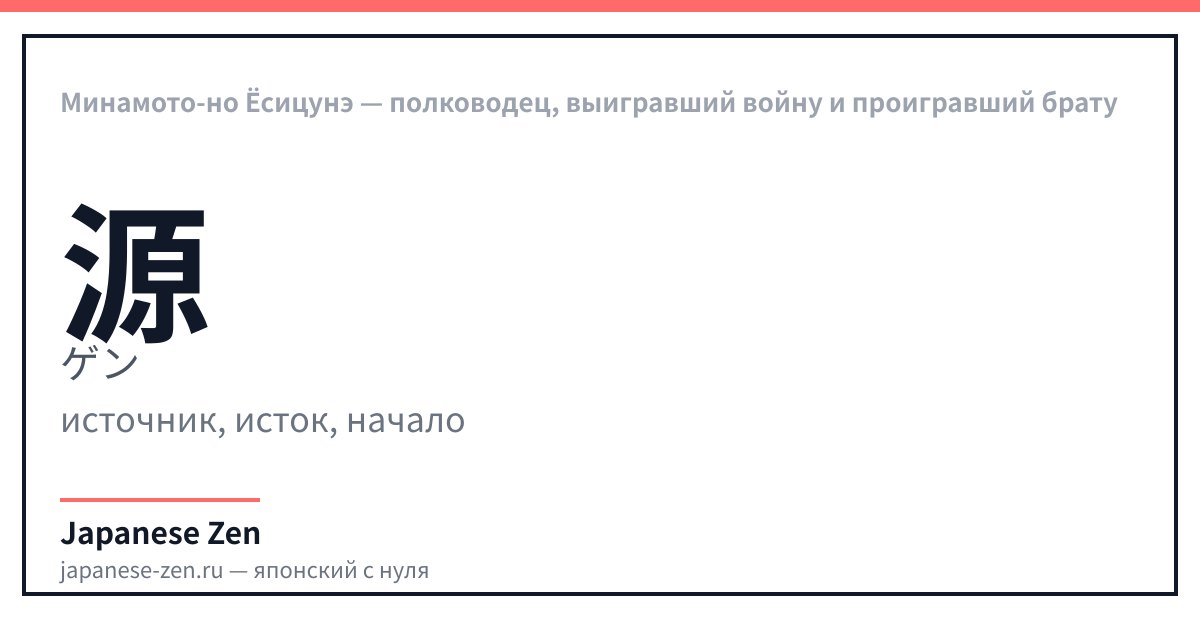
源 is read みなもと (kun'yomi) or ゲン (on'yomi) and means 'source, origin, beginning.' As a clan surname (Minamoto, also known as Genji 源氏) the character became established in the 9th century. Emperors regularly removed some of their sons from the line of succession and gave them the clan name 源, to relieve the treasury and the court of an overgrown imperial family — this practice was called shinseki kōka (臣籍降下). Thus 'source' became the surname of one of the two main warrior houses of the era, which opposed the Taira (平氏).
源 — значение: source, origin, beginning — онъёми: ゲン — кунъёми: みなもと — 13 штрих(ов). 源 — 'source, origin, beginning': 13 strokes. The same root appears in 資源 (shigen, 'resources') and 源流 (genryū, 'river source,' figuratively 'original source').
Why 'no' appears in the name
'Minamoto no Yoshitsune' literally means 'Yoshitsune of the Minamoto clan' — the particle の (no) once indicated belonging to an ancient clan name (kabane), unlike modern surnames, which are read as one word, without 'no.' The same pattern survives in a handful of old clans: Taira no, Fujiwara no, Tachibana no — while ordinary Japanese surnames today do not use 'no.'
| Japanese | Reading | Translation |
|---|---|---|
| 源義経 | Minamoto no Yoshitsune · Minamoto no Yoshitsune | Name of the page's hero |
| 源氏 | Genji · Genji | The Minamoto clan |
| 源平 | Genpei · Genpei | Minamoto and Taira — the two warring factions |
| 武士 | bushi · bushi | Warrior, samurai |
Listen and repeat the commander's name and related words.
What was invented about him
There is a big difference between what the chronicle Azuma Kagami says about Yoshitsune and what the Gikeiki (義経記) tells of him — a semi-legendary biography composed in the Muromachi period, two centuries after the events. The chronicle records the facts sparingly: battles, titles, the break with his brother, his death. The Gikeiki and later popular tradition built a colorful story around this skeleton, part of which has long lived separately from its source.
- True, documented in the chronicle: the victories at Ichinotani, Yashima, and Dan-no-ura, the break with Yoritomo, the flight to Hiraizumi, death in 1189.
- Legend, the Gikeiki: the young Yoshitsune learned swordsmanship from a tengu master on Mount Kurama — a touching story about a prodigy, not confirmed by contemporaries of the events.
- Legend, the Gikeiki: the duel on Gojo Bridge with the monk Benkei, after which he became his retainer — examined in detail on a separate page about Benkei.
- Late invention, Edo period and especially Meiji: that Yoshitsune did not die in 1189 but fled to the continent and became Genghis Khan. The version was concocted centuries later for the sake of a pretty parallel between Japanese and continental history; serious historians do not share it.
Where the expression 'hoganbiiki' came from
判官贔屓 (hōganbiiki) — 'sympathy for the loser,' a set expression in modern Japanese that grew precisely out of Yoshitsune's story: 'hōgan' is the court title he received (判官, the same word is also read as 'hōjō'), 'biiki' is partiality, advocacy. Popular sympathy for a talented commander destroyed by his own brother turned out to be so strong that it became a linguistic formula — now it refers to sympathy for any loser, not only Yoshitsune.
FAQ
- Who was Minamoto no Yoshitsune?
- Minamoto no Yoshitsune was a Japanese commander of the late 12th century, the younger brother of Minamoto no Yoritomo, who by his victories at Ichinotani, Yashima, and Dan-no-ura effectively won the Genpei War. After the victory he fell out with his brother and died in 1189, betrayed by a former ally in the north of the country.
- What do the kanji in Yoshitsune's name mean?
- 源義経, read みなもとのよしつね. 源 (gen/minamoto) is the clan name 'source,' which gave its name to the Minamoto clan; 義経 (Yoshitsune) is the personal name. In classical writing, the particle 'no' stands between the clan and the name, showing belonging to an old clan.
- Why did Yoritomo turn against his brother Yoshitsune?
- After the victories in the Genpei War, Yoshitsune accepted court titles directly from the Kyoto court, bypassing his brother, who was just then building a military government in Kamakura independent of the court. Yoritomo considered this willfulness and a breach of clan discipline, and declared Yoshitsune an outlaw.
- Is it true that Yoshitsune studied under a tengu on Mount Kurama?
- This is a legend from the semi-legendary Gikeiki, composed two centuries after the events, not a fact from the official chronicle Azuma Kagami. The story is beautiful and persistent, but Yoshitsune's contemporaries do not confirm it.
- Did he really become Genghis Khan?
- No. The version that Yoshitsune did not die in 1189 but fled to the continent and became Genghis Khan appeared much later — in the Edo period and especially Meiji — and is not supported by serious historians. The chronicles record his death in Hiraizumi.
- What is hoganbiiki?
- 判官贔屓 (hōganbiiki) — 'sympathy for the loser,' an expression in modern Japanese that grew out of popular sympathy for Yoshitsune: a talented commander destroyed by his own brother. Today it refers to sympathy for any losing side, not only the historical Yoshitsune.
Sources
Updated: 2026-09-10