Onsen — what it is and how it differs from an ordinary bathhouse
An onsen (温泉) is a natural hot spring and the bathing facility built at it. Under a Japanese law of 1948, a spring is recognized as an onsen if the water is at least 25 degrees Celsius at the point where it emerges from the ground, or if it contains at least one of nineteen substances listed in the law — in that case temperature no longer matters. What distinguishes an onsen from an ordinary bathhouse is the natural origin of the water, not the bathing ritual itself.
In everyday speech, "onsen" has long meant the spring, the bathhouse, and the whole resort town around it — but the word has a precise legal definition, and it is far more specific than a tourist's intuition. Let's look at what makes a spring an onsen by law, how it differs from an ordinary urban bathhouse (sento), and how the character 温, "warm," lives on in ordinary words like "temperature" and "warm soup."
Onsen by law: 25 degrees or one of nineteen substances
An onsen (温泉) is a natural hot spring and the bathing facility built at it. In everyday use the word means both the water itself and the place people travel to for it — from a single bath in a remote village to an entire resort town. The legal definition is far more precise than the everyday one: since 1948, Japan has had a separate law on onsen (温泉法).
Two independent reasons to count as an onsen
Under the law, a spring is recognized as an onsen if water, steam, or gas — other than natural gas based on hydrocarbons — emerges from the ground. Recognition follows from one of two conditions. The first is a temperature of at least 25 degrees Celsius at the point of emergence. The second is composition: at least one of nineteen substances from a separate list in the law, such as chloride ion, bicarbonate ion, or sulfur, in a specified amount. This second condition applies regardless of temperature: formally, a cold spring can also be an onsen if its composition matches the list.
Open-air bath, foot bath, and water types by composition
Onsen have a layout and a water composition — these are different ways of classifying them: layout describes the bathing facility itself, composition describes which substances predominate in the water. Both sets of terms appear in guidebooks and on signs at springs.
| Term | Kanji | What makes it different |
|---|---|---|
| Rotemburo | 露天風呂 | An open-air bath, without a roof or with a partial canopy |
| Ashiyu | 足湯 | A foot bath only, without full immersion — often free and outdoors |
| Tanjun-onsen | 単純温泉 | A simple water type: few minerals, none predominant — the water is mild in composition |
| Enkabutsu-sen | 塩化物泉 | Chloride water: chloride ion predominates, the water tastes slightly salty |
| Iosen | 硫黄泉 | Sulfur water: a distinctive smell by which it is recognized even without seeing the spring |
Why so many categories are needed
Classification by composition is not a tourist convention but part of the same system that determines the legal status of an onsen: it is precisely these substances and their concentrations that are tested when a spring is registered under the law. The water type is usually indicated on a sign at the entrance to the bathhouse along with the temperature and the origin of the spring.
Onsen, sento, and toji — neighboring but different words
Sento (銭湯) is an urban public bathhouse established under a separate law on public baths: as a rule, it heats ordinary tap water, although some sento do indeed draw water from a real onsen. Legally, sento and onsen are different categories: a sento has no requirement for the natural origin of the water; only the function of daily washing matters.
Toji — staying for health, not for leisure
湯治 (toji) is an old custom of staying at a spring for a long time for one's health: several days or weeks of regular bathing were considered a way to relieve a wide range of ailments, from the aftereffects of injuries to rheumatism. Today toji is no longer the main reason to go to an onsen, but the word itself and the inns that still take guests for a week or longer have not disappeared. The words 温泉街 (onsen-gai), "resort town at a spring," and 温泉旅館 (onsen-ryokan), "inn at a spring," come from the same word family.
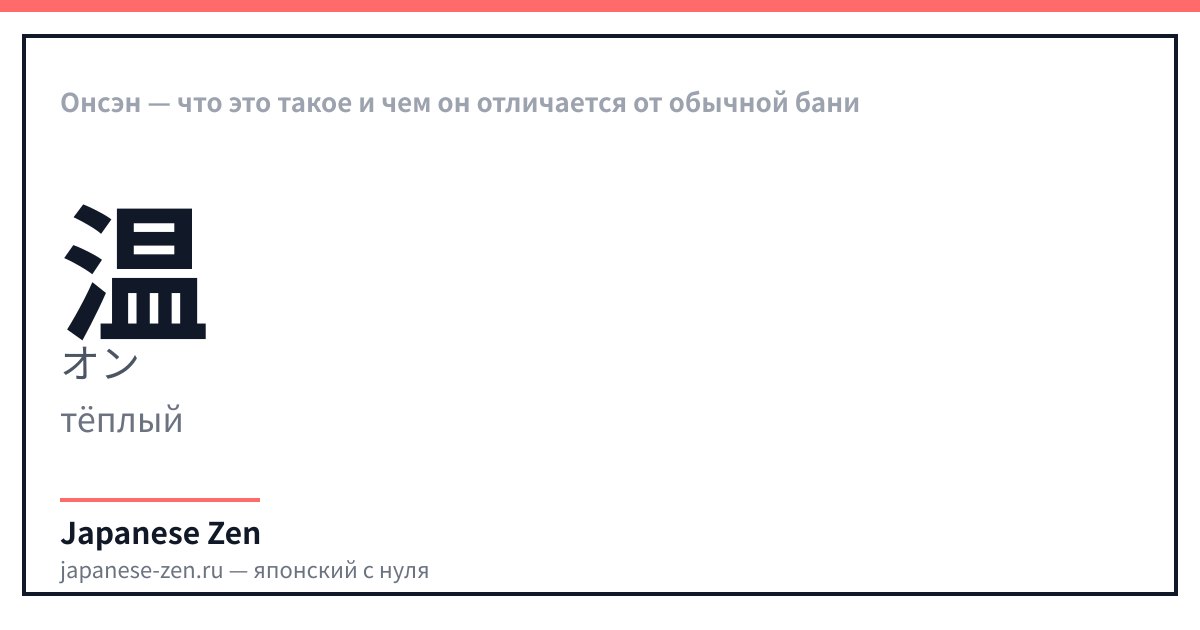
温 — warm: the character that begins the word "onsen"
温 — значение: warm — онъёми: オン — кунъёми: あたた.か、あたた.かい、あたた.まる、あたた.める、ぬく — 12 штрих(ов). 温 — "warm": the first character in 温泉, "warm spring." The same character appears in 温度, "temperature," and in 温かい, "warm" about food or to the touch.
温 is read on in compound words, and as a standalone adjective it is atatakai. 温度 (ondo) is "temperature" in the most general sense, while 気温 (kion) is specifically "air temperature." There is also the homophone 暖かい: it is read the same way, atatakai, but written with a different character — it more often describes warm weather, while 温かい is reserved for food, drinks, and touch.
泉 — a spring apart from "warm"
The second character in 温泉, 泉, by itself means "spring, source" and is read sen in compound words, izumi as a standalone word. Without the first character, 泉 says nothing about temperature: a cold spring in the forest is called by the same character as the hot spring of an onsen — only 温 makes the difference.
| Japanese | Reading | Translation |
|---|---|---|
| 温泉 | onsen · onsen | Onsen, hot spring |
| 温度 | ondo · ondo | Temperature |
| 温かい | atatakai · atatakai | Warm (about food, to the touch) |
| 気温 | kion · kion | Air temperature |
| 泉 | izumi · izumi | Spring, source |
Write 温 along the guides — the character for "warm," with which the word "onsen" begins.
FAQ
- What is an onsen?
- A natural hot spring and the bathing facility built at it. In Japan, onsen status has been established by a separate law since 1948 — it is not just an everyday word for any hot water, but a precise legal category with its own conditions for temperature and composition.
- Which spring counts as an onsen by law?
- One whose water is at least 25 degrees Celsius where it emerges from the ground, or one whose composition contains at least one of nineteen substances from a separate list in the law — for example, chloride ion or sulfur. Meeting one of the two conditions is enough.
- How does an onsen differ from a sento?
- A sento is an urban public bathhouse where ordinary tap water is usually heated; an onsen is a spring of natural origin that meets the conditions of a separate law. Legally these are different categories, although some sento do indeed draw water from real onsen.
- Can an onsen be cold?
- Formally, yes: if the water is colder than 25 degrees but contains at least one of the nineteen substances from the law's list in the required amount, the spring is still recognized as an onsen. In practice, most bathhouses still heat the water before it goes into the bath.
- What is toji?
- 湯治 (toji) is an old custom of staying at a spring for a long time for one's health, bathing regularly for a week or longer. Today it is no longer the main reason to go to an onsen, but the word and the inns designed for such long stays have survived.
- How is "onsen" written in kanji?
- 温泉, read おんせん. 温 means "warm," 泉 means "spring, source": together, "warm spring." Without the first character, the second says nothing about temperature — a cold spring in the forest is called by the same 泉 as the hot spring of an onsen.
Sources
Updated: 2026-09-15