Samurai Tattoo — What It Means and Which Kanji Are Used
The samurai tattoo is a common motif: a warrior in armor and menpo mask, katana, sometimes a demon or wave in the background. The kanji 侍 'samurai' is also tattooed separately, but it is often confused with similar-meaning signs — 武士道, 忠, 誠 — and the writing is ruined at the sketch stage.
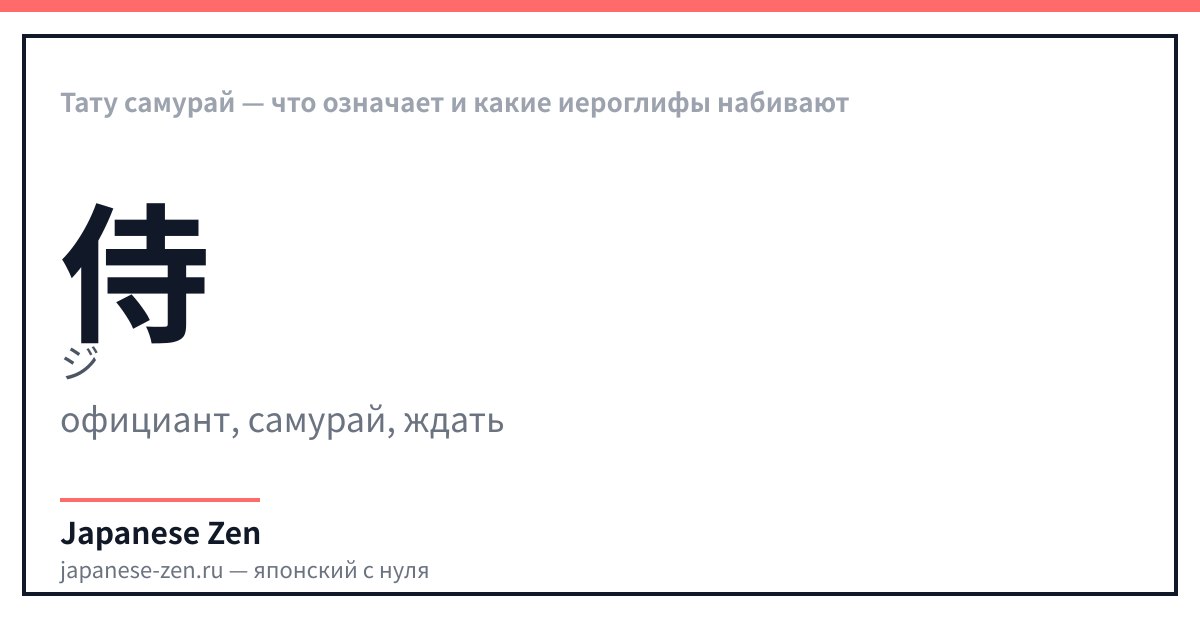
Most people ordering a 'samurai kanji' actually ask for one of three different signs — 侍, 武士道, or 忠 — and do not distinguish their meanings.
What a Samurai Tattoo Means
A samurai tattoo is not a portrait of a specific historical warrior, but a collective image: a figure in armor, a menpo mask covering half the face, a katana in hand. The motif is read as a wish — for fortitude, honor, and readiness to go to the end. Men more often get the full figure, women — the same image, but with the addition of a flower or fan.
- Figure in full armor with katana — warrior valor and protection, the most common option.
- Menpo mask alone, without the body — the same meaning more compactly, on the forearm or shin.
- Samurai against a wave — resilience before the elements, often paired with the motif of 'The Great Wave off Kanagawa'.
- Samurai with a chrysanthemum — a combination of strength and noble origin: the chrysanthemum is historically associated with the imperial house.
- Samurai and an oni demon in a pair — a story about confronting an external or internal enemy.
- A composition of several figures — three or five samurai in a row — is read as a squad or brotherhood, not as a sign with a hidden number.
Attributes Matter More Than Portrait Likeness
The composition is usually chosen for its meaning, not for portrait likeness: unlike portrait tattoos, here the set of attributes — armor, mask, weapon — is more important than historical accuracy. Irezumi masters compose the motif as a single scene, not as a separate small icon.
Name and Kanji: 侍
侍 — значение: waiter, samurai, to wait, to serve — онъёми: ジ、シ — кунъёми: さむらい、はべ.る — 8 штрих(ов). 侍 — 'to serve, to wait on': this was the name for armed servants of noble houses, and later for the warrior class as a whole. The most common request for a tattoo labeled 'samurai'.
| Japanese | Reading | Translation |
|---|---|---|
| 侍 | samurai · samurai | Samurai, servant (the most common request for a tattoo) |
| 武士道 | bushidō · bushidō | Way of the Warrior (asked for less often, but confused with 侍) |
| 忠 | chū · chū | Loyalty |
| 誠 | makoto · makoto | Sincerity |
| 誠実 | seijitsu · seijitsu | Conscientiousness, honesty (sometimes confused with 誠 when choosing a sketch) |
Which Signs Are Most Often Mistaken
Besides 侍, people ask for 武士道 ('way of the warrior'), 忠 ('loyalty'), and 誠 ('sincerity') — and it is on these that mistakes are most often made. They are ruined in four ways. The sign is mirrored, simply flipping the sketch horizontally. It is placed 'upside down' due to incorrect orientation in the layout. The stroke order is drawn incorrectly — this is immediately noticeable to a native speaker. And the meaning is substituted: a similar-looking kanji with a different meaning is tattooed. Checking the spelling with a translator or native speaker before the session is cheaper than removing the tattoo later.
Write 侍 along the guides and check the stroke order — before taking the sketch to the master.
How the Japanese School Differs from the European Sketch
The Japanese irezumi school builds the tattoo as a single composition over the whole body or a large area — figure, background, water, clouds — and rarely makes a separate small icon. The European 'samurai' sketch, on the contrary, is more often compact: a bust portrait or a single kanji without a background. Both approaches are common, but they are different traditions: one works with the body as a canvas, the other with a separate picture.
- Irezumi — a large composition, often on the back, entire arm, or thigh, with a background: wave, clouds, wind.
- European sketch — a compact portrait or a single sign, without a mandatory background.
- Traditional tebori technique (hand poking) — longer and more expensive than machine work.
- In the Japanese school, they rarely do only a kanji without a motif: a bare sign without a composition is considered unfinished.
Honest Advice: How Not to Ruin a Kanji
If the sketch contains a kanji — 侍, 忠, 誠, or any other — ask the master to show a sample of the writing and, if possible, check with a translator or native speaker before the session. A mirrored sign, reversed stroke order, or confused meaning can only be corrected later with a new tattoo over the old one.
Samurai Tattoos in Anime and Games
Tattoo artists and clients often look to specific images from pop culture — here are some sources of this visual language.
- 'Samurai Champloo' — a stylized figure of a warrior with a sword, a recognizable silhouette for such a motif.
- 'Rurouni Kenshin' — the image of a swordsman with a scar on his face, recognizable worldwide.
- The game 'Ghost of Tsushima' — detailed armor and menpo mask, a notable visual reference of recent years.
- The game 'Sekiro: Shadows Die Twice' — the protagonist's prosthetic arm and mask sometimes appear in sketches separately from the full figure.
FAQ
- What does a samurai tattoo mean?
- A collective image of a warrior in armor with a katana — a symbol of fortitude, honor, and readiness to go to the end, not a portrait of a specific historical person.
- Which kanji are most often requested for a samurai tattoo?
- 侍 'samurai', 武士道 'way of the warrior', 忠 'loyalty', and 誠 'sincerity'. These are the most common requests and the most common sources of spelling errors.
- How do you write 'samurai' in Japanese?
- 侍, read as 'samurai'. The sign originally meant 'to serve, to wait on' and over time became the designation of the warrior class.
- What does a tattoo of 3 or 5 samurai mean?
- A composition of several identical figures is a popular variant of the same motif: warriors in a row are read as a squad or brotherhood. The number usually means nothing special, except for the symmetry of the composition on the body.
- How does the Japanese tattoo school differ from the European sketch?
- Irezumi builds a large composition with a background over the whole body or a large area, while the European sketch is more often compact — a portrait or a single sign without a background.
- How to avoid mistakes with a kanji tattoo?
- Check the spelling with a translator or native speaker before the session: a mirrored sign, reversed stroke order, or confused meaning can only be corrected with a new tattoo over the old one.
Sources
Updated: 2026-08-29