Samurai — who they really were and what they looked like
A samurai (侍) is not a movie hero but a military class of Japan: those who from the 12th century served the nobility with weapons, received land or a stipend in return, and followed a code of loyalty to their lord. The class was abolished after the Meiji Restoration in the 1870s. Any authentic photo of a samurai was taken in the 1860s–1870s, at the very twilight of the era, and such images show that the real warrior did not look like the cinematic one.
It seems that a samurai is a character from anime with a perfect hairstyle and shining armor. Real photographs taken shortly before the abolition of the class show far more ordinary people — with tired faces and worn-out equipment.
Who were the samurai and what did they do
The samurai were a military service class that took shape by the 12th century with the rise of military rulers, the shoguns. Their service consisted of defending the lord's lands, participating in wars, and, during the peaceful Edo period from the 17th century, administrative duties: tax collection, maintaining order, and clerical work. In return for service, a samurai received a rice stipend or a land grant.
- Duties: military service, guard duty, and in peacetime — administration and clerical work.
- Income: a rice stipend from the lord; for the highest ranks, their own lands.
- Status: a hereditary class, second in nobility after the court aristocracy.
- Status symbol: the right to wear two swords — the katana and the wakizashi; this was forbidden to other classes.
The class was inherited, not chosen
In the vast majority of cases, it was by birth: a samurai's son inherited his father's status. Transition from peasants and merchants into the samurai class was possible but rare — through adoption by a childless samurai or as a reward for exceptional service.
One of the first to photograph late samurai Japan extensively was the Italo-British photographer Felice Beato: his photographs from the 1860s remain one of the few direct visual sources of what samurai actually looked like shortly before the abolition of the class.
Women samurai and Yasuke — a foreigner in service
Women warriors from samurai families were called onna-bugeisha (女武芸者): they were skilled in weapons, most often the naginata — a polearm with a curved blade — and in rare cases defended the home or castle when the men were away on campaign. A separate figure is Yasuke: an African brought to Japan in 1579 and taken into service by the warlord Oda Nobunaga, who gave him a status close to samurai. This is not a legend: mentions of him exist in Japanese chronicles of the era.
- Onna-bugeisha — women from samurai families trained in weapons to defend the home.
- The term 'onna-musha' (女武者) is broader and includes all fighting women of that era, not just the noble.
- Yasuke served Oda Nobunaga as a weapon-bearer and bodyguard — evidence of him survives in Japanese and European sources.
The word and the kanji: 侍
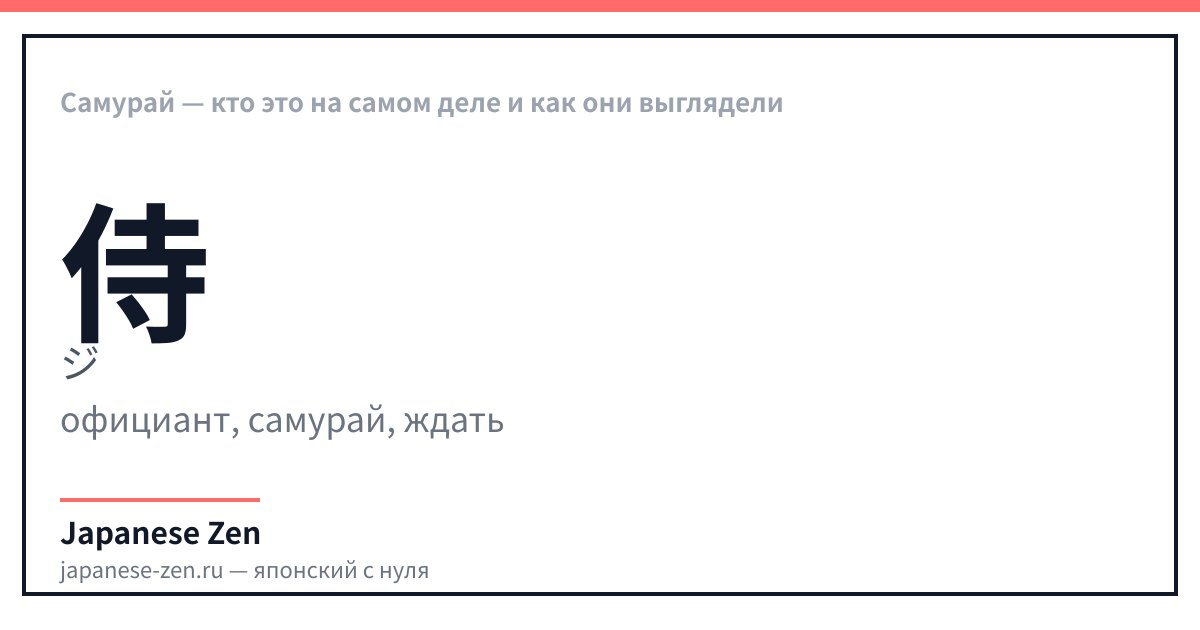
侍 — значение: waiter, samurai, to wait upon, to serve — онъёми: ジ、シ — кунъёми: さむらい、はべ.る — 8 штрих(ов). 侍 — 'to serve': 8 strokes. On the left is the radical 'person' 亻, on the right 寺 — a reference to the idea of service. Literally 'one who serves', not 'warrior': the meaning is broader than commonly thought.
| Japanese | Reading | Translation |
|---|---|---|
| 侍 | samurai · samurai | Samurai |
| 武士 | bushi · bushi | Warrior, the entire military class |
| 刀 | katana · katana | Long samurai sword |
| 脇差 | wakizashi · wakizashi | Short companion sword |
| 鎧 | yoroi · yoroi | Armor |
Types of samurai swords and their names
A samurai usually had not one weapon but a set. The katana (刀) is a long curved sword, the main weapon. The wakizashi (脇差) is a short companion sword for close combat and as a backup weapon. The tanto (短刀) is a dagger, part of the everyday set. The tachi (太刀) is an earlier and longer predecessor of the katana, worn with the blade facing down. The nodachi (野太刀) is a heavy two-handed sword for infantry and fighting against cavalry.
Listen to the word samurai and related terms — the app will evaluate your pronunciation.
Are there samurai today?
As a class, the samurai ceased to exist in the 1870s: the Meiji reforms abolished class privileges, banned the wearing of swords in daily life in 1876, and replaced the samurai army with a conscript one. Many former samurai became officials, entrepreneurs, or military officers of the new model — some modern Japanese surnames trace back to samurai clans, but the samurai as an active status does not exist today.
Samurai in anime and dramas
The on-screen samurai is almost always more handsome and decisive than the historical prototype — to the point that photos from the 1870s sometimes disappoint viewers who expected to see someone else.
- 'Samurai Champloo' — a free stylization of samurai Japan, not a historical reconstruction.
- 'Rurouni Kenshin' — a samurai hero of the Meiji era, the plot is centered precisely on the abolition of the class.
- 'Afro Samurai' — the image of a black warrior in samurai settings, more a reference to the legends of Yasuke than to his real biography.
The samurai-bureaucrat instead of the hero with a sword
Cinema almost never shows the samurai-bureaucrat with papers instead of a sword, yet this was the main occupation of the class during the peaceful Edo era, which lasted almost 250 years.
FAQ
- Who are the samurai?
- A military service class of Japan that took shape by the 12th century: in exchange for military service to a lord, a samurai received a stipend or land and followed a code of loyalty.
- What did the samurai do?
- They fought, defended the lord's lands, and during the peaceful Edo period mainly performed clerical work: tax collection, oversight, and office service.
- Do real photos of samurai exist?
- Yes. Authentic photographs of samurai were taken in the 1860s–1870s, at the twilight of the class — they show that the real appearance was far more mundane than the cinematic one.
- Were there women samurai?
- Yes, onna-bugeisha — women from samurai families trained in weapons, most often the naginata, to defend the home in the absence of men.
- Is it true that Oda Nobunaga had an African samurai in his service?
- Yes, this is a confirmed historical fact: Yasuke, brought to Japan in 1579, received a status close to samurai in the service of Oda Nobunaga.
- How do you write the word 'samurai' in Japanese?
- 侍, in kana さむらい. The character is composed of the radical 'person' 亻 and the element 寺; literally it means 'one who serves'.
- How many types of samurai swords are there and what is the difference?
- There are five main ones: katana (刀), wakizashi (脇差), tanto (短刀) — a dagger, tachi (太刀) — an earlier long sword, and nodachi (野太刀) — a heavy two-handed sword.
Sources
Updated: 2026-08-28