The Way of the Samurai — What It Really Means
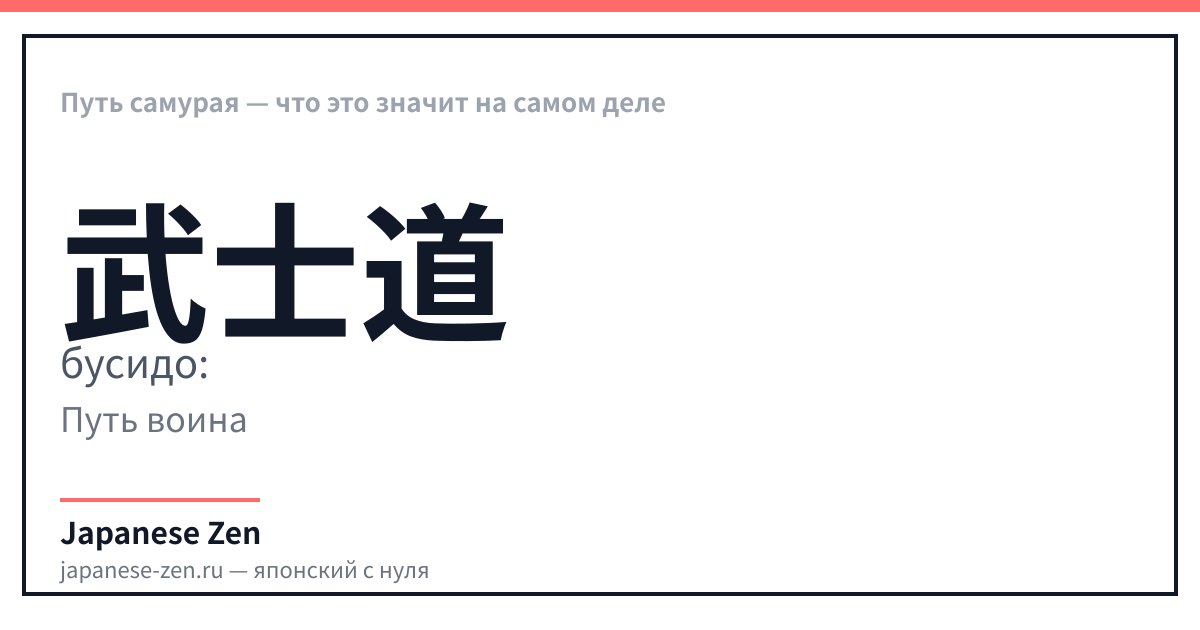
"The Way of the Samurai" is a colloquial translation of the word 武士道 (bushidō), which literally means "the way of the warrior class": 武士 — warrior, bushi, 道 — way. It is not a set of written laws, but a collective concept of duty, loyalty, and honor that was shaped into a coherent "code" only during the Meiji era — largely thanks to a book written for a Western audience.
Bushidō is often spoken of as an ancient code of rules with paragraphs. No such text existed in medieval Japan — the idea of a "code" was largely constructed retroactively, half a century after the samurai were gone.
What "the way of the samurai" means
武士道 (bushidō) literally translates as "the way of the warrior," more precisely — "the way of the bushi," the class from which the samurai came. 武士 — "warrior, man of service," 道 — "way," the same character as in judo (柔道) and calligraphy-shodō (書道): a practice that becomes a lifelong discipline, not just a set of skills. The difference between "the way of the samurai" and mere rules of conduct is that the way has no endpoint — it must be practiced constantly, not learned once.
| Japanese | Reading | Translation |
|---|---|---|
| 武士道 | bushidou · bushidō: | The Way of the Warrior |
| 道 | michi · michi | Way, road |
| 義 | gi · gi | Duty, justice |
| 忠義 | chuugi · chūgi | Loyalty to one's lord |
Why "the way of the warrior" is not the whole meaning
The exact translation "the way of the bushi" sounds unusual, so "the way of the samurai" stuck — using the more recognizable word. The semantic shift is small: 侍 (samurai) historically refers to the upper echelon of the 武士 (bushi) class, so the translation does not distort the essence, only shifts the emphasis. What the word "bushidō" itself means and where it came from is covered on a separate page.
Kanji breakdown: 武士道
道 — значение: road, street, district, journey, course — онъёми: ドウ、トウ — кунъёми: みち、いう — 12 штрих(ов). 道 — "way": 12 strokes, N4 level. Bottom-left is ⻌ "to go along a road," top-right is 首 "head." In 武士道 (bushidō) it means not a road, but a practice that becomes a lifelong discipline. The character 武 is not in the database, so we break down 道 specifically.
What the character 武士道 is made of
The image is simple: a person moves along a road, led by the head — hence the transition from the literal "road" to "life's calling." The same character appears in 剣道 (kendō, "the way of the sword") and 茶道 (sadō, "the way of tea"): the suffix 道 turns an activity into a discipline with no final point.
Note: the "road" at the bottom-left is written last.
The book "Bushidō: The Soul of Japan"
The modern image of "the way of the samurai" as a coherent code of honor was shaped not by a Japanese text, but by the book "Bushidō: The Soul of Japan." It was written in English in 1900 by Nitobe Inazō, a Japanese educator and diplomat. He wrote for a Western audience that asked how Japan taught morality without religion. That is where the list of seven bushidō virtues comes from — duty (義), courage (勇), benevolence (仁), politeness (礼), sincerity (誠), honor (名誉), and loyalty (忠義): in Japan itself, no code of rules with such a list existed before this book.
What the West added
In the Japanese tradition, ideas of duty and loyalty really existed, but were scattered: in the household codes of individual clans, in Buddhist and Confucian ideas, in the oral practice of service. The coherent "seven-point code" is a systematization from Nitobe's book, later picked up and popularized. This does not mean the ideas were invented — it means they were compiled into a list retroactively, already in the Meiji era, when the samurai as a class no longer existed.
What "Hagakure" says about this
Another source of ideas about "the way of the samurai" is "Hagakure" (葉隠), records of the reflections of the samurai Yamamoto Tsunetomo from the early 18th century. From there comes the most quoted phrase about bushidō: 武士道と云は死ぬ事と見付たり — "The way of the samurai is death." The phrase is not about a desire to die, but about a way of making decisions: if you act as if your life is no longer yours, hesitation disappears, and the choice becomes quick and honest. A detailed breakdown of the book and the context of the phrase is on a separate page about "Hagakure."
What this means in context
In Nitobe, a similar idea sounds softer — as a readiness to sacrifice the momentary for duty, not as a cult of death. Both sources agree on one thing: the "way" is a constant inner composure, not a set of prohibitions.
Common misconceptions about the way of the samurai
- "Bushidō is the translated name of a single code of laws" — no, there was no single text; ideas were formed from various sources.
- "The seven virtues are an ancient list" — it is a systematization from Nitobe's 1900 book, not a text from the samurai era.
- "The way of the samurai" and "Hagakure" are the same thing" — no, "Hagakure" is just one of the sources, along with Nitobe's book and clan codes.
- "Bushidō is heard at every turn in Japan" — in practice, the word is bookish and rarely used in everyday speech.
FAQ
- What does "the way of the samurai" mean?
- A colloquial translation of 武士道 (bushidō) — "the way of the warrior," more precisely "the way of the bushi." A collective concept of duty and honor, not a single written code.
- How is "the way of the samurai" written in kanji?
- 武士道, in kana ぶしどう. 武士 — warrior, 道 — way: the same character as in judo (柔道) and shodō (書道).
- Where did the idea of the bushidō code come from?
- Largely from the book "Bushidō: The Soul of Japan" by Nitobe Inazō from 1900, written in English for a Western audience. The list of seven virtues comes from there, not from medieval texts.
- What does "Hagakure" say about the way of the samurai?
- "The way of the samurai is death" — the phrase is not about a desire to die, but about decisiveness: to act without hesitation, as if life has already been given.
- Is it true that bushidō is an ancient written code?
- No, a single text with such a list of rules did not exist in feudal Japan. The coherent "code" is largely a reconstruction from the Meiji era.
- How does "the way of the samurai" differ from the meaning of the word "bushidō"?
- Not at all in essence — "the way of the samurai" is simply a translation of 武士道. A breakdown of the word itself and the history of the term is on the page "What does bushidō mean."
Sources
Updated: 2026-08-24