Hagakure — what kind of book is it and what it is about
Hagakure (葉隠, 'Hidden in the Leaves') is a collection of reflections by the samurai Yamamoto Tsunetomo, dictated by him in 1709–1716 and recorded by the junior samurai Tashiro Tsuranomo. The book was not published during the author's lifetime and circulated in manuscripts after his death. The most famous phrase from it is 'The Way of the Samurai is death.'
The paradox of the book lies in who wrote it and when: a retired samurai who spent his final years as a monk in the peaceful Edo period, when there was no one left to fight — and it was he who left the harshest text about readiness to die.
What is 'Hagakure' and who wrote it
'Hagakure' is not a book in the usual sense, but a record of conversations. The samurai Yamamoto Tsunetomo served the Nabeshima clan on the island of Kyushu, and by 1709 he had already retired and taken monastic vows. For seven years he dictated his thoughts on service, honor, and death to the young samurai Tashiro Tsuranomo. Yamamoto himself did not edit the book or prepare it for publication — that was done for him by the student who recorded his words.
- Author of the sayings: Yamamoto Tsunetomo, former vassal of the Nabeshima clan.
- Recorded by: Tashiro Tsuranomo, a junior samurai of the same clan.
- When: 1709–1716, oral conversations, not a text written in one sitting.
- Publication: not published during the author's lifetime, circulated in manuscripts among the clan's samurai.
Why the book was not published
Yamamoto explicitly asked to destroy the records after reading — he considered them too personal and not intended for outsiders' eyes. Tashiro disobeyed, and the manuscript began to circulate in copies within the clan; wide fame beyond Nabeshima came to 'Hagakure' only in the 20th century. The book contains eleven scrolls in total: the first two are Yamamoto's general reflections on duty and service, the rest are stories and anecdotes about the samurai of the Nabeshima clan that he cited as examples.
How the book was rediscovered in the 20th century
A special role in the fame of 'Hagakure' was played by the writer Yukio Mishima: in 1967 he published a commentary book 'Hagakure Nyumon', in which he analyzed Yamamoto's ideas and confessed to a long personal attachment to this text. Three years later, Mishima himself committed seppuku — a coincidence that has since been invariably mentioned alongside the history of the book.
'The Way of the Samurai is death': what the phrase means
The opening thought of the book — 武士道と云は死ぬ事と見付たり, 'The Way of the Samurai is death,' — is the most quoted line of 'Hagakure' and at the same time the most misunderstood. It is not a call to seek death, nor a glorification of sacrifice for its own sake. Yamamoto explains the attitude differently: if at any moment of choice you keep in mind the readiness to die, hesitation disappears and the decision is made quickly and honestly. It is about composure in the face of risk, not a cult of death.
The paradox of the book
It was written in the most peaceful era in the entire history of the samurai class: after the unification of the country by Tokugawa and almost a century without major wars, combat experience became rare, and the very profession of the warrior increasingly reduced to bureaucratic service. Yamamoto wrote about readiness to die in a battle that objectively had nowhere to come from — partly for this reason his text is read as nostalgia for the passing warrior spirit, not only as an instruction.
The title and characters: 葉隠
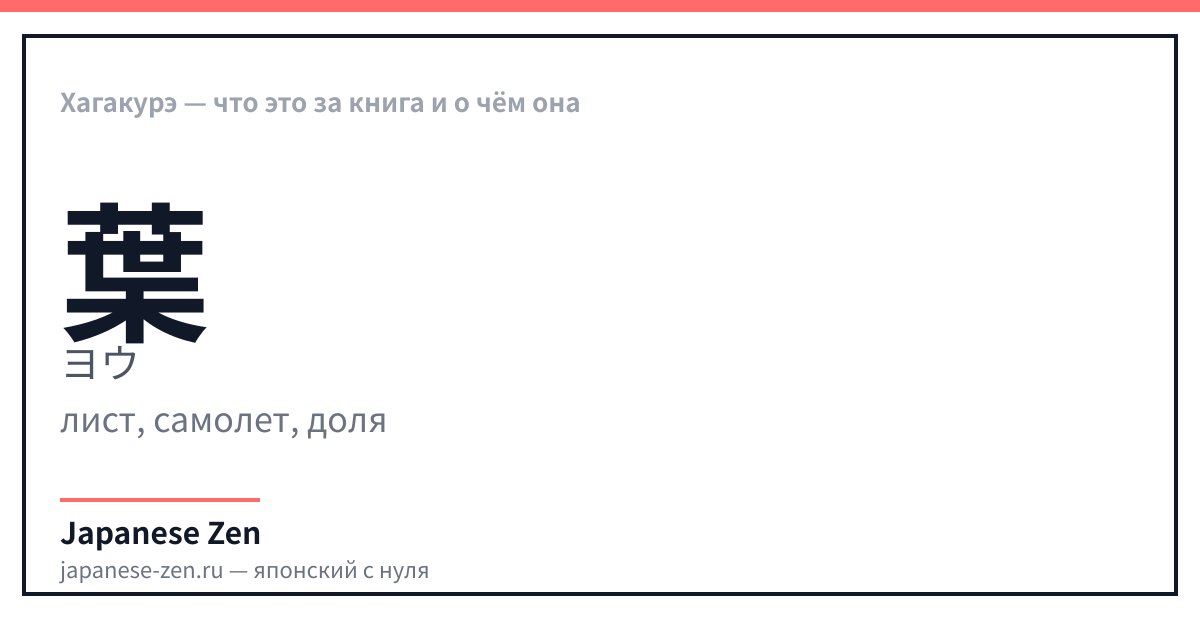
葉 — значение: leaf, plane, share, needles, blade — онъёми: ヨウ — кунъёми: は — 12 штрих(ов). 葉 — 'leaf'. In combination with 隠 'hidden, concealed' gives 葉隠 — 'hidden in the leaves', an image of quiet, non-public knowledge.
| Japanese | Reading | Translation |
|---|---|---|
| 葉隠 | hagakure · hagakure | Title of the book, 'hidden in the leaves' |
| 山本常朝 | Yamamoto Tsunetomo · Yamamoto Tsunetomo | Author of the sayings |
| 武士道 | bushidou · bushidou | The Way of the Warrior — central theme of the book |
| 忠義 | chuugi · chuugi | Loyalty to one's lord |
葉隠 — hidden in the leaves
葉隠 is composed of 葉 'leaf' and 隠 'hidden, concealed'. According to one version, the title refers to a line of classical poetry about a flower hidden in the foliage — an image of humble, non-public service without striving for fame.
Listen to the title of the book and the author's name — the app will evaluate your pronunciation.
'Hagakure' in anime and games
There are no direct adaptations of the book, but it is quoted and referenced in works about samurai as a symbol of ultimate resolve.
- 'Ghost Dog: The Way of the Samurai' (1999) — not an anime, but a live-action film by Jim Jarmusch, built entirely on quotes from 'Hagakure' that the main character reads in voice-over.
- 'Afro Samurai' and 'Samurai Champloo' reference the book's ideas through the theme of readiness for death as part of the code, without quoting it directly.
- In the games of the Ghost of Tsushima series, the atmosphere and monologues about duty echo the tone of 'Hagakure', although the developers do not use direct quotes.
FAQ
- What is 'Hagakure'?
- 葉隠 — a collection of reflections by the samurai Yamamoto Tsunetomo on service, honor, and death, dictated by him in 1709–1716 and recorded by his student Tashiro Tsuranomo.
- Who wrote 'Hagakure'?
- The sayings belong to Yamamoto Tsunetomo, a former vassal of the Nabeshima clan; they were recorded by the junior samurai Tashiro Tsuranomo.
- What does the phrase 'The Way of the Samurai is death' mean?
- It is not a call to seek death, but an attitude of keeping in mind the readiness to die at any moment of choice — then the decision is made without hesitation.
- Was the book published during the author's lifetime?
- No, 'Hagakure' circulated in manuscripts within the clan after Yamamoto's death — he himself asked to destroy the records.
- How is 'Hagakure' written in Japanese?
- 葉隠, in kana はがくれ. 葉 — 'leaf', 隠 — 'hidden': 'hidden in the leaves'.
- Why was the book written in a peaceful era when there was no one to fight?
- That is the paradox: the author is a retired samurai of the Tokugawa era, when there had been no major wars for almost a century. The text is read partly as nostalgia for the passing warrior spirit.
Sources
Updated: 2026-08-24