Japanese Mythology: Books — Where to Start Reading
It all starts with two chronicles: the Kojiki (712) and the Nihon Shoki (720) — that's where Japanese mythology first appeared on paper, and any book on the subject relies on them in one way or another. Next come collections like the Konjaku Monogatari-shū with tales of spirits, and Toriyama Sekien's illustrated encyclopedias of yōkai — that's no longer myth, but a catalog of creatures.
In practice, 'reading Japanese mythology' means choosing between two different genres: the official court chronicle or a folk collection of tales — and these are two very different kinds of reading.
Which Books Are Considered the Most Important
| Book | Characters | Known For |
|---|---|---|
| Kojiki | 古事記 | the oldest chronicle, 712: myths about the gods and the first emperors |
| Nihon Shoki | 日本書紀 | chronicle of 720 for external prestige, several versions of each myth |
| Konjaku Monogatari-shū | 今昔物語集 | a huge 12th-century collection: Buddhist parables mixed with tales of spirits |
| Toriyama Sekien's illustrated encyclopedias | 画図百鬼夜行 | 18th century, systematized and drew hundreds of yōkai |
| Gaki-zōshi | 餓鬼草紙 | illustrated 12th-century scroll about hungry ghosts |
Chronicle or collection of tales: where the line is drawn
The main boundary is between official mythology and folk folklore. The Kojiki and Nihon Shoki were written by the court and justify the power of the imperial dynasty. Everything else — later private compilations that recorded oral traditions about yōkai and spirits — has nothing to do with state ideology.
Where to Start Reading
- Kojiki — if you're interested specifically in the mythology of the gods: a coherent text without repetitions, the default book #1.
- Nihon Shoki — if you're curious to compare several versions of the same myth in a row.
- Toriyama Sekien's encyclopedias — if you want not myths, but specific yōkai with illustrations.
- Konjaku Monogatari-shū — if you prefer short tales and parables over a continuous narrative.
The Character 書 in the Titles of the Main Books
| Japanese | Reading | Translation |
|---|---|---|
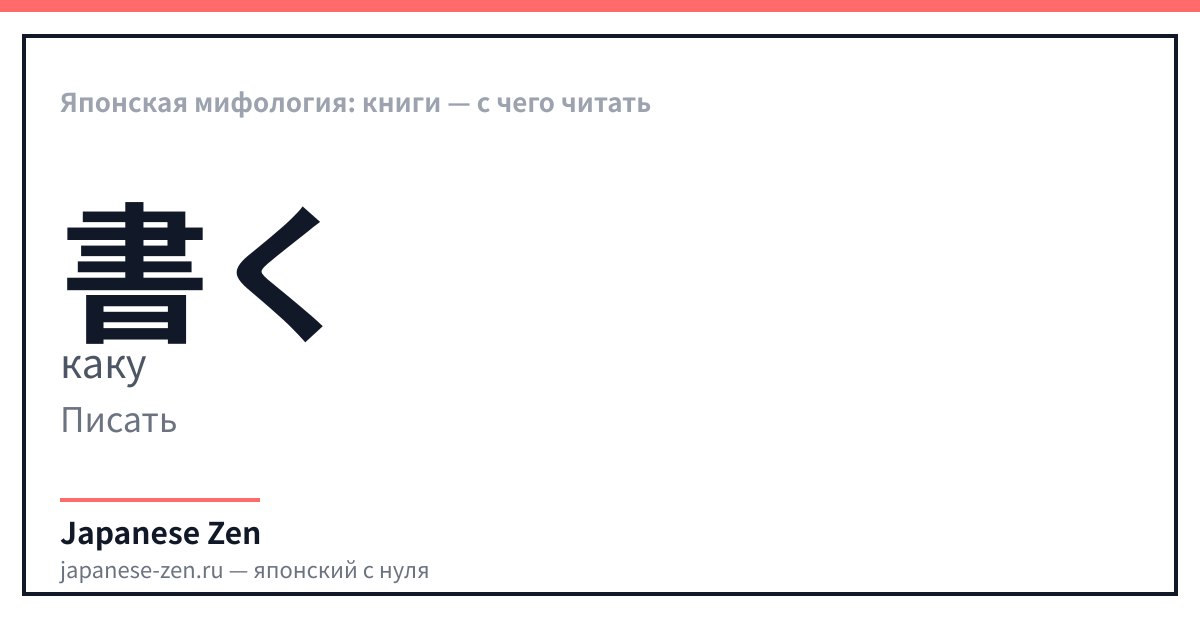
| 書く | kaku · kaku | To write |
| 物語 | monogatari · monogatari | Tale, narrative |
| 集 | shū · shū | Collection, anthology |
| 絵巻 | emaki · emaki | Illustrated scroll |
| 全集 | zenshū · zenshū | Complete works |
| 口伝 | kuden · kuden | Oral transmission of a tradition |
How 書 is read and what else it is used to write
書 (sho, 'to write, book') appears in both titles of the main chronicles — 日本書紀 and in the very word 'book' 図書 (tosho, 'illustrations and books', from which 図書館 — library). Noticing this character, you can safely assume that it refers to a written source.
書 — значение: to write — онъёми: ショ — кунъёми: か.く、-が.き、-がき — 10 штрих(ов). 書 — 'to write, book': at the top is the brush 聿, at the bottom — the sun/inkstone 日. The same character appears in 図書館 (library) and 辞書 (dictionary).
Write 書 along the guides and learn the stroke order.
Which Anime Retell These Books
- Ōkami — the plot practically retells the first scroll of the Kojiki in game form.
- Natsume's Book of Friends — in spirit, closest to Toriyama Sekien's encyclopedias: a catalog of individual creatures, not a single myth.
- Many historical anime set in the Heian period quote tales from the Konjaku Monogatari-shū as separate inserted episodes.
- Naruto borrows names and images directly from the Kojiki without explicitly referencing the source.
FAQ
- How many main books about Japanese mythology are there in total?
- There are not many main, frequently cited sources — the Kojiki and Nihon Shoki as chronicles, plus several collections like the Konjaku Monogatari-shū. Hundreds of retellings and studies have already been written based on them.
- Which book is the most famous?
- The Kojiki is the oldest and most cited chronicle of Japanese mythology, written in 712. Its status grew especially after the analysis by the scholar Motoori Norinaga in the 18th century.
- How is this related to the Japanese language?
- The character 書 ('to write, book') appears in the titles of both main chronicles and in the word 'library' (図書館). Analyzing classical texts also teaches archaic, now rare kanji readings.
- Where should I start reading?
- With the Kojiki — it is the most coherent and complete text among all sources, without the repeated variants of one myth as in the Nihon Shoki.
- Which anime are based on these books?
- Direct quotes are rare, but plots and names from the Kojiki underlie Ōkami, and the format of Toriyama Sekien's yōkai encyclopedia is recognizable in Natsume's Book of Friends.
Sources
Updated: 2026-08-29