Japanese Mythology in Art — Where and How It Was Depicted
Ukiyo-e prints with gods and yokai, Noh theater masks like hannya, temple screens with gods of thunder and wind, illustrated emaki scrolls with terrifying stories — this is where Japanese mythology and art converge most closely. The image is often the main source of a creature's appearance: texts about the appearance of many yokai simply have not survived.
For many Japanese mythological creatures, the artist was not an illustrator but effectively the author: how a demon or spirit looks was often decided by a single carver or engraver, not by centuries of oral tradition.
Which art forms depict mythology
| Form | Kanji | Known for |
|---|---|---|
| Ukiyo-e (woodblock print) | 浮世絵 | Mass-produced Edo graphic art: gods, yokai, legendary heroes |
| Noh theater masks | 能面 | Hannya and other demon and spirit masks for the stage |
| Emaki (scrolls) | 絵巻 | Illustrated narratives like 'Gaki-zoshi' |
| Temple painting | 襖絵 | Screens and sliding doors with gods and guardians |
| Yokai encyclopedias | 画図百鬼夜行 | Systematized bestiary by Toriyama Sekien |
Temple and market: the purpose of the images
The main difference is purpose. Temple art and Noh masks were created for ritual and stage, while ukiyo-e and yokai encyclopedias were made for mass sale to townspeople. It is the second, commercial line that most often gave rise to the stable, widely reproduced images of creatures that are recognized in anime today.
Where to start looking
- The screen 'Fujin Raijin zu' by Tawaraya Sotatsu — the most famous work with the gods of thunder and wind, a national treasure.
- Toriyama Sekien's encyclopedias — if you are interested in a unified-style yokai bestiary.
- The hannya mask — if you want to understand how emotion is conveyed through a static object.
- 'Gaki-zoshi' — an illustrated scroll about hungry ghosts, a rare example of a Buddhist subject in mythological art.
The character 話: myth as a 'story about gods'
| Japanese | Reading | Translation |
|---|---|---|
| 話 | hanashi · hanashi | Tale, story |
| 浮世絵 | ukiyo-e · ukiyo-e | 'Pictures of the floating world' — a genre of woodblock prints |
| 描く | egaku · egaku | To depict, to draw |
| 彫刻 | chōkoku · chōkoku | Carving, sculpture |
| 屏風 | byōbu · byōbu | Folding screen |
| 国宝 | kokuhō · kokuhō | National treasure |
How 話 is read and where it appears
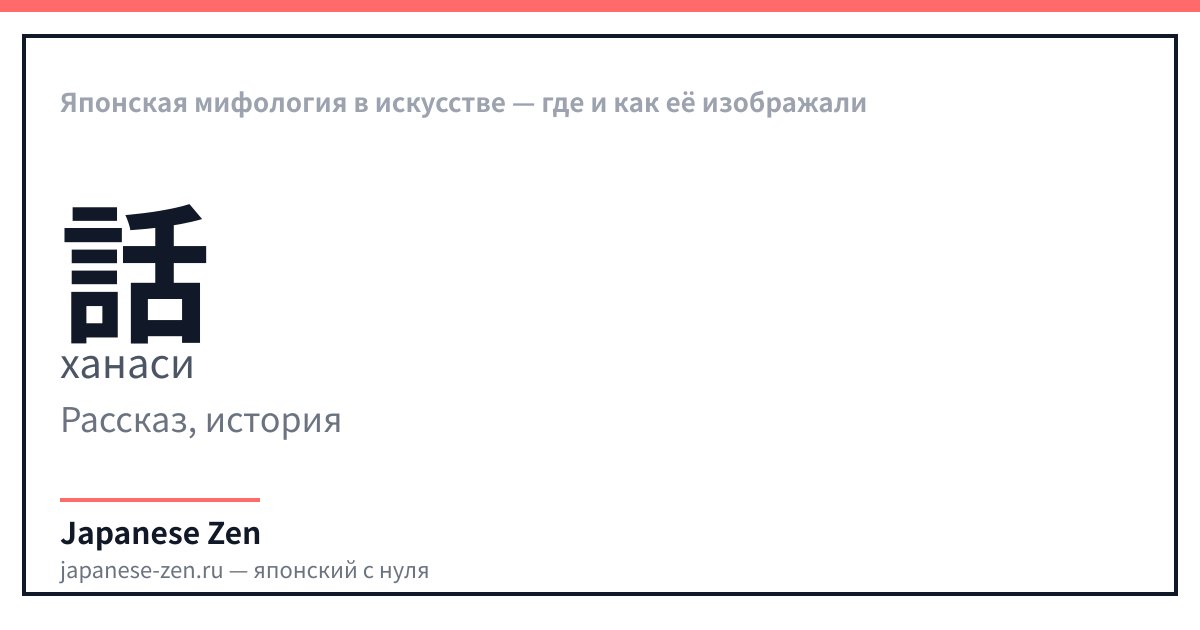
話 (hanashi/wa, 'tale, story') is part of the word 神話 (shinwa, 'myth' — literally 'story about gods') and 昔話 (mukashibanashi, 'old tale'): almost any Japanese word about narrative is built around this character.
話 — значение: tale, talk — онъёми: ワ — кунъёми: はな.す、はなし — 13 штрих(ов). 話 — 'to speak, tale': on the left is speech 言, on the right the phonetic 舌 'tongue'. The same character appears in 神話 (myth) and 電話 (telephone).
Write 話 along the guides and break down the stroke order.
How anime continues this visual tradition
- 'Natsume's Book of Friends' — the visual style of spirits directly inherits the tradition of illustrated emaki.
- Many anime about yakuza and horror use the hannya mask as a direct quote from Noh theater.
- 'Demon Slayer' — the animation style of battle scenes is inspired by ukiyo-e composition.
- Historical dramas about gods regularly recreate the composition of temple screens in the frame.
FAQ
- How many directions are distinguished in this art?
- Five main ones: ukiyo-e prints, Noh theater masks, illustrated emaki scrolls, temple painting, and yokai encyclopedias — each with its own audience and purpose.
- What is the most famous work?
- The screen 'Fujin Raijin zu' by Tawaraya Sotatsu depicting the gods of thunder and wind is one of the most quoted works in the history of Japanese art, recognized as a national treasure.
- How is this related to the Japanese language?
- The character 話 ('tale') is the basis of the word 神話 (myth) itself and dozens of words about narrative — from fairy tales 昔話 to telephone 電話, which also fundamentally 'conveys speech'.
- Where should I start?
- With Toriyama Sekien's encyclopedias — they provide a visual, systematized dictionary of yokai, from which it is convenient to move on to more complex forms like theatrical masks.
- How is this tradition visible in anime?
- Most often through direct quotation: the hannya mask, the composition of ukiyo-e prints, and the style of illustrated emaki scrolls are recognizable in character design and shot staging.
Sources
Updated: 2026-08-29