Giri — the debt of honor in Japan: from Chikamatsu to "obligation chocolate"
Giri (義理) is the Japanese concept of duty and obligation: if someone has helped you or shown you respect, you are obliged to repay in kind, proportionately and without delay. For centuries, Japanese theater has shown this side of life — in Chikamatsu's plays, duty argues with love. Anthropologist Ruth Benedict, in The Chrysanthemum and the Sword (1946), distinguished giri from on (恩): on is the benefit received, giri is the obligation to return it.
Let's look at the precise meaning of the Japanese concept of duty, the conflict between giri and feelings in the plays of the dramatist Chikamatsu Monzaemon, and what chocolate has to do with it — chocolate that in Japan is given on February 14 not out of affection, but out of politeness.
Giri — a debt you cannot simply not pay
Giri (義理) is the Japanese concept of duty and obligation to another person: if you have been helped, done a favor, or shown respect, you are obliged to respond in kind, and proportionately. Dictionaries define it more broadly — as the right path to follow in relations with people, not just a specific debt for a specific favor.
How giri differs from on (恩)
Anthropologist Ruth Benedict in The Chrysanthemum and the Sword (1946) distinguished these concepts as follows: on is the favor or benefit itself that a person has received and remains indebted for. Giri is the obligation to repay that debt, and to do so precisely, not "someday and somehow." In other words, on is what you were given, giri is what you now owe.
Duty versus love: giri and ninjō in Chikamatsu
The conflict between giri and ninjō (人情, "human feelings") is one of the main themes of Japanese puppet theater jōruri and kabuki of the 18th century, and it was most vividly shown by the playwright Chikamatsu Monzaemon. In the play Shinjū Ten no Amijima (心中天網島, 1720), the paper merchant Jihei is torn between duty to his wife Osan and love for the courtesan Koharu. Osan, out of feminine duty to Koharu, tries to buy her out of the pleasure house herself, and in the finale the couple decides to end their lives and dies in different places — also out of giri toward Osan.
What Ruth Benedict wrote about giri
Benedict divided giri into two types. The first is "duty to the world": obligations to one's lord, family, elders, and for gifts and favors received. The second is "duty to one's name," that is, the need to wash away an insult or suspicion of failure. Benedict's model is the view of an American anthropologist of the war years, and Japanese scholars have repeatedly argued with her simplifications.
From "obligation chocolate" to one's mother-in-law: giri in everyday life
The most famous modern example is 義理チョコ (girichoko), chocolate that women give to colleagues and bosses on Valentine's Day not out of romantic interest, but out of politeness. The custom developed gradually, and confectionery companies promoted it starting in the 1980s. Giri also appears in related words: 義理の母 — mother-in-law, 義理の父 — father-in-law, since the prefix 義理 marks kinship not by blood but by marriage.
Why "out of obligation" does not mean "insincerely"
Girichoko and similar gestures are easy to mistake for cold formality, but for many Japanese people it is not deception but an ordinary part of politely maintaining relationships — like a birthday card to a colleague. Giri does not cancel personal affection; it simply exists alongside it, not instead of it.
理: "order" inside the word "giri"
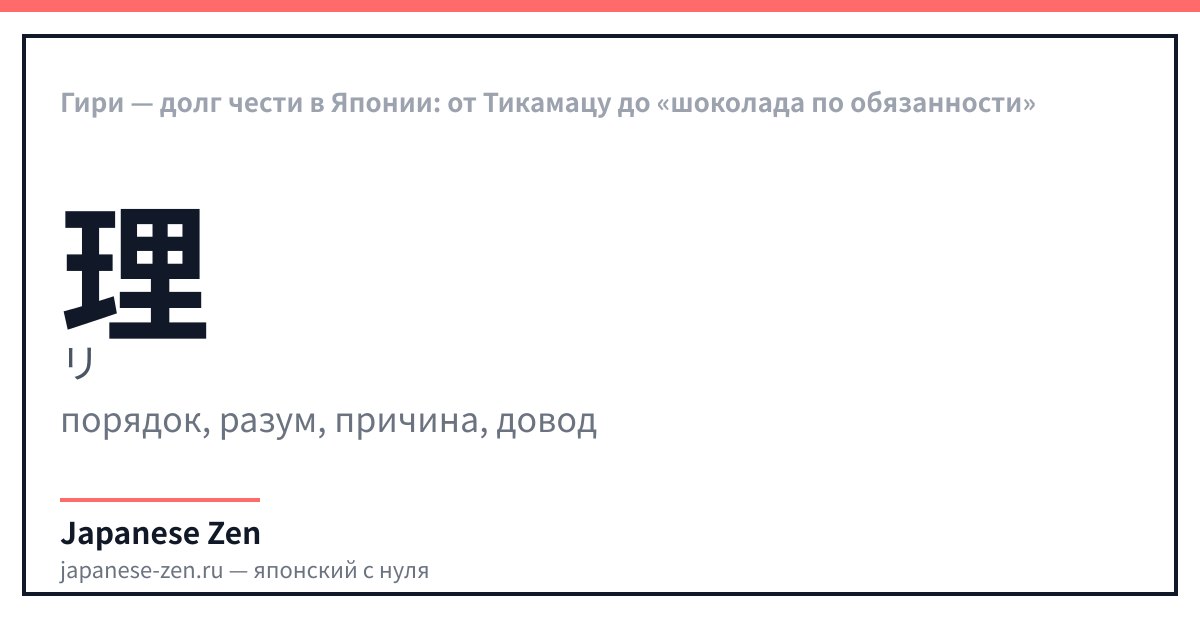
理 — значение: order, reason, cause, ground — онъёми: リ — кунъёми: ことわり — 11 штрих(ов). 理 — "order, reason": the same character also appears in the much more everyday word 理由 (riyū) "reason." The second character of the word giri explains the first — 義 "justice, debt of honor": together 義理 means "the right order of duty," not a random feeling.
義 and 理: justice plus order
The on'yomi of 理 is リ (ri), and in 義理 it is pronounced exactly so: gi-ri. The kun'yomi ことわり is rarer and means "reason, ground." The first character of the word, 義, besides "debt of honor" is also translated as "justice." The same meaning is seen in 義務 (gimu) "duty, obligation" — but that is duty in general, by law or by office, not to a specific person, as with giri.
| Japanese | Reading | Translation |
|---|---|---|
| 義理 | giri · giri | A debt that must be repaid |
| 人情 | ninjō · ninjō | Human feelings — what often argues with giri |
| 義理チョコ | girichoko · girichoko | Chocolate given out of obligation, not love |
| 義理の母 | giri no haha · giri no haha | Mother-in-law — kinship not by blood |
Write 理 along the guides — the character of "order," without which the Japanese word "giri" cannot do.
FAQ
- What is giri in Japanese culture?
- Giri (義理) is duty and obligation to another person: if you have been done a favor or shown respect, you are expected to respond in kind, proportionately and in good time. The concept is broader than a single case — it is the right way of behaving in relations with people in general, not a one-time thank-you.
- How does giri differ from the Japanese concept of on (恩)?
- According to anthropologist Ruth Benedict, on is the favor or benefit itself that a person has received, while giri is the obligation to repay it, precisely and within a specific time, not whenever it happens. On is what you were given, giri is what you now must do in return.
- How is giri shown in the plays of Chikamatsu Monzaemon?
- In the play Shinjū Ten no Amijima (1720), the merchant Jihei is torn between duty to his wife Osan and love for the courtesan Koharu. Osan, out of giri, tries to buy out her rival herself, and in the finale the heroes die in different parts of the city — also out of giri toward the abandoned wife.
- What is "girichoko" on Valentine's Day?
- 義理チョコ — chocolate that women in Japan give to colleagues and bosses on February 14 not out of romantic interest, but out of politeness. The custom developed gradually, and confectionery companies promoted it since the 1980s; today alongside it there is also 友チョコ — chocolate for female friends.
- How is the word "giri" written in kanji?
- 義理, read ぎり: 義 "justice, debt of honor" and 理 "order, reason." Together the characters add up to "the right order of duty" — not a random feeling, but what one is supposed to follow in relations with people.
- Is giri the same as strict discipline?
- No, they are different things: discipline is about rules and self-control, while giri is about obligations to specific people that arise from a favor received, kinship, or position. Discipline can be observed alone, but giri always presupposes someone to whom you are indebted.
Sources
Updated: 2026-09-15