Omotenashi — Japanese hospitality: what おもてなし means and why it's not just service
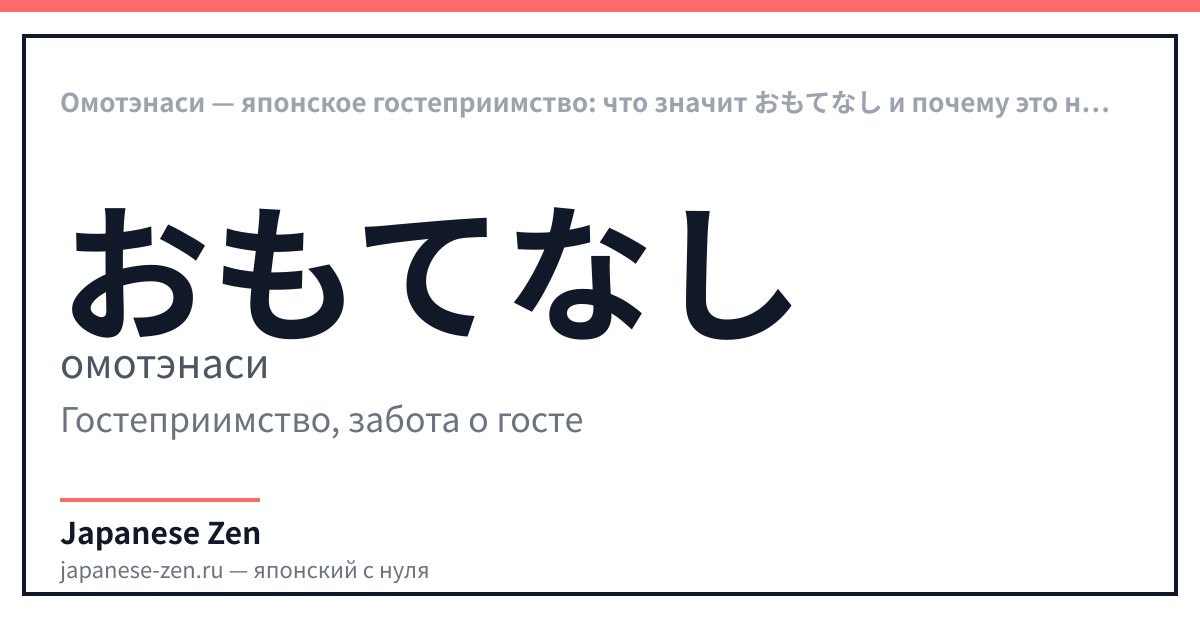
Omotenashi (おもてなし) is Japanese hospitality: the art of welcoming a guest and anticipating their needs without being asked and without expecting thanks. It's not service for a tip — tipping isn't done in Japan — but a manner of attentiveness that works the same way in a hotel, a café, or at a friend's home.
The word became known worldwide in 2013, when TV presenter Christel Takigawa pronounced it syllable by syllable with a gesture at the presentation of Tokyo's Olympic bid. But the word itself is far older than that speech and that bid. Let's look at where it actually comes from, how its kanji spelling breaks down, and why it's not the same as polite service for money or tipping.
Omotenashi: care you don't ask for
おもてなし (o-motenashi) — the polite prefix お- plus もてなす "to receive, to entertain, to care for a guest." The meaning of the word is to anticipate a person's needs before they ask, and to do so without expecting a reward. A similar spirit existed long before tourism in the Buddhist tradition of o-settai (お接待): along the pilgrimage route on the island of Shikoku, locals feed and shelter henro pilgrims for free. Ordinary service gives what is ordered; omotenashi is attention beyond that list.
Why "hospitality" is not quite an exact translation
"Hospitality" and "care" convey only part of the meaning: in English these are words about an attitude, while おもてなし is also about a concrete action performed for the guest silently, without announcing it out loud. The closest is "anticipated care" — attention you don't ask for, because it's supposed to be noticed on its own.
| Japanese | Reading | Translation |
|---|---|---|
| おもてなし | omotenashi · omotenashi | Hospitality, care for a guest |
| もてなす | motenasu · motenasu | To receive, to entertain a guest |
| 一期一会 | ichigo ichie · ichigo ichie | Once in a lifetime, one meeting (the motto of the tea ceremony, from which the spirit of omotenashi is often derived) |
| 心遣い | kokorozukai · kokorozukai | Care, attentiveness to another |
| お客様 | okyakusama · okyakusama | Respectful "guest, customer" |
持て成す: what lies behind the word おもてなし
持 — значение: to hold, to carry, to have on oneself — онъёми: ジ — кунъёми: も.つ、-も.ち、も.てる — 9 штрих(ов). 持 — "to hold": the verb もてなす is written as 持て成す — "to hold" (持) plus "to accomplish" (成). おもてなし is the polite form of the same word, almost always written in hiragana.
From "to behave" to "to entertain a guest"
The verb もてなす is written as 持て成す: 持 "to hold" and 成 "to accomplish, to do." In old texts it meant "to hold oneself, to behave," then "to treat a person, to care for them," and only later "to receive and entertain a guest warmly." Today the kanji spelling is rare: both in everyday life and in official texts the word is almost always written in hiragana as おもてなし.
Write 持 along the guides — the sign "to hold," from which the verb "motenasu," "to receive a guest," is built.
"No reverse side" and tips: myths about omotenashi
- "Omotenashi means 'no reverse side' (表無し)." This is folk etymology: the word is linked to 表 "front side," hinting at sincerity without ulterior motive. Dictionaries trace it to the verb もてなす "to treat, to receive a guest" with the polite prefix お-.
- "Omotenashi is service for a tip." In Japan tipping is not customary in a restaurant, a taxi, or a hotel. The care called omotenashi is part of the service from the start or offered entirely for free.
- "The word was invented specifically for the 2020 Olympics." もてなす appears as early as The Kagerō Diary (蜻蛉日記, around 974) — then in the sense "to hold oneself, to behave." The meaning "to entertain a guest warmly" is noted by dictionaries from The Tale of the Heike (13th century). The 2013 Olympic bid gave the word not birth, but worldwide fame.
FAQ
- What does the word "omotenashi" mean?
- Omotenashi (おもてなし) is Japanese hospitality: care for a guest in which the host anticipates their needs in advance and does not expect a reward. The word comes from the verb もてなす "to receive, to entertain" with the polite prefix お-, not from the idea of "no reverse side," as is sometimes written.
- How is "omotenashi" written in kanji?
- In kanji the verb もてなす is written 持て成す: 持 "to hold" and 成 "to accomplish." The word おもてなし itself is almost never seen in kanji — it is written in hiragana, and that is how the word is printed in modern Japanese texts, from hotel advertisements to official documents.
- How did the word omotenashi become known worldwide?
- On September 7, 2013, at a session of the International Olympic Committee in Buenos Aires, TV presenter Christel Takigawa pronounced "o-mo-te-na-shi" syllable by syllable with a gesture, presenting Tokyo's bid for the 2020 Olympics. The word received the top "Word of the Year" award for 2013 and spread around the world, though it is far older than that speech.
- Should you leave a tip for omotenashi?
- No: tipping is not customary in Japan, whether in restaurants, hotels, or taxis. The care called omotenashi is part of the service from the start or offered for free. If you leave money on the table, the waiter will most likely chase after the guest to return it.
- Is it true that the word omotenashi was invented for the Tokyo Olympics?
- No. The verb もてなす has been known since the 10th century, and the meaning "to entertain a guest warmly" is found by dictionaries in The Tale of the Heike (13th century). Christel Takigawa's speech in Buenos Aires in 2013 made the word famous outside Japan, but did not create it.
Sources
Updated: 2026-09-13