Ganbaru — what it means and why it's not just "try your best"
Ganbaru (頑張る) means "to persist, to try with all your might" — the most common verb of encouragement in Japanese speech. From it come 頑張って (ganbatte) — "hang in there, go for it", 頑張ります (ganbarimasu) — "I'll do my best", 頑張りましょう (ganbarimashō) — "let's do our best". The word has a flip side: the same demand to "try harder" underlies the overwork culture that Japan has been debating for decades.
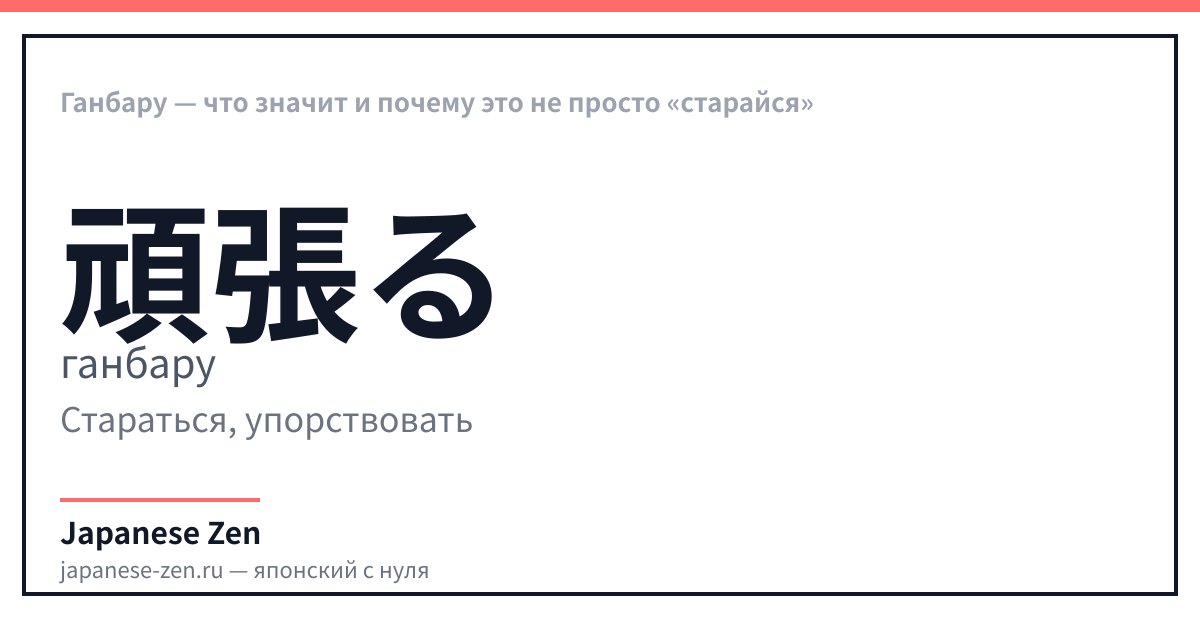
A word a Japanese person will say to you before an exam, after a layoff, and at the start of a marathon — and all three times it will be appropriate.
What "ganbaru" means
Ganbaru means not just "to try" but "to hold your ground and not give up". The verb carries a shade of stubbornness: to keep going even when circumstances are against you. Dictionaries give two possible etymologies — either from 眼張る "to fix one's gaze", or from 我に張る "to stand one's ground" — and the current spelling 頑張る, with the character for "stubborn", was chosen later for its sound. In practice it's the most common word of encouragement: it's what sees people off to work, to an exam, to surgery, and onto the stage. English "good luck" doesn't work here — the Japanese formula is not about luck but about effort.
| Japanese | Reading | Translation |
|---|---|---|
| 頑張る | ganbaru · ganbaru | To try hard, to persist |
| 頑張って | ganbatte · ganbatte | "Hang in there!", "Go for it!" |
| 頑張ります | ganbarimasu · ganbarimasu | "I'll do my best" |
| 頑張りましょう | ganbarimashō · ganbarimashō | "Let's do our best together" |
| 頑張れ | ganbare · ganbare | "Go!" — the blunt form shouted from the stands |
| お疲れ様です | otsukaresama desu · otsukaresama desu | "Thank you for your hard work" — the reply to effort |
How it differs from "to try" and how to write it in English
Neither "to try", nor "to endure", nor "to fight" works on its own. "To try" is too neutral; "to fight" adds an opponent that the verb doesn't have. The closest phrase is "to give it your all and not give up". A note on spelling: in romanization, the Japanese ん before b is often written n, but the sound is m, so the dictionary form is ganbaru while the inflected forms are usually written ganbatte, ganbarimasu. This variation is exactly where the inconsistency comes from, and both spellings are considered acceptable.
Ganbatte, ganbarimasu, ganbarimashō: who says what to whom
| Form | Spelling | To whom and when |
|---|---|---|
| ganbatte | 頑張って | to another person: "hang in there", "go for it". Neutral-friendly form, works almost anywhere |
| ganbatte kudasai | 頑張ってください | the same politely: to a client, a teacher, a not-close senior |
| ganbare | 頑張れ | blunt command: shouted at a stadium, said to a close friend; you wouldn't say it to your boss |
| ganbarimasu | 頑張ります | about oneself: "I'll do my best". The standard reply to encouragement and to a new task |
| ganbarimashō | 頑張りましょう | about us: "let's do our best". A commanding and inclusive tone — the speaker joins in with everyone |
| ganbatte iru | 頑張っている | about a third person: "he's doing his best". A statement, often with a note of sympathy |
When it's better not to say "ganbatte"
The formula implies that the addressee could put in more effort — and that's its weak spot. To someone who has already given everything, "ganbatte" sounds like a reproach: so you're not trying hard enough. This was discussed especially after the 2011 earthquake, when the slogan "Ganbarō, Nihon!" was heard everywhere, while victims said they had no effort left to give. In such cases Japanese people switch to other formulas: "muri shinaide" — don't overdo it, or "otsukaresama desu" — thank you for your hard work. A safe rule: ganbatte is said before a task, not after.
The character 頑: stubbornness inside diligence
頑 — значение: stubborn, obstinate — онъёми: ガン — кунъёми: かたく.な — 13 штрих(ов). 頑 (gan) — "stubborn, obstinate, thick-headed". On the left is 元 "origin, source", on the right 頁 "head". On its own the character is rather negative: 頑固 (ganko) — "stubborn". In 頑張る the same firmness becomes a virtue.
The second character, 張, means "to stretch, to pull taut" — like a bowstring or tent canvas; it's not part of our copybook set, so only 頑 can be practiced here. The combination is expressive: "to stubbornly pull taut". An important caveat — this spelling is ateji, meaning the characters were chosen to match an already existing sound rather than to compose the word by meaning. So there's no point looking for deep kanji philosophy in 頑張る: it's a common verb with a conveniently matching spelling.
Check the pronunciation of the forms ganbatte and ganbarimasu — they differ more by ear than in romanization.
What people wrongly attribute to this word
- "Ganbatte is the Japanese 'good luck'." No: "good luck" leaves the outcome to chance, while ganbatte places it on the addressee. A wish of good luck in Japanese sounds different — "go kōun o inorimasu" — and is almost never used in everyday life.
- "Ganbaru is an ancient philosophy of work." The word is everyday and relatively recent in its current meaning; it was turned into a philosophy by books about the Japanese miracle. In Japan itself it's simply the most common verb of encouragement.
- "Trying to the end is an absolute value." The flip side is discussed publicly: overwork culture, karoshi — death from overwork — as a recognized term, and government programs to limit overtime. The demand to "ganbaru" is exactly what stands behind this.
- "Ganbaru and gaman are the same thing." Gaman is about silently enduring unpleasantness, without action. Ganbaru is about acting despite resistance. The first is passive, the second active, and in a given situation a Japanese person will choose only one of the two.
FAQ
- What does "ganbaru" mean?
- Ganbaru means "to persist, to try with all your might, not to give up". It's the most common Japanese verb of encouragement: from it come ganbatte, ganbarimasu, and ganbarimashō, which are heard in speech a dozen times a day.
- How is "ganbaru" written in kanji?
- 頑張る, read がんばる. The character 頑 means "stubborn, obstinate", 張る — "to stretch". The spelling was chosen after the word already existed, so a literal breakdown of the characters explains only half the verb's meaning.
- How does "ganbatte" differ from "ganbarimasu"?
- By direction. Ganbatte is said to someone else — "hang in there, go for it". Ganbarimasu is said about oneself — "I'll do my best", usually in reply to encouragement or when given a task. Mixing them up is like answering "good luck" to "good luck".
- Why is "ganbaru" sometimes criticized?
- Because the formula implies that one could try even harder. To someone who has already given everything, it sounds like a reproach. The same logic props up the overwork culture for which Japanese has a separate word — karoshi.
- How does ganbaru differ from gaman?
- Gaman is to endure unpleasantness silently and without complaint — a passive state. Ganbaru is to exert effort despite resistance — an active state. In Japanese these are different words for different situations, and they are not interchangeable.
- How should you reply if someone says "ganbatte" to you?
- The usual reply is "ganbarimasu", meaning "I'll do my best". A more reserved option is "arigatō gozaimasu" — simply thank them. Replying with "ganbatte" in return is odd: it would mean you're encouraging the encourager.
Sources
Updated: 2026-09-05