Yūgen — what it means and why it isn't mysticism
Yūgen (幽玄) is an aesthetic category often translated as "profound grace" or "mysterious depth." It's about what isn't shown directly: geese hidden behind a cloud, a boat that has disappeared behind an island, an actor who doesn't play a feeling to the end. The term came from Chinese philosophical and Buddhist texts, took hold in waka poetics in the 12th–13th centuries, and became Zeami's key word about Noh theater.
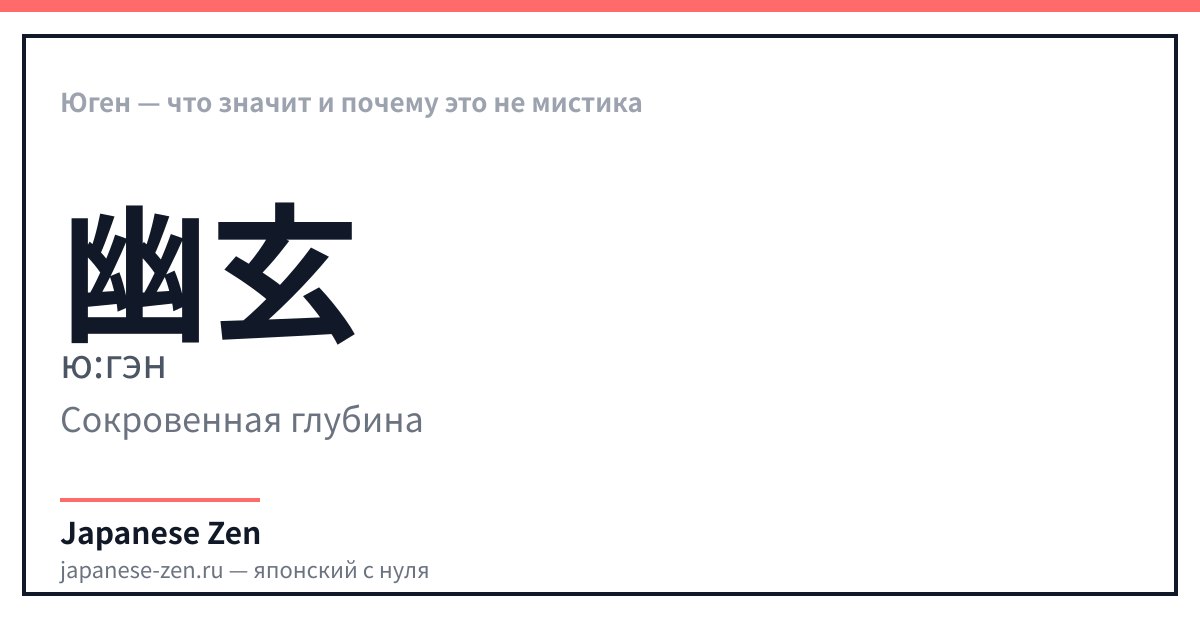
A category designed so that a detailed explanation slightly spoils it: yūgen is exactly what is lost when you say it all the way to the end.
What "yūgen" means
Yūgen is a quality of a thing or a performance in which the main point remains off-screen but is still felt. It's not a riddle to be solved, nor fog for beauty's sake: the point is that the part shown makes you feel the part not shown. The classic examples belong to the poet and monk Kamo no Chōmei and the theorist Zeami: an autumn sky without a single word about sadness; a boat that has disappeared behind a distant island; a deer crying somewhere beyond the hill. In waka poetics, yūgen became the main criterion for judging a poem; in Noh theater, it is the reason an actor holds back a movement rather than expanding it.
| Japanese | Reading | Translation |
|---|---|---|
| 幽玄 | yūgen · yūgen | Profound grace |
| 能 | nō · nō | Noh theater |
| 余情 | yojō · yojō | Lingering feeling, remaining mood |
| 奥深い | okubukai · okubukai | Deep, holding much within |
| 世阿弥 | zeami · zeami | Zeami — actor and theorist of Noh theater |
Why "profound grace" drifts toward mysticism
English renderings — "profound grace," "mysterious depth," "subtle profundity" — drift toward mysticism more than the original does. The phrase "profound grace" has stuck, and it works on one condition: remembering that 幽 means not "mystical" but "hidden, shadowed," and 玄 means "dark" in the sense of "indistinguishable because of depth," not "ominous." A working translation for reading: "a depth you see only by its edge." A note on spelling: in English texts you'll see both "yugen" and the more precise "yūgen" — the difference is only in how the long vowel is marked.
The characters 幽 and 玄: what's dark in them
幽 — значение: second, confine a room, deep, secluded, faint — онъёми: ユウ — кунъёми: ふか.い、かす.か、くら.い、しろ.い — 9 штрих(ов). 幽 (yū) — "hidden, otherworldly, faint." Inside the character 山 "mountain" stand two threads 幺幺: light tangled in the depths of a mountain gorge. The same character works in 幽霊 (yūrei) — "ghost."
玄 — значение: mysterious, occult, black, deep — онъёми: ゲン — кунъёми: くろ、くろ.い — 5 штрих(ов). 玄 (gen) — "dark, deep, profound." The character came from Daoist texts, where 玄 is the color of impenetrable depth; from the same root comes 玄関 (genkan) — an entryway, the "profound entrance" to a house.
Why together they give "depth"
Both characters mean roughly the same thing — "dark, indistinguishable" — and the doubling here works as intensification: not just hidden, but hidden so thoroughly that only its presence can be made out. The combination 幽玄 existed in Chinese Buddhist and Daoist texts long before Japan, where it meant the incomprehensible depth of the teaching. Japanese poetics took the word, removed the doctrine from it, and kept the quality of perception — and from the 12th century, 幽玄 became an evaluative word for critics, not philosophers.
Write 幽 along the guides: a mountain in which two threads of light have become tangled.
What yūgen actually doesn't contain
- "Yūgen is about mysticism and the otherworldly." The character 幽 does appear in the word for "ghost," but in 幽玄 it works as "shadowed." The category describes a way of showing, not the content of what is shown.
- "It's a Japanese feeling that Europeans don't have." The technique — hinting instead of stating — is universal; what's unique is not the emotion but the fact that Japanese poetics made it a separate criterion of evaluation with its own name.
- "Yūgen and wabi-sabi are roughly the same." They're different things: wabi-sabi values wear and simplicity of material, yūgen values understatement. A new, flawlessly smooth Noh mask can be yūgen and have nothing to do with wabi.
- "It's enough to be unclear, and you'll get yūgen." Understatement works only with precision: in Zeami, the actor holds back a movement knowing what it would be in full. Vagueness without mastery gives not depth but incoherence.
Yūgen, wabi-sabi, and mono no aware — how they differ
| Category | Characters | What it's directed at |
|---|---|---|
| Mono no aware | 物の哀れ | the observer's response: pity and tenderness for what is passing right now |
| Wabi-sabi | 侘寂 | the thing itself: simple, unassuming, with traces of time and wear |
| Yūgen | 幽玄 | what remains beyond what is shown: a hint instead of a depiction |
FAQ
- What does "yūgen" mean?
- Yūgen is an aesthetic category of "profound grace": the main point isn't shown directly but is made felt at the edge of what is shown. A boat behind an island, a deer's cry beyond a hill, a restrained gesture of a Noh actor.
- How is "yūgen" written in kanji?
- 幽玄, read as ゆうげん. Both characters mean "dark, hidden": 幽 is light tangled in a mountain gorge, 玄 is impenetrable depth from Daoist texts. The doubling intensifies: hidden so thoroughly that only its presence is perceptible.
- Where did this category come from?
- From Chinese philosophical and Buddhist texts, where 幽玄 meant the incomprehensible depth of the teaching. Japanese waka poetics picked up the word in the 12th–13th centuries as a criterion for judging a poem, and Zeami in the 15th century made it the central concept of Noh theater.
- How does yūgen differ from wabi-sabi?
- Wabi-sabi is about the quality of a thing: simplicity, unassumingness, traces of time. Yūgen is about the way it's presented: understatement behind which something greater is felt. A flawlessly new Noh mask can be yūgen, but in no way wabi.
- How is yūgen shown on the Noh stage?
- Through restraint. The mask doesn't change expression, movements are slowed and pared down, the pause lasts longer than is comfortable. The viewer completes the feeling themselves — and it is precisely this completion, according to Zeami, that is the goal of the performance.
- Which is correct — "yugen" or "yūgen"?
- "Yūgen" is more precise: the macron marks the long vowel in ゆう. The spelling "yugen" is also common in English and isn't considered an error. The Japanese writing is the same in both cases — 幽玄.
Sources
Updated: 2026-09-05