Visual kei: what "kei" means and why it's not a music genre
Visual kei (ヴィジュアル系) is not a music genre but a Japanese movement of the late 1980s where looks matter as much as sound: metal, punk and melodic pop coexist within it. The name is most often linked to the slogan "PSYCHEDELIC VIOLENCE CRIME OF VISUAL SHOCK" on X Japan's album "Blue Blood" (1989), though the founder of SHOXX also claims to have coined the term. The word "kei" (系) is an ordinary suffix meaning "type, direction".
It's easy to mistake visual kei for a genre: it seems that if there's makeup and costumes, the music must be uniform too. In reality, metal bands, punk and melodic pop coexisted under one banner, united only by their approach to the stage. Let's look at where the album that first gave rise to the term came from, what the suffix 系 (kei) does to any Japanese word, and why the letter "v" in katakana is unusual.
Looks that matter more than sound
Visual kei (ヴィジュアル系) is a Japanese movement in rock music where the performers' appearance — elaborate makeup, extravagant costumes, dyed and styled hair — is an independent part of the image, not an accessory to the music. Because of this, visual kei is often mistaken for a music genre, but that's a mistake: metal, punk, gothic rock and melodic ballads coexist within the movement, and what unites the bands is their approach to appearance, not their sound.
Who bangyaru are and why it's not just about the stage
The movement developed its own audience with its own name: female fans are called bangyaru (バンギャル), male fans are called gyao (ギャ男). Many fans dress in the style of their favorite band or the musicians themselves, carrying elements of the stage look into everyday life — that's how this aesthetic spread far beyond the music itself.
The album Blue Blood and the disputed origin of the term
The origin of the term is most often linked to the album "Blue Blood" by the band X (renamed X Japan in 1992) — it was released on April 21, 1989 and became the band's major debut. The album cover features the slogan "PSYCHEDELIC VIOLENCE CRIME OF VISUAL SHOCK"; it's believed that these words, "visual shock", gave the movement its name. Bands with striking makeup existed before — since the late 1970s, among them the heavy metal band 44MAGNUM and the prog rock band NOVELA — but they didn't yet have a name for this phenomenon.
The version of the founder of SHOXX magazine
There's another account of the word's origin. Hoshiko Seiichi, who launched SHOXX magazine in 1990, claims that he himself came up with the subtitle "ヴィジュアル&ハードショック・マガジン" ("visual and hard shock magazine"), drawing on the words of guitarist hide, and that before that the phenomenon was called something simpler — "o-keshō-kei", "the made-up type". Both versions converge around 1989–1990; the word only became truly widespread in 1997, at the height of the band SHAZNA's popularity.
Among the bands whose connection to visual kei is confirmed by sources are X Japan, BUCK-TICK, LUNA SEA, L'Arc~en~Ciel. They play completely different music, from heavy metal to melodic rock, and that's the best proof that visual kei is not a sound but a shared language of image.
系 — the suffix that sticks to anything
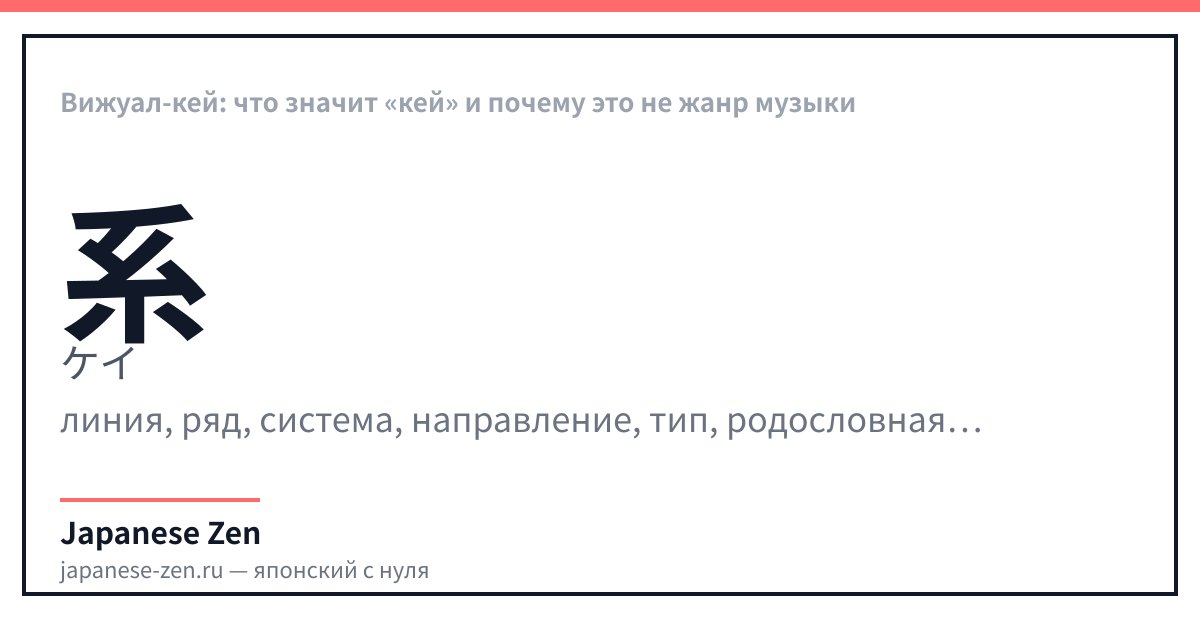
系 (kei) is one of the hardest-working suffixes in Japanese: it means "line, row", and in colloquial speech it turns into "type, direction" and sticks to almost any word. 理系 (rikei) — "science type", literally "natural-science type"; 文系 (bunkei) — "humanities type"; 体育会系 (taiikukaikei) — a person with the mannerisms of a school sports team captain, disciplined and a bit straightforward. The word 草食系 (sōshokukei) "herbivore type", used for men with a non-aggressive manner in relationships, is built on the same model.
What 系 (kei) means — and why "visual" is already Japanese
系 is read けい (kei) and means "system," "style," or "school" — the suffix Japanese uses to name a whole genre family, the way ロック系 (rokku-kei) means "rock style" and オカルト系 (okaruto-kei) means "occult style." The word "visual" in "visual kei" isn't a plain English word either — it's a Japanese loanword from English, spelled ヴィジュアル (vijuaru), combined with the native suffix 系. Written in Latin letters, the genre is "visual kei," following standard Hepburn romanization.
系 — the line that became a type
系 — значение: line, row, system, direction, type, lineage, origin — онъёми: ケイ — 7 штрих(ов). 系 — the suffix "type, direction", which is attached to any word: 理系 "science type", 草食系 "herbivore type" and the term ヴィジュアル系 itself are all built on the same model.
Other words with 系
The on'yomi of 系 is ケイ (kei); the character has no kun'yomi. Besides the suffix, 系 appears on its own in 系統 (keitō) "system, line of origin", 家系 (kakei) "lineage, family line" and 日系 (nikkei) "of Japanese origin" — that's what people of Japanese descent outside Japan are called, for example.
| Japanese | Reading | Translation |
|---|---|---|
| ヴィジュアル系 | vijuaru-kei · vijuaru-kei | Visual kei — looks matter more than genre |
| 系 | kei · kei | The suffix "type, direction" |
| 理系 | rikei · rikei | Science type, natural sciences |
| 文系 | bunkei · bunkei | Humanities type, humanities |
| 化粧 | keshō · keshō | Makeup |
Write 系 along the guides — the suffix "type, direction" that no discussion of Japanese subcultures can do without.
FAQ
- Is visual kei a music genre?
- No: it's a Japanese movement where appearance — makeup, hairstyle, costume — is as important as the music, and the sound within it varies widely, from metal to melodic pop. What the bands share is their approach to the stage, not a set of chords or a tempo.
- Where did the name "visual kei" come from?
- It's most often linked to the album "Blue Blood" by the band X (later X Japan), released on April 21, 1989: the cover featured the slogan "PSYCHEDELIC VIOLENCE CRIME OF VISUAL SHOCK". There's another version too: the founder of SHOXX magazine claims that he himself came up with the subtitle containing this word around 1990.
- What does the suffix 系 ("kei") mean?
- 系 (kei) literally means "line, row", and in colloquial speech it works as the suffix "type, direction": 理系 — "science type", 文系 — "humanities type". The name of the movement itself, ヴィジュアル系, "visual type", is built on the same model.
- Which bands are considered visual kei?
- Sources name X Japan, BUCK-TICK, LUNA SEA and L'Arc~en~Ciel — even though they play completely different music, from heavy metal to melodic rock. That's exactly why visual kei is described through appearance rather than genre: the only thing the bands share is their approach to the stage.
- What does the "kei" in "visual kei" actually mean?
- 系 is read けい (kei) and means "system, style, direction" — a suffix Japanese uses to name genres and subcultures, as in ロック系 ("rock style") or オカルト系 ("occult style"). "Visual" itself is a Japanese loanword from English, ヴィジュアル (vijuaru); together they form ヴィジュアル系, romanized as "visual kei."
Sources
Updated: 2026-09-15