Music in Japanese: 音楽 (ongaku) — writing, readings, and words
Music in Japanese is 音楽 (ongaku), a word made of two characters: 音 "sound" and 楽 "joy, pleasure." Together they give "sound that brings joy" — a definition through experience, not through notes or instruments. The second character 楽 has two readings: "gaku" in the word for music and "raku" meaning "easy, pleasant" — 楽 (raku) "relief," 気楽 (kiraku) "casualness." The same character describes sound, pleasure, and ease — three meanings on one root.
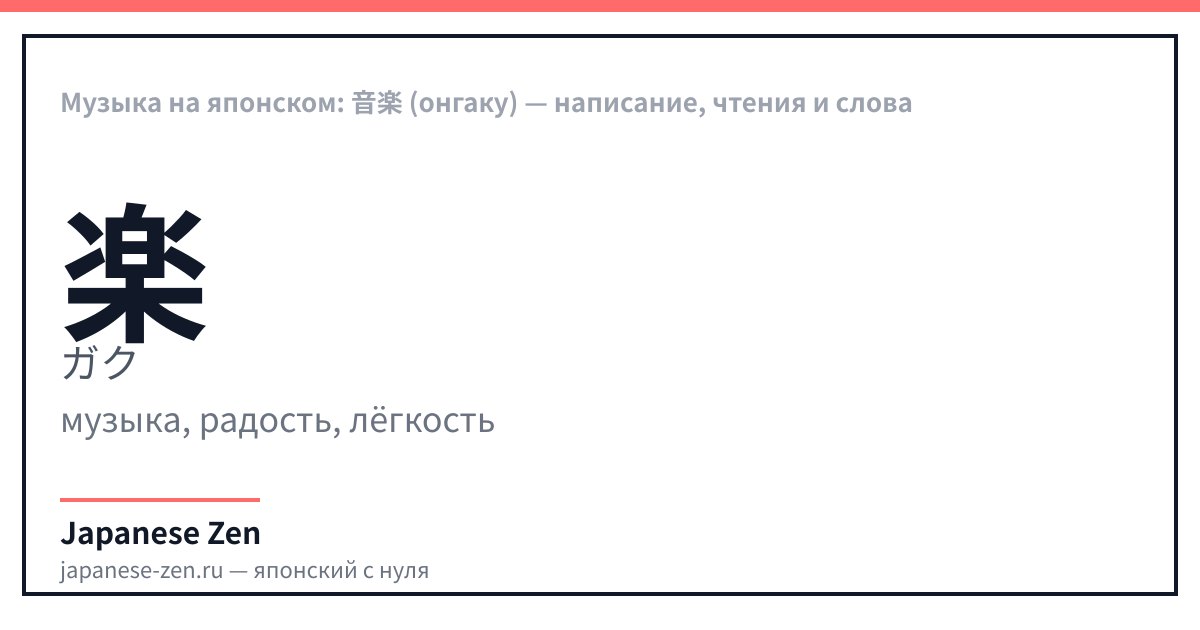
In Japanese, music is defined not by an instrument or a rhythm, but by its effect: 音楽 literally means a sound that makes you feel good. The word "joy" here is not a metaphor — it is the second character, right there in the spelling.
How "music" is written: two characters instead of one
楽 — значение: music, joy, ease — онъёми: ガク、ラク、ゴウ — кунъёми: たの.しい、たの.しむ、この.む — 13 штрих(ов).
One character — two different readings
楽 is a rare example of a character with two widely diverged readings. As "gaku" it appears in words about music: 音楽 (ongaku), 楽器 (gakki, "musical instrument"), 楽団 (gakudan, "orchestra, ensemble"). The same character also carries a second meaning — "easy, pleasant, comfortable": on its own 楽 (raku) means "comfort, relief," and 気楽 (kiraku) means "casualness." The choice of reading and meaning depends on the specific word as a whole — there is no single rule for "when to use which," they are learned in pairs.
Ongaku and words with 音楽
| Japanese | Reading | Translation |
|---|---|---|
| 音楽 | ongaku · ongaku | Music (literally "sound of joy") |
| 音 | oto · oto | Sound (the first character of the word 音楽) |
| 楽器 | gakki · gakki | Musical instrument |
| 音楽家 | ongakuka · ongakuka | Musician, composer |
| 演歌 | enka · enka | Enka (a genre of popular ballad) |
| 気楽 | kiraku · kiraku | Casualness, ease of mind (the same character 楽 is read "raku") |
Why sound and pleasure are written with one character
The connection between "gaku" and "raku" is not accidental — both readings grew from a single ancient meaning of the character that combined music, ritual merrymaking, and relief. In modern language, genres are named with separate words: J-POP (ジェイポップ) for pop music and 演歌 (enka) for a sentimental ballad with a raspy vibrato, but "music" as a concept is always 音楽, regardless of genre.
Write 楽 yourself
13 strokes: a complex character, best traced along the guides step by step.
FAQ
- How do you say "music" in Japanese?
- 音楽 (ongaku) — a word made of two characters: "sound" and "joy." Literally it comes out as "sound that brings joy," a definition through impression, not through technique.
- Why is the character 楽 read sometimes "gaku" and sometimes "raku"?
- These are two on'yomi readings of one kanji, fixed to different groups of words. "Gaku" appears in words about music — 音楽, 楽器. "Raku" appears in words about ease and pleasure — 気楽, 楽. Both grew from a common ancient meaning, but which reading to choose is determined by the specific word, not by a rule.
- How is the first character in 音楽 — "sound" — read?
- The kun reading is "oto," used for a sound in itself: 音がする "a sound is heard." The on reading is "on," and that is the one in the word 音楽. On its own, outside of compounds, the kun reading "oto" is more often used.
- How does J-POP differ from 演歌?
- J-POP is the general name for contemporary Japanese pop music; the word is borrowed from English and written in katakana or Latin letters. 演歌 is an older genre of sentimental ballad with a characteristic vibrato that took shape in the 20th century and is perceived as "traditionally Japanese" pop music, although in fact it formed under the influence of Western music.
- How do you say "musical instrument" in Japanese?
- 楽器 (gakki) — the same character for "music" as in 音楽, plus "instrument, tool." Individual instruments have their own names: ピアノ (piano, "piano"), 三味線 (shamisen, a traditional stringed instrument).
Sources
Updated: 2026-09-09