Karaoke: the meaning of the word and where the "empty orchestra" came from
The meaning of the word "karaoke" is simple: 空 "empty" plus オケ, a clipping of オーケストラ "orchestra" — a backing track instead of live accompaniment. The invention has no undisputed author: in 1967 Negishi Shigeichi presented the "Sparko Box" machine, and a more famous version was built in Kobe in 1971 by Inoue Daisuke. Neither filed a patent, and in 2004 Inoue received the Ig Nobel Peace Prize for karaoke.
The word looks like a single unit, but it is assembled from two different languages: the Japanese "empty" plus a clipped English "orchestra" — a common device in Japanese speech. Let's look at both versions of the invention of karaoke, why the inventors didn't get rich from a patent, and how karaoke went from a bar with an open stage to private rooms where you can come even alone.
空 plus オケ: how the meaning of the word "karaoke" is put together
カラオケ is made up of 空 "empty" and オケ — a shortened オーケストラ, the Japanese rendering of English orchestra. The literal meaning comes out as "empty orchestra": the place of the musicians and the vocalist is taken by a recording, and only the guest with a microphone sings live. The word was born not in a bar but in a studio: that is what a backing track that replaced a live orchestra was called on radio and on stage.
Half in Japanese, half in clipped English
Such hybrids are common in colloquial Japanese: part of the word is taken from the native language, part from a loanword, and the loanword itself is clipped down to one or two syllables. カラオケ in this sense is not an exception but a typical example of word formation at the junction of two languages.
Who invented karaoke: a dispute half a century long
Karaoke has no single recognized inventor. Historians count up to a dozen people involved in the idea between 1965 and 1975, but two names are mentioned most often.
- Negishi Shigeichi in 1967 released the "Sparko Box" machine — a coin-operated player with eight-track recordings of instrumental versions of popular songs and a paper booklet with lyrics. He toured all over Japan with the invention and sold about 8,000 such machines to bars, restaurants, and hotels, but never filed a patent. Negishi died in 2024 at the age of 100.
- Inoue Daisuke in 1971 in Kobe built a similar device called the "8-Juke": an eight-track cassette player, amplifier, and coin acceptor in one housing. He is the one most often called the "father of karaoke" — partly because he was the first to record backing tracks for ordinary amateurs, not just professional singers.
Why no one got rich from a patent
Neither Negishi nor Inoue patented their device: both assembled it from ready-made mass-produced parts — a tape recorder, an amplifier, a coin acceptor — and did not consider it a patentable invention. In 2004 Inoue received the Ig Nobel Peace Prize for karaoke with the citation "for inventing karaoke, thereby providing an entirely new way for people to learn to tolerate each other": the prize is a joke, but it is awarded by real Nobel laureates at Harvard.
From a bar with a stage to a room for one
For the first twenty years, karaoke was sung in front of everyone: in a bar, in front of the counter, accompanied by a machine shared by all the patrons. Everything changed in the mid-1980s, when in Okayama Prefecture converted shipping containers began to be rented out as private rooms with their own machine — at 100 yen per song. By the nineties, private rooms, カラオケボックス (karaoke box), had become the main format in Japan, displacing singing in front of a common hall.
Hitokara: singing karaoke alone
The private room also made possible what had previously seemed strange — karaoke alone. The word 一人カラオケ (hitori karaoke), more often shortened to ヒトカラ, has been established in Japanese since about the early 2000s: it refers to visiting a karaoke box without company, to practice your voice or simply to unwind after a workday.
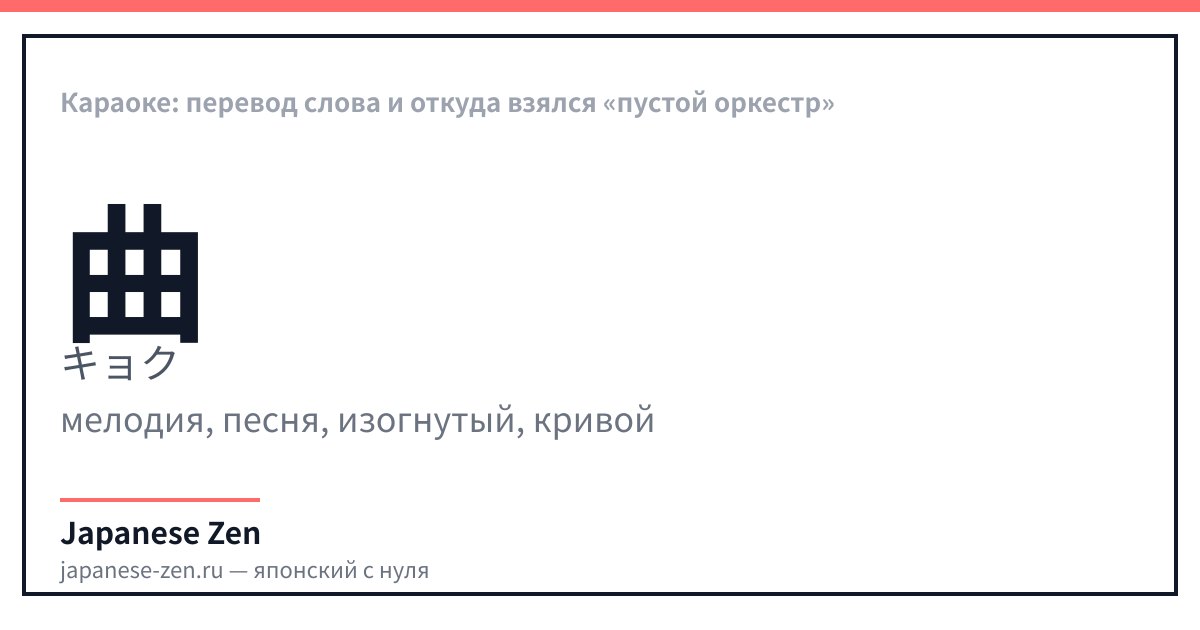
曲: the character for song in words about karaoke
曲 — значение: melody, song, bent, crooked — онъёми: キョク — кунъёми: ま.がる、ま.げる、くま — 6 штрих(ов). 曲 — "melody, musical piece": the same character appears in 名曲 (meikyoku) "famous song" and 曲名 (kyokumei) "song title" — words without which no evening in a karaoke box is complete.
Readings of 曲: キョク and ま.がる
The on reading キョク is heard in words about music — 名曲, 曲名, 作曲 (sakkyoku) "composing music". The kun reading まがる means "to bend, to curve" — at first glance, a different word not about music at all. But there is a connection: the same character historically described both a melodic line with its bends and literal crookedness, hence the second, less expected meaning — "dishonest, by roundabout ways".
空: "empty", "sky", and "air" — one character, three meanings
The character 空 from the word "karaoke" itself is read differently depending on the meaning. から (kara) — "empty", which is exactly the meaning in カラオケ; そら (sora) — "sky"; くう (ku) — the on reading for abstract concepts like 空気 (kūki) "air" or 航空 (kōkū) "aviation".
| Japanese | Reading | Translation |
|---|---|---|
| カラオケ | karaoke · karaoke | Karaoke |
| 曲 | kyoku · kyoku | Song, musical piece |
| カラオケボックス | karaoke bokkusu · karaoke bokkusu | Karaoke box, a private room for singing |
| 一人カラオケ | hitori karaoke · hitori karaoke | Karaoke alone (in conversation more often shortened to ヒトカラ) |
| 名曲 | meikyoku · meikyoku | Famous song, masterpiece |
Write 曲 along the guides — the character for "song", without which you can't put together any karaoke hit title.
FAQ
- What does the word "karaoke" mean?
- Literally — "empty orchestra": 空 "empty" plus オケ, a shortening of オーケストラ "orchestra". The point is that instead of live musicians and a vocalist, a recording plays, and only the guest with the microphone sings live.
- Who invented karaoke?
- There is no single author. In 1967 Negishi Shigeichi released the "Sparko Box" machine with eight-track recordings, and in 1971 in Kobe Inoue Daisuke built his own device, the "8-Juke". He is the one most often called the "father of karaoke", although formally Negishi was earlier.
- Why did no one patent karaoke?
- Both inventors assembled their devices from ready-made mass-produced parts — a tape recorder, an amplifier, a coin acceptor — and did not consider this combination a patentable invention. As a result, neither Negishi nor Inoue earned a single yen from karaoke rights.
- What did karaoke receive the Ig Nobel Prize for?
- Inoue Daisuke became an Ig Nobel Peace Prize laureate in 2004 — with a joking citation about "a new way to teach people to tolerate each other". The award itself is a parody, but it is presented to a full hall at Harvard by real Nobel laureates.
- What is a karaoke box and hitokara?
- A karaoke box (カラオケボックス) is a private room with its own machine, a format that spread from the mid-1980s and by the nineties had become the main one in Japan. Hitokara (ヒトカラ, from 一人カラオケ) is visiting such a room alone, without company.
Sources
Updated: 2026-09-15