Tamagotchi: What the Name Means and How an Egg with a Clock Took Over the World
Tamagotchi is a pocket pet toy by Bandai: it was released in Japan on November 23, 1996. The name is built from たまご "egg" and the English word watch — giving たまごっち. The pet had to be fed and treated: without care it got sick and could "die." In 1997 the creators were awarded the Ig Nobel Prize in Economics — for the millions of work hours spent on the toy.
Tamagotchi became a symbol of an entire era even before smartphones: in the winter of 1996–1997, people in Japan queued for the toy, and resellers raised the price dozens of times over. Let's look at who actually invented it, where the "-tchi" at the end of the name came from, and why a virtual pet received a real, albeit humorous, scientific prize.
Tamagotchi — a pocket pet that really needs care
Tamagotchi is a small egg-shaped device with a screen and three buttons, released by Bandai in Japan on November 23, 1996. Inside lived a virtual pet: it hatched from an egg on the screen, grew, asked for food, demanded that you clean up after it, and could get sick if you forgot about it for several hours in a row.
The care was not just for show
That was the whole idea: the pet truly depended on whether the owner pressed the buttons on time. If you didn't feed it and clean the screen of "dirt" for a long time, the character got sick, and with very poor care it "died," and the game had to be started over from a new egg.
Where the name たまごっち came from
The name is made of two parts: たまご (tamago) — "egg" and the English word watch, written as ウォッチ (wotchi). When combined, it became たまごっち — "tamagotchi," and the extra syllable wasn't just added: Japanese often shortens and contracts borrowed words at the end of compound nouns, especially diminutive-affectionate ones, hence the characteristic "-tchi" at the end.
Why there isn't a single kanji in the name
たまごっち is written entirely in hiragana, without a single kanji — and this is common practice for Japanese toys and characters aimed at children: kana can be read immediately, even before a child learns the necessary characters. The same principle can be seen in the names of dozens of other toys and cartoon characters.
Who invented Tamagotchi and what happened next
The toy has two creators with different roles. Akihiro Yokoi, an employee of WiZ, submitted the idea of a pocket pet to Bandai in June 1995. According to his own words, the thought came to him when he saw a boy upset that he couldn't take his pet turtle on vacation. Aki Maita, a Bandai employee, brought the idea to a finished product: she developed the characters and turned the concept into a toy that could be released for sale.
A queue that lasted all winter
In Japan, Tamagotchi almost immediately disappeared from store shelves: the retail price stayed around 1,980 yen, while resellers sold the toy for 50,000–200,000. The same story repeated overseas: since the American release in spring 1997, devices were swept off shelves, and parents signed up for queues and lotteries just to get one for their child. In 1997, Yokoi and Maita received the Ig Nobel Prize in Economics for Tamagotchi — with the citation "for distracting millions of work hours of people to care for virtual pets."
Tamagotchi returned more than once
In 2004, the Tamagotchi Connection version with infrared communication was released — pets of different owners could "befriend" each other through the devices. In 2017, for the twentieth anniversary of the American release, the original model was reissued, and in 2019, Tamagotchi On with a color screen came out. According to Bandai itself, by July 2025, more than 100 million Tamagotchi of all generations had been sold worldwide.
卵: the "egg" character that isn't in the toy's name itself
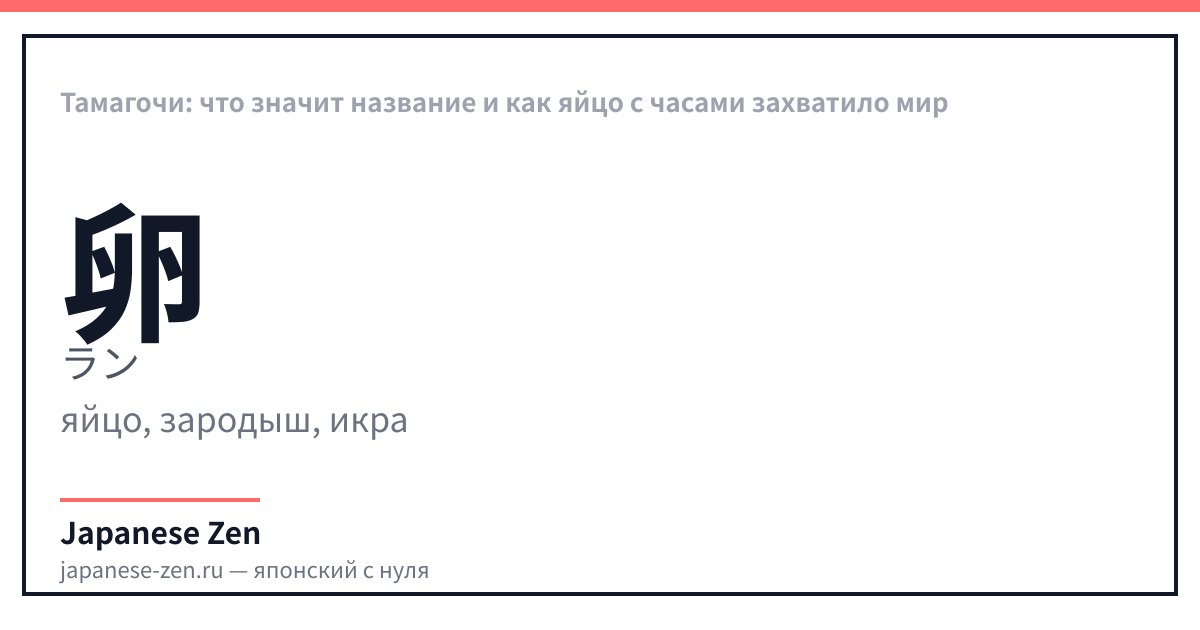
卵 — значение: egg, embryo, roe — онъёми: ラン — кунъёми: たまご — 7 штрих(ов). 卵 — "egg": this character is used to write たまご, the first half of the word "tamagotchi," although the toy's name itself doesn't use the kanji — it's entirely in hiragana.
Readings of 卵: ラン and たまご
The on'yomi reading ラン appears in literary and medical words like 産卵 (sanran) "laying eggs." The kun'yomi reading たまご is an ordinary everyday word: 卵焼き (tamagoyaki) is a "rolled omelet," a popular breakfast dish, and 生卵 (namatamago) means "raw egg." It is this kun'yomi reading that stands at the beginning of the toy's name, simply written in kana rather than the kanji.
| Japanese | Reading | Translation |
|---|---|---|
| たまご | tamago · tamago | Egg |
| 卵焼き | tamagoyaki · tamagoyaki | Rolled omelet |
| 生卵 | namatamago · namatamago | Raw egg |
| 育てる | sodateru · sodateru | To raise, to bring up |
| 電子ペット | denshi petto · denshi petto | Electronic pet |
Write 卵 along the guides — the "egg" character that begins the name たまごっち.
FAQ
- What does the word "tamagotchi" mean?
- The word is made of two parts: たまご means "egg," and ウォッチ is the Japanese rendering of the English word watch: the toy was worn on a keychain, like a compact wristwatch. This combination produced the hybrid たまごっち, typical of Japanese neologisms.
- Who invented Tamagotchi?
- The idea was proposed in June 1995 by Akihiro Yokoi of WiZ, and Aki Maita of Bandai brought it to a finished toy, developing the characters and the device's design. The toy has two creators with different roles, not a single author.
- When was the first Tamagotchi released?
- On November 23, 1996, in Japan, and in spring 1997 in the US and other countries. Almost immediately after release, the device disappeared from shelves: demand far exceeded supply, and a real shortage began in both countries.
- Why did Tamagotchi receive the Ig Nobel Prize?
- In 1997, Akihiro Yokoi and Aki Maita received the Ig Nobel Prize in Economics with the citation "for distracting millions of work hours of people to care for virtual pets." The prize is humorous, but it is awarded by genuine Nobel laureates.
- Why are there no kanji in the name "tamagotchi"?
- The name is written entirely in hiragana — as is done with almost all Japanese toys and characters for children: kana can be read immediately, even before a child learns the necessary kanji. The kanji 卵 "egg" is not used in the word たまごっち itself, although its first part is precisely the kun'yomi reading of that character.
- Is it true that there was a Tamagotchi shortage in 1997?
- Yes, both in Japan and the US. In Japan, a retail Tamagotchi cost a little under 2,000 yen, while resellers charged 20–30 times more. In the US, parents signed up for lotteries and queues to get the toy for their child by the holidays.
Sources
Updated: 2026-09-15