Shinkansen — Japan's high-speed train: speed, history and names
Shinkansen (新幹線) is the network of high-speed lines operated by the Japan Railways companies. The first shinkansen train entered service on the Tokaido line on October 1, 1964, nine days before the Tokyo Olympics. Today the fastest trains reach 320 km/h, and since the Tokaido line opened in 1964 there has not been a single accident with a passenger killed or injured on board.
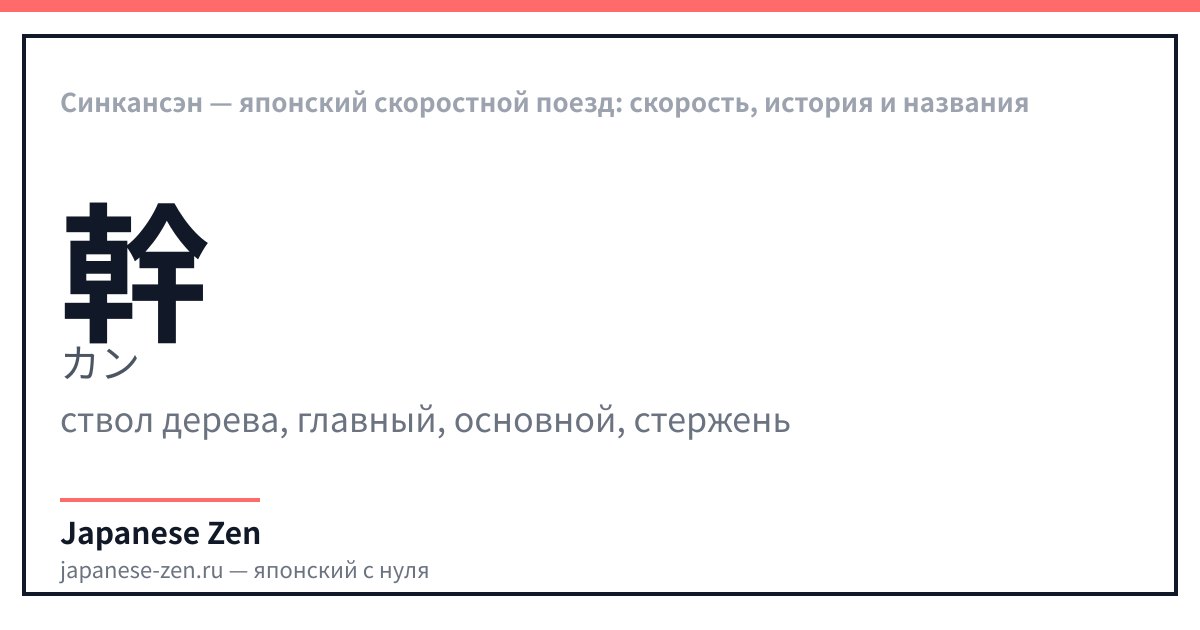
Let's look at how many lines the shinkansen network consists of, what the names Nozomi, Hikari and Hayabusa mean, and where the nickname "bullet train" came from — it is a quarter of a century older than the shinkansen itself. We'll also see how the character 幹 "tree trunk" came to mean "main" and why the word "shinkansen" itself does not mean "bullet" at all.
How many shinkansen lines there are and when it appeared
Each shinkansen line runs on its own tracks, separate from ordinary Japanese railways: they have a different gauge and no level crossings with roads. The trains simply never meet a barrier or a freight train on the way. The Tokaido line opened first in 1964, and the first train on it was the 0 series.
- Tokaido and Sanyo are the oldest lines, connecting Tokyo, Osaka, Hiroshima and Fukuoka.
- Kyushu and Nishi-Kyushu (West Kyushu) continue the network across the island of Kyushu.
- Tohoku and Hokkaido run north, as far as the island of Hokkaido.
- Joetsu and Hokuriku link Tokyo with Niigata and with the coast of the Sea of Japan.
- Yamagata and Akita are mini-shinkansen: their trains switch to ordinary tracks and slow down noticeably there.
How fast and how punctually the shinkansen runs
On the Tokaido line the fastest Nozomi trains reach 285 km/h, and the record among all lines is held by Hayabusa on the Tohoku line — 320 km/h. According to JR Central's annual report, in fiscal year 2023 the average delay of a single train on the Tokaido line was 1.6 minutes, including delays caused by natural disasters. In its 2025 report the same company also notes something else: since the Tokaido line opened in 1964, there has not been a single accident with a passenger killed or injured on board. By that time the line had been used about 7.2 billion times.
Nozomi, Hikari, Hayabusa: what the train names mean
On the Tokaido and Sanyo lines trains are divided into three speed classes: Nozomi is the fastest, stopping at few stations; Hikari, "light", makes a medium number of stops; Kodama, "echo", stops at every station. According to a common explanation, the difference in speed is also played on in the names themselves: light outruns sound, that is, the echo. The name of the fastest train, Nozomi, however, has nothing to do with speed in meaning — it means "wish, hope".
What the train names on other lines mean
On the Tohoku and Hokkaido lines there is a similar pair: Hayabusa, "peregrine falcon", is the fastest train in the network, up to 320 km/h, while Yamabiko, "mountain echo", stops more often. On the Kyushu line all trains under the name Tsubame, "swallow", stop at every station. The names are almost always ordinary Japanese words rather than technical terms: for instance, "Tsubame" was also the name of an express train before the war, and the shinkansen simply inherited the name.
Shinkansen in film and anime
In the film Bullet Train (2022, directed by David Leitch), hitmen get stuck on one train — a fictional version of a Tokaido line shinkansen; the plot is based on Kotaro Isaka's novel Maria Beetle (マリアビートル, 2010). The children's anime Shinkalion (新幹線変形ロボ シンカリオン, first season from January 2018 to June 2019) is built around robots that shinkansen trains from various lines transform into.
From tree trunk to main line
幹 — значение: tree trunk, main, principal, core — онъёми: カン — кунъёми: みき — 13 штрих(ов). 幹 — "tree trunk, main": the same character appears in 新幹線 (shinkansen), 幹部 (leadership) and 幹事 (event organizer).
新幹線 is made up of 新 "new" and 幹線 "trunk line" — and 幹線 itself consists of 幹 "trunk" and 線 "line". Literally it comes out as "new trunk line", that is, a new main artery as opposed to ordinary "branch" lines.
Why "trunk" means "main"
From the image of a tree trunk from which branches grow, the character 幹 expanded in meaning to "main, principal" in other words as well. 幹部 (kanbu) is "leadership, the backbone of an organization", literally "trunk part"; 幹事 (kanji) is a person who organizes an event or handles a group's affairs, also a "trunk" figure for their circle. The same logic as with a "trunk" line from which ordinary "branch" lines extend.
| Japanese | Reading | Translation |
|---|---|---|
| 新幹線 | shinkansen · shinkansen | Shinkansen |
| 駅 | eki · eki | Station |
| 切符 | kippu · kippu | Ticket |
| 自由席 | jiyūseki · jiyūseki | Non-reserved seat — take any free one |
| のぞみ | nozomi · nozomi | The fastest train on the Tokaido line, "wish, hope" |
| 幹線 | kansen · kansen | Trunk line, main line |
Write 幹 along the guides — the character for "trunk" that made the line "main".
Wheels, not magnets: confusion about the shinkansen
One network — many trains and speeds
- "The shinkansen is a maglev train." No, all operating shinkansen lines run on ordinary steel wheels on rails. A separate Chuo Shinkansen line is being built on magnetic suspension — its opening date has been postponed many times, so naming an exact date does not make sense yet.
- "The shinkansen is one specific train." The shinkansen is a network of lines and a whole system of different trains with their own names: Nozomi, Hikari, Hayabusa and others run on different routes and at different speeds.
- "In Japanese 'shinkansen' means 'bullet'." The word 新幹線 literally means "new main line", with no "bullet" at all. However, the pre-war high-speed railway project from Tokyo to Shimonoseki, approved in 1940 and abandoned because of the war, was commonly called 弾丸列車 — "bullet train". The English bullet train is a direct translation of that word: that is what the shinkansen was called in the first English-language tourist brochures too.
- "The shinkansen always and everywhere runs at over 300 km/h." The maximum speed depends on the line and the section: trains reach 320 km/h only on the Tohoku line, while the Yamagata and Akita mini-shinkansen switch to ordinary tracks and run noticeably slower there.
FAQ
- What is the shinkansen?
- The shinkansen (新幹線) is the network of high-speed railways of the Japanese Japan Railways companies, as well as the trains themselves that run on it. The first line, the Tokaido, opened on October 1, 1964; today the network has about a dozen lines across the country.
- How fast does the shinkansen go?
- The fastest is Hayabusa on the Tohoku line, up to 320 km/h. On the Tokaido line Nozomi trains hold 285 km/h. The Yamagata and Akita mini-shinkansen run part of the way on ordinary tracks and go noticeably slower there.
- When did the first shinkansen appear?
- On October 1, 1964, when the Tokaido line between Tokyo and Shin-Osaka opened — nine days before the start of the Tokyo Summer Olympics, for which the line was timed. The first train type on it was the 0 series.
- Why is the shinkansen called the "bullet train"?
- Because of the pre-war high-speed railway project approved in 1940 and abandoned because of the war: it was commonly called 弾丸列車, "bullet train", and the English bullet train is a direct translation of that word. The word "shinkansen" itself, unlike it, does not mean "bullet" — it means "new main line".
- What do the shinkansen train names mean?
- They are ordinary Japanese words: Nozomi — "wish, hope", Hikari — "light", Kodama — "echo" on the Tokaido line; Hayabusa — "peregrine falcon", Yamabiko — "mountain echo" on the Tohoku line.
- How is "shinkansen" written in kanji?
- 新幹線, kana しんかんせん. 新 means "new", 幹 — "trunk, main", 線 — "line": together it comes out as "new main line". The same character 幹 appears in the words 幹部 "leadership" and 幹事 "organizer".
Sources
Updated: 2026-09-14