Kinkaku-ji, the Golden Pavilion: History, the 1950 Fire, and Mishima's Novel
The Golden Pavilion is the Buddhist temple Kinkaku-ji, officially Rokuon-ji, in Kyoto: the top two of its three stories are covered in gold leaf. The retirement villa of shogun Ashikaga Yoshimitsu was turned into a temple after his death in 1408. In 1950 a novice burned the building to the ground; it was rebuilt by 1955, and the gold leaf was renewed in 1987.
The Golden Pavilion is easy to mistake for untouched antiquity, though the building seen today is a mid-20th-century reconstruction on the site of the burned original. Let's look at why a retired shogun needed a gilded villa, why the temple has two different names, and how the Silver Pavilion differs from the Golden one far more than by the color of metal.
Kinkaku-ji: A Shogun's Villa Turned Zen Temple
Kinkaku-ji (金閣寺) is the common name of a Buddhist temple in Kyoto officially called Rokuon-ji (鹿苑寺), belonging to the Rinzai school, branch of Shokoku-ji. Not all three stories of the pavilion are actually covered in gold: the first is built in the shinden palace style and bears no gold, while the second and third are entirely covered outside with gold leaf; the third story is gilded inside as well. The roof is crowned by a bronze phoenix, and the building itself is reflected in the Kyoko-chi pond, the 'mirror pond.' The complex was added to the UNESCO World Heritage list 'Historic Monuments of Ancient Kyoto' in 1994 along with sixteen other sites in Kyoto and its surroundings.
Why a Shogun Needed a Golden Pavilion
In 1397 the retired shogun Ashikaga Yoshimitsu bought the estate that stood on this site and began building his own suburban villa Kitayama-dai, the 'palace in the northern mountains'; the golden pavilion itself was apparently completed by 1399. Formally Yoshimitsu had already ceded the title of shogun to his son, but he ruled the country from the new residence — the golden pavilion is considered a sign of that power no less than of Buddhist piety.
The 1950 Fire and the Pavilion's New Life
After Yoshimitsu's death in 1408, the villa, according to his will, was turned into the Zen temple Rokuon-ji only in 1420. The name Kinkaku-ji, 'temple of the Golden Pavilion,' refers to the pavilion itself and over time became better known than the official name of the whole complex.
Early in the morning of July 2, 1950, a novice of the temple set fire to the pavilion. The building, by then recognized as a national treasure, burned to the ground along with the statues inside. The new building was erected in 1952–1955, repeating the former proportions, and on October 10, 1955, an opening ceremony was held. At the time of the fire, gold survived only on the third story, and during the restoration the second was gilded as well. In 1986–1987 the gold leaf was renewed: the sheets were made five times thicker than usual — about twenty kilograms of gold on two hundred thousand sheets.
The Silver Pavilion Without Silver
In 1489 Yoshimitsu's grandson, shogun Ashikaga Yoshimasa, built in another district of Kyoto his own villa with a similar pavilion — today this is Jisho-ji, known as Ginkaku-ji, the 'Silver Pavilion.' It was never covered in silver — a 2007 study confirmed this. The upper story was originally covered with black lacquer, and the pavilion began to be called 'Silver' only in the Edo period, as a counterpart to the Golden one.
The 1950 fire became the basis for Yukio Mishima's novel The Temple of the Golden Pavilion (金閣寺, 1956): the writer told the story through a fictional novice obsessed with the beauty of the temple — this is literary fiction, not a documentary account of the arson.
How 金閣寺 Is Read and What 鹿苑寺 Means
金閣寺 is read きんかくじ (Kinkaku-ji): 金 'gold,' 閣 'pavilion, tall building,' 寺 'temple' — literally 'temple of the golden pavilion.' In compounds the character 金 is read kin, sometimes kon, and as a standalone word kane, 'money, metal.' Hence the everyday お金 (okane), 'money'; and 金曜日 (kin'yōbi), 'Friday,' is the 'day of metal,' after the planet Venus (金星).
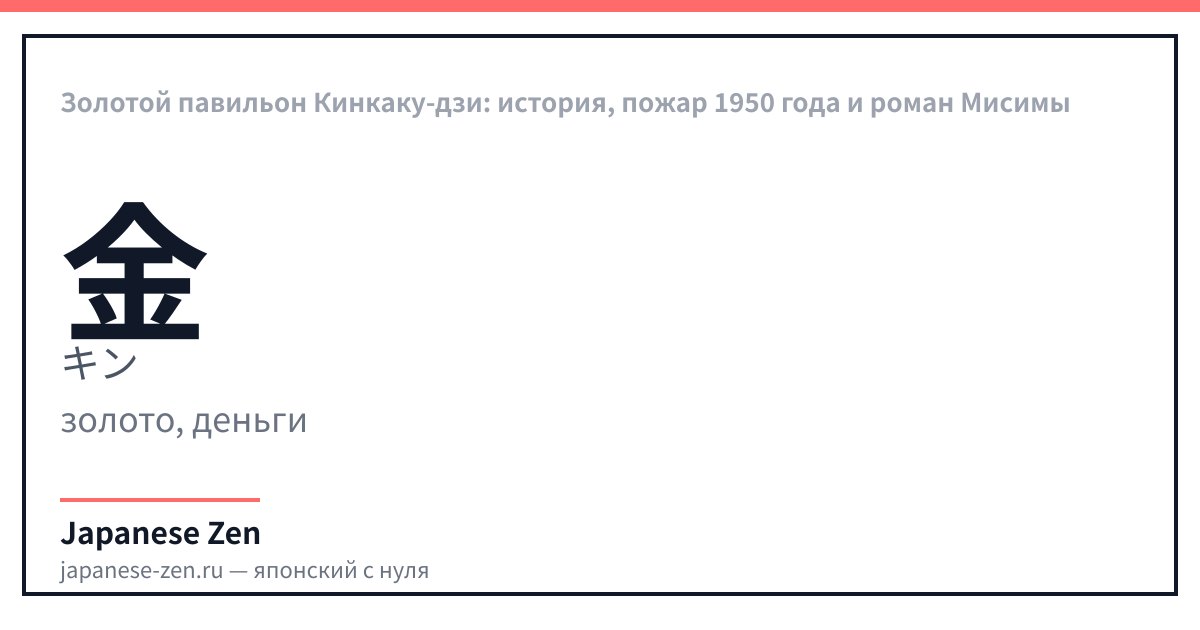
金 — значение: gold, money — онъёми: キン、コン、ゴン — кунъёми: かね、かな-、-がね — 8 штрих(ов). 金 — 'gold, money': the first character in 金閣寺 and in everyday words like お金 and 金曜日.
Why the Temple Has Two Names
The official name of the whole complex is Rokuon-ji (鹿苑寺), literally 'temple of the Deer Garden': it was named after Yoshimitsu's Buddhist posthumous name, Rokuon-in-dono. In guidebooks and conversation the name Kinkaku-ji is far more common — after the golden pavilion itself, which is in fact only one of the buildings of the entire temple complex.
| Japanese | Reading | Translation |
|---|---|---|
| 金閣寺 | Kinkaku-ji · Kinkaku-ji | Golden Pavilion |
| 鹿苑寺 | Rokuon-ji · Rokuon-ji | Official name of the temple |
| 銀閣寺 | Ginkaku-ji · Ginkaku-ji | Silver Pavilion |
| 金箔 | kinpaku · kinpaku | Gold leaf |
| お金 | o-kane · o-kane | Money |
| 金曜日 | kin'yōbi · kin'yōbi | Friday, literally 'day of gold' |
Write 金 along the guides — the character for 'gold' from the name Kinkaku-ji.
Solid Gold and Six Centuries of History — What's Not True Here
- 'The pavilion is made entirely of gold.' No: only the top two of the three stories are covered in gold leaf, and the first is built in the shinden palace style and bears no gold at all — the building is fundamentally wooden.
- 'The current building has stood since the 14th century.' No: the structure seen today is a 1955 reconstruction: the original pavilion of the late 14th century burned to the ground in the 1950 fire.
- 'The Silver Pavilion Ginkaku-ji is covered in silver.' No, it never was: a 2007 study found no traces of silver on it, and the upper story was originally covered with black lacquer.
- 'Kinkaku-ji was always a Buddhist temple.' Originally it was the secular suburban residence of shogun Yoshimitsu, and only after his death, according to his will, was the estate turned into a Zen temple.
FAQ
- What is the Golden Pavilion?
- The Golden Pavilion, or Kinkaku-ji, is a Buddhist temple in Kyoto officially called Rokuon-ji. The top two stories of the three-story pavilion are covered in gold leaf, and the whole building stands on the shore of the Kyoko-chi pond and has been a UNESCO World Heritage site since 1994.
- Who built the Golden Pavilion?
- The villa on this site was begun in 1397 by the retired shogun Ashikaga Yoshimitsu; the pavilion itself was completed around 1399. After Yoshimitsu's death in 1408, the estate, according to his will, was turned into the Zen temple Rokuon-ji in 1420.
- Is it true that the Golden Pavilion burned down?
- Yes, early in the morning of July 2, 1950, a novice of the temple set fire to the building, and it burned to the ground along with the statues inside. The new building, exactly repeating the former proportions, was erected by 1955, and in 1986–1987 its gold leaf was renewed.
- Is the Golden Pavilion covered in real gold?
- Yes, but not entirely: only the second and third stories, including the roof, are finished with gold leaf, while the first story is built in the shinden palace style and bears no gold. During the 1987 renewal, sheets five times thicker than usual were used — about twenty kilograms of gold for the whole pavilion.
- How does the Golden Pavilion differ from the Silver Pavilion?
- The Golden Pavilion Kinkaku-ji was built by Ashikaga Yoshimitsu and finished with gold leaf. The Silver Pavilion Ginkaku-ji was built in 1489 by his grandson Ashikaga Yoshimasa, but the building was never covered in silver: it was nicknamed 'Silver' in the Edo period, as a counterpart to the Golden one.
- How do you say 'Golden Pavilion' in Japanese?
- 金閣寺, read きんかくじ (Kinkaku-ji): 金 'gold,' 閣 'pavilion, tall building,' 寺 'temple.' The official name of the whole temple complex is different — Rokuon-ji (鹿苑寺), 'temple of the Deer Garden,' while Kinkaku-ji is the name after the golden building itself.
Sources
Updated: 2026-09-14