The Muromachi Period — When It Was and What It's Known For
The Muromachi period is the era of Ashikaga shogun rule from 1336 to 1573, named after the Muromachi district of Kyoto where their residence stood. It was the time of the Golden and Silver Pavilions, Noh theater, and the birth of the tea ceremony, and it ended with the Onin War of 1467, which split the country and opened the century of Sengoku.
The Muromachi period is easy to confuse with the name of a city, but the name isn't about the place itself — it's about the Kyoto district where the Ashikaga shoguns kept their headquarters. Two centuries of this era contained both a golden age of courtly art and a gradual collapse of power that ended in open war. Let's look at what appeared during this time and why it all ended in turmoil.
When the Muromachi Period Was and How Long It Lasted
The Muromachi period began in 1336, when Ashikaga Takauji established a new shogunate, and continued until 1573, when Oda Nobunaga drove the last shogun, Ashikaga Yoshiaki, out of Kyoto. The name comes from the Muromachi district of Kyoto, where the shoguns' residence stood from 1378. Between the fall of the previous Kamakura shogunate in 1333 and the founding of the new one there was a three-year interregnum — a brief attempt by Emperor Go-Daigo to restore direct rule to the court, known as the Kenmu Restoration.
| Year | Event |
|---|---|
| 1336 | Ashikaga Takauji establishes a new shogunate |
| 1378 | The shogun's residence moves to the Muromachi district of Kyoto |
| 1397 | Ashikaga Yoshimitsu builds the Golden Pavilion, Kinkaku-ji |
| 1467–1477 | The Onin War devastates Kyoto and undermines the shogunate's power |
| 1489 | Ashikaga Yoshimasa builds the Silver Pavilion, Ginkaku-ji |
| 1573 | Oda Nobunaga drives the last shogun, Ashikaga Yoshiaki, out of Kyoto |
How the Muromachi Period Differed from Neighboring Eras
What sets the Muromachi period apart from the preceding Kamakura era is a weaker center: the Ashikaga shoguns never established the same tight control over the provinces that the Hojo regents had held. Local power gradually shifted to regional military houses. The second half of the era, after the Onin War of 1467, was effectively the turbulent Sengoku period: the Ashikaga shogunate simply continued to exist formally for another century, until Oda Nobunaga drove out the last shogun in 1573.
The Name and Kanji: 室町時代
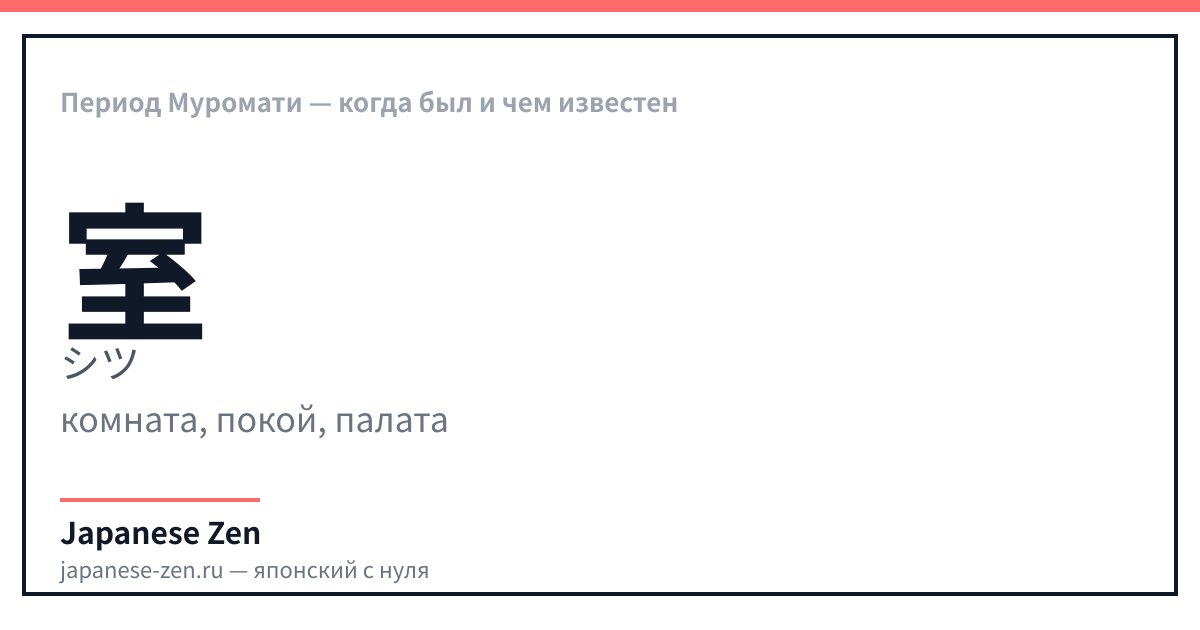
室町時代 is read むろまちじだい: 室町 is the name of the Kyoto district where the shoguns' residence stood (室 "room, chamber," 町 "district, town"), and 時代 means "era." The district itself was named after one of the Ashikaga clan's estates, but the era was named this way by later generations in hindsight — contemporaries usually said simply "Ashikaga rule."
室 — значение: room, chamber, apartment — онъёми: シツ — кунъёми: むろ — 9 штрих(ов). 室 — "room, chamber, apartment": 9 strokes, N4-level character. The same root appears in 教室 (kyōshitsu, "classroom") and 室内 (shitsunai, "indoors").
| Japanese | Reading | Translation |
|---|---|---|
| 室町時代 | Muromachi jidai · Muromachi jidai | The Muromachi period |
| 足利 | Ashikaga · Ashikaga | Ashikaga — the surname of the shogun clan |
| 能 | nō · nō | Noh theater, which emerged in this era |
| 茶道 | sadō · sadō | The way of tea, the tea ceremony |
| 侘び | wabi · wabi | Humble simplicity — the aesthetic of this era |
| 金閣寺 | Kinkaku-ji · Kinkaku-ji | The Golden Pavilion in Kyoto |
Write 室 along the guides — the character for "chamber" from 室町時代.
Why the War Was Named After an Era Name, Not an Event
The name of the Onin War is also an era name: 応仁 was the name of the era of 1467–1469, in the first two years of which the conflict began. So it became permanently attached to the war itself, even though the fighting continued for another eight years and carried over into the next era name, Bunmei. This kind of confusion is common in Japanese history: events and phenomena are often named after the gengō in which they began, even if the era name had already changed.
Which Anime Take Place in the Muromachi Period
- "Ikkyu-san" (1975–1982, Toei Animation) — a classic anime about the childhood of the real Zen monk Ikkyu Sojun, who influenced the aesthetics of the tea ceremony and monochrome painting.
- "The Elusive Samurai" (逃げ上手の若君, 2024) — the first episodes unfold at the boundary of Kamakura and Muromachi, around the founder of the new shogunate, Ashikaga Takauji.
How to Recognize Muromachi on Screen
The Muromachi period is rarely shown on screen in its entirety — usually it's either its beginning, near the fall of Kamakura, or the Onin War and the transition into Sengoku. The reliable markers of this era are golden and silver pavilions in the sets, Noh scenes with masks, and a tea room with tatami and minimal decoration: that very wabi-sabi aesthetic that took shape in this same century.
FAQ
- When was the Muromachi period?
- From 1336 to 1573 — from the establishment of the shogunate by Ashikaga Takauji to the expulsion of the last shogun by Oda Nobunaga. Between this period and the previous one, Kamakura, there was a three-year interregnum — the Kenmu Restoration of 1333–1336.
- How long did the Muromachi period last?
- 237 years — from 1336 to 1573. The first century was relatively stable, but after the Onin War of 1467 the shogunate no longer truly controlled the country, though it formally survived for more than a century longer.
- What happened during the Muromachi period?
- The Ashikaga shoguns ruled the country from Kyoto, and courtly culture flourished twice during this time: first Kitayama under Yoshimitsu — the Golden Pavilion, Noh theater — then Higashiyama under Yoshimasa — the Silver Pavilion, the tea ceremony, the wabi-sabi aesthetic.
- How is "Muromachi period" written in kanji?
- 室町時代, read むろまちじだい: 室町 is the name of the Kyoto district where the shoguns' residence stood, and 時代 means "era." The name was given in hindsight; contemporaries usually said simply "Ashikaga rule."
- How did the Muromachi period end?
- With a gradual collapse of power: the Onin War of 1467–1477 devastated Kyoto and stripped the shogunate of real control over the provinces, and the formal end came in 1573, when Oda Nobunaga drove out the last shogun, Ashikaga Yoshiaki.
- Which anime show the Muromachi period?
- The classic "Ikkyu-san" — about the real Zen monk of that era who influenced the tea ceremony. The beginning of the anime "The Elusive Samurai" takes place at the boundary of Kamakura and Muromachi, around the founder of the shogunate, Ashikaga Takauji.
Sources
Updated: 2026-09-11