The Heian Period — When It Was and What It Is Known For
The Heian period is an era of Japanese history from 794 to 1185 (sometimes to 1192), when the capital was Heian-kyō, present-day Kyoto, and the country was effectively ruled by the Fujiwara clan through the positions of regents. This was the time of the flourishing of court culture: kana took shape, The Tale of Genji and The Pillow Book were written, and by the end of the era the warrior houses of Taira and Minamoto grew stronger, leading to the Genpei War.
Heian is the longest era in Japanese history: almost four centuries with almost no major war within the country, but with court romances, poetry contests, and the slow decline of the capital aristocracy. Below are the coordinates of the era and what is worth knowing before reading about its heroes and wars.
When the Heian Period Was and How Long It Lasted
The Heian period began in 794, when Emperor Kanmu moved the capital to Heian-kyō (平安京) — the site of present-day Kyoto. The formal end of the era is a matter of debate: some historians set the boundary at 1185, when the Taira clan fell and real power passed to the warrior houses, others at 1192, when Minamoto no Yoritomo officially received the title of shogun. Within these almost four centuries, the country was in fact governed by the Fujiwara clan, which held the positions of regent for a minor emperor (sesshō) and regent for an adult emperor (kampaku).
| Year | Event |
|---|---|
| 794 | Transfer of the capital to Heian-kyō |
| 894 | End of embassies to China — on the advice of the scholar Sugawara no Michizane |
| c. 1000 | The Tale of Genji by Murasaki Shikibu and The Pillow Book by Sei Shōnagon |
| 1156 | Hōgen Disturbance — the first open clash between court power and the warrior houses |
| 1159 | Heiji Disturbance — Taira no Kiyomori gains the upper hand over the Minamoto house |
| 1180–1185 | Genpei War between the Taira and Minamoto |
| 1185 (or 1192) | End of the Heian period — the boundary is disputed |
How It Differed from Neighboring Eras
Before Heian was the Nara period (710–794), where the court lived in the shadow of Buddhist monasteries, whose political influence forced the capital to be moved farther away. After Heian came the Kamakura period (1185/1192–1333) — power passed for the first time from the court aristocracy to a military government, the shogunate, and remained in the hands of the warrior class for seven centuries thereafter. Heian turned out to be the last era when the country was governed by the court rather than by samurai.
平安 — “Peace and Tranquility”: Where the Era Got Its Name
平安 is read へいあん: 平 “even, peaceful” and 安 “calm, safe” together give “peace and tranquility.” The very fact of the move gave the new capital and the entire era its name: Heian-kyō translates as “capital of peace and tranquility” — a wish, not a description of what had already happened. The same root 平安 survives in modern Japanese in the common word for “peace, well-being.”
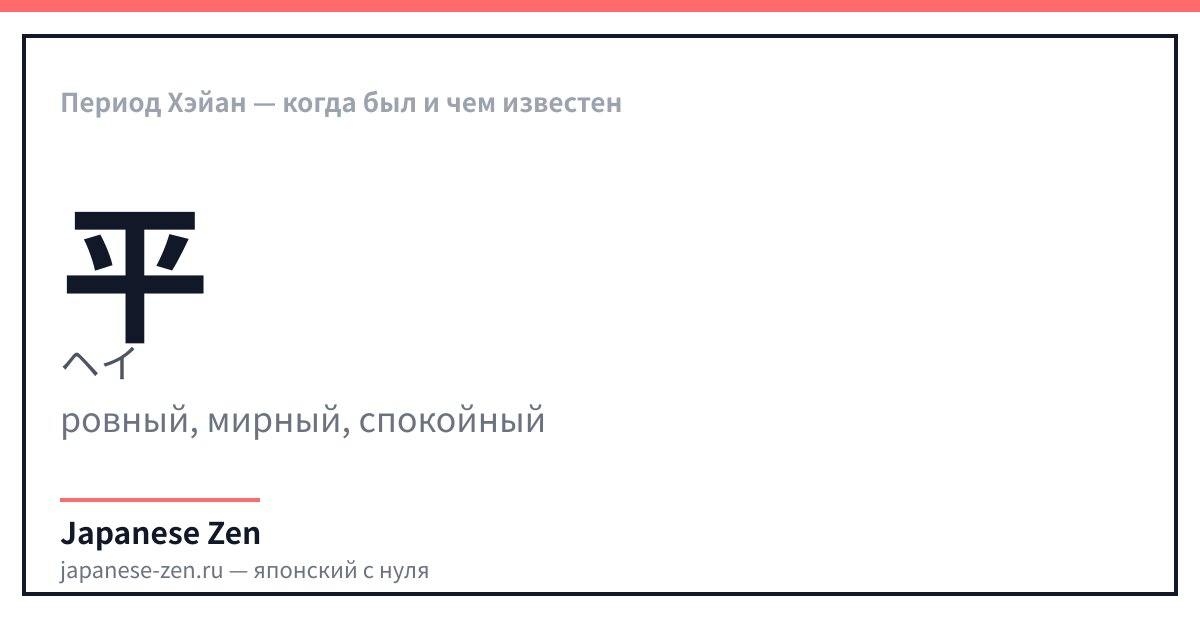
平 — значение: even, peaceful, calm — онъёми: ヘイ、ビョウ、ヒョウ — кунъёми: たい.ら、たい.らげる、ひら — 5 штрих(ов). 平 — “even, peaceful, calm”: five strokes, an N3-level character. The same root appears in 平和 (heiwa, “peace”) and 平等 (byōdō, “equality”) — in the era’s name it reinforces the wish for tranquility for the new capital.
Why the Era’s Name Does Not Contain the Word “Kyoto”
When founded, the city was officially called Heian-kyō, not Kyoto. “Kyōto” (京都) literally means simply “capital city.” For centuries this was a colloquial, unofficial name, and it became firmly established only after the capital was moved to Tokyo in 1869, while the former Heian-kyō remained in history under its everyday name.
| Japanese | Reading | Translation |
|---|---|---|
| 平安時代 | Heian jidai · Heian jidai | Heian period |
| 平安京 | Heian-kyō · Heian-kyō | Capital Heian-kyō, present-day Kyoto |
| 時代 | jidai · jidai | Era, period |
| 貴族 | kizoku · kizoku | Aristocracy, nobility |
Write 平 along the guides and study the stroke order.
Anime and Films Set in the Heian Period
There are few direct screen adaptations of the era — much more often individual characters (Abe no Seimei, Tamamo-no-Mae, Yoshitsune) are taken from it for separate plots. But two titles show the Heian court itself as a setting, not merely as a source of characters.
- “Genji Monogatari Sennenki” (2009) — a direct anime adaptation of Murasaki Shikibu’s classic novel, in which Prince Hikaru Genji grows up at the emperor’s court and experiences his first love for Fujitsubo.
- “Otogi Zoshi” (2004, Production I.G) — the “Heian” arc of the series unfolds in mid-period Kyoto: the heroine Hikaru, younger sister of Minamoto no Raikō, secretly takes the place of her ailing brother, while the onmyoji Abe no Seimei advises the emperor.
How to Recognize the Era on Screen
Heian scenery is recognizable even without a caption: layered court robes jūnihitoe on women, tall lacquered eboshi and kanmuri caps on men, ox-drawn carriages (gissha, 牛車), wooden lattice shutters shitomi instead of walls, and the exchange of tanka poems instead of ordinary conversation. In later, warrior eras, there is far more armor and swords on screen.
FAQ
- When was the Heian period?
- From 794 to 1185 — this is the most common dating of the Heian period, counting from the transfer of the capital to Heian-kyō to the fall of the Taira clan. Some historians move the end of the era to 1192, when Minamoto no Yoritomo officially became shogun: there is no single boundary, and both dates are considered correct.
- Why was the era called Heian?
- After the name of the new capital: Heian-kyō (平安京) means “capital of peace and tranquility” — 平 “peaceful” and 安 “calm.” The name was a wish given to the city by its founder, Emperor Kanmu, not a description of an already achieved result.
- Who ruled during the Heian period?
- Formally the emperor ruled the country, but real power was held almost throughout the era by the Fujiwara clan — through the positions of regent for a minor sovereign (sesshō) and regent for an adult (kampaku). Emperors retained ritual status but rarely made decisions on their own.
- What is the Heian period known for besides literature?
- Besides The Tale of Genji and The Pillow Book, Heian left behind the kana syllabary itself, court etiquette, and the aesthetic of mono no aware (“the sorrowful charm of things”). And toward the end of the era — the strengthening of the warrior houses of Taira and Minamoto, which led to the Genpei War.
- How did the Heian period end?
- With the Genpei War of 1180–1185 between the Taira and Minamoto clans: the Taira were destroyed in the naval battle of Dan-no-ura, and the victor Minamoto no Yoritomo founded the first shogunate in Kamakura, taking real power from the court aristocracy.
- In which anime is the Heian period shown?
- A direct adaptation of the court is “Genji Monogatari Sennenki” (2009), based on Murasaki Shikibu’s classic novel. The “Heian” arc of the series “Otogi Zoshi” (2004) unfolds in Kyoto of the same time and features Abe no Seimei.
Sources
Updated: 2026-09-10