Abe no Seimei — the court onmyoji who became a legend
Abe no Seimei (921–1005) was a real court onmyoji of the Heian period, serving as temmon-hakase — a court astronomer-astrologer — under six emperors. After his death he became the hero of legends: the Seimei Shrine in Kyoto keeps his star seal, and the exposure of the fox Tamamo-no-Mae is wrongly attributed to him — that was done by another onmyoji, Abe no Yasunari.
Between the real court official and the character of urban legends lie roughly a thousand years of retellings. Seimei lived a long life by the standards of his era and rose to a notable court rank — and posthumous fame turned him into the semi-mythical magician that pop culture knows today.
Who was Abe no Seimei
Abe no Seimei (安倍晴明, 921–1005) was a court onmyoji of the Heian period, serving six emperors in a row in the post of temmon-hakase (天文博士) — a court astronomer-astrologer who observed the heavens, compiled the calendar, and interpreted omens. He rose to the court rank of Junior Fourth Rank, Lower Grade (従四位下) — notably high for someone not from the first-tier aristocracy. He became the founder of the Tsuchimikado line of the Abe clan, which headed the Onmyo-ryo bureau until the beginning of the Meiji era.
| Year | Event |
|---|---|
| 921 | traditional date of birth |
| before 1005 | service as temmon-hakase at court, under six emperors |
| 1005 | died in his 85th year, 26th day of the 9th month of the 2nd year of Kanko |
| 1007 | Seimei Shrine founded on the site of his residence in Kyoto |
What he actually did at court
Unlike the image of the magician from pop culture, Seimei's service was quite bureaucratic: observing celestial phenomena, compiling the calendar, interpreting omens for the court — a government post in the Onmyo-ryo bureau, not the secret craft of a lone individual.
晴 — 'clear' in the name
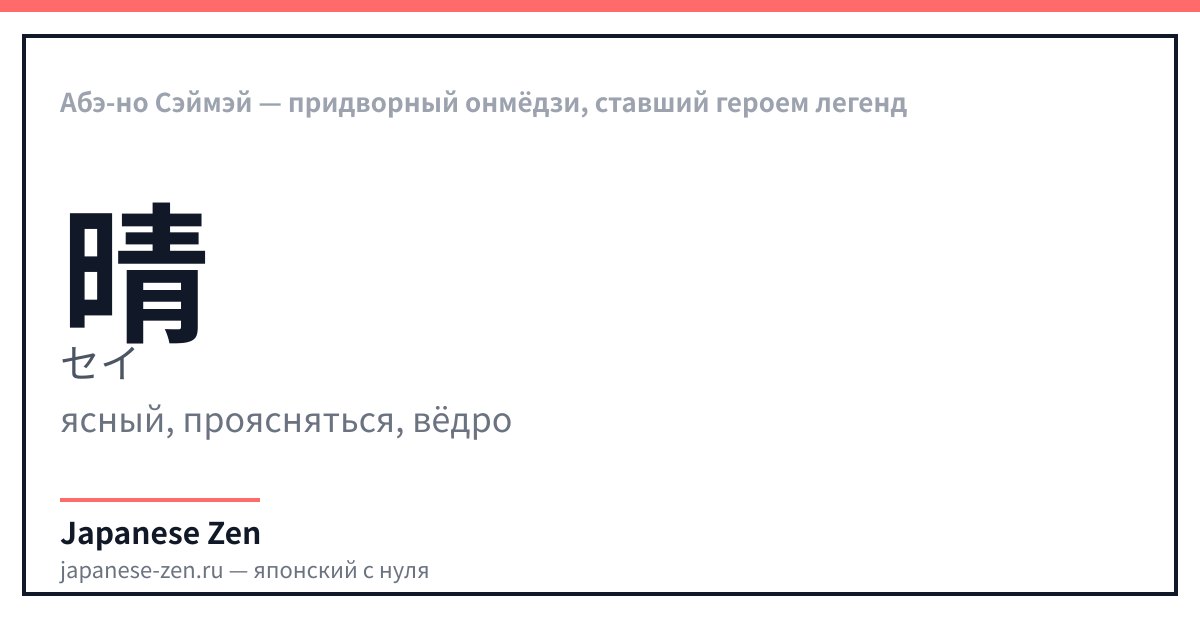
The name 晴明 is made up of two characters meaning 'clear, cleared up': 晴 (a day without clouds) and 明 (bright, light) — together 'clear and bright', a fitting name for a man whose official duty was to observe the sky. Publicly the name is read in the Chinese manner, combining the on readings of both characters: セイ + メイ → Seimei.
晴 — значение: clear, to clear up, fair weather — онъёми: セイ — кунъёми: は.れる、は.れ、は.れ-、-ば.れ、は.らす — 12 штрих(ов). 晴 — 'clear, fair weather': 12 strokes, radical 日 'sun' on the left. The same character appears in 快晴 (cloudless and clear) and 晴れ (clear weather).
| Japanese | Reading | Translation |
|---|---|---|
| 安倍晴明 | Abe no Seimei · Abe no Seimei | The court onmyoji this page is about |
| 陰陽師 | onmyōji · onmyōji | A master of onmyodo, a court diviner and astrologer |
| 式神 | shikigami · shikigami | A spirit servant of an onmyoji |
| 五芒星 | gobōsei · gobōsei | The five-pointed star on the emblem of Seimei Shrine |
Why the name is read entirely 'in the Chinese manner'
Personal names of Heian courtiers often consisted of two characters and in official usage were pronounced with on (Sino-Japanese) readings. A two-character name turned into a single euphonious word, even if in ordinary text the same characters would be read differently. Seimei is just such a case.
Listen and repeat the name and key words of this page.
The shrine in Kyoto and Seimei's star
In 1007, two years after Seimei's death, Seimei Shrine was founded on the site of his residence in Kyoto — near Ichijo Modoribashi bridge. Its emblem is the five-pointed star goseisei (五芒星), also called seimei-kikyo (晴明桔梗): the design goes back both to the kikyo bellflower (the clan symbol of the Abe) and to the five elements — wood, fire, earth, metal, and water.
What was invented about him
- The exposure of the fox shapeshifter Tamamo-no-Mae is attributed to Seimei — a persistent internet error. In fact it was done by another onmyoji, Abe no Yasunari, about a hundred years after Seimei's death: they are easy to confuse because of a similar title and a shared surname, but they are different people from different centuries.
- According to legend his mother was the fox shapeshifter Kuzunoha from the Shinoda tale — a beautiful story, but a legend, not a biographical fact; it took shape and spread after Seimei's death, primarily through the theatrical tradition.
- The image of the magician fighting demons with the help of shikigami is largely due to Yumemakura Baku's novels 'Onmyoji' (陰陽師, since 1988) and the 2001 film based on them. They turned the historical figure into a pop-culture hero, but added far more of their own than the sources preserved.
FAQ
- Who was Abe no Seimei?
- A real court onmyoji of the Heian period (921–1005), who served six emperors in the post of temmon-hakase — a court astronomer-astrologer. After his death he became the hero of many legends and remains one of the most famous historical figures of Japan associated with divination and magic.
- When did Abe no Seimei live?
- 921–1005, according to traditional dating. He died in his 85th year, on the 26th day of the 9th month of the 2nd year of Kanko — a rare case where an exact date of death survives for a court figure of that time.
- What did Seimei do at court?
- He served as temmon-hakase — a court astronomer-astrologer in the Onmyo-ryo bureau: he observed the heavens, compiled the calendar, and interpreted omens for the court. It was a government post, not the secret craft of a lone individual as later legends depict him.
- Is it true that Seimei exposed the fox Tamamo-no-Mae?
- No, that is a common mistake. The fox shapeshifter was exposed by another court onmyoji — Abe no Yasunari, and it happened about a hundred years after Seimei's death. They are confused because of a shared surname and the same title.
- Is it true that Seimei's mother was a fox?
- This is a popular legend about the fox Kuzunoha from the Shinoda tale, not a biographical fact. The legend took shape and spread after Seimei's death, primarily through the stage tradition, and is not confirmed by sources about his origins.
- What does the five-pointed star on Seimei's emblem mean?
- Goseisei (五芒星), also called seimei-kikyo — the emblem of Seimei Shrine in Kyoto. The design is associated with the five elements of onmyodo (wood, fire, earth, metal, water) and with the kikyo bellflower, the clan symbol of the Abe.
Sources
Updated: 2026-09-10