Murasaki Shikibu — the court lady who wrote The Tale of Genji
Murasaki Shikibu was a Heian-period court lady and the author of The Tale of Genji. Her real name is unknown: "Shikibu" is a nickname derived from her father's post in the Ministry of Ceremonial, and "Murasaki," according to the prevailing theory, was attached to her later — after the heroine of her novel, Murasaki-no Ue. She was born, by various estimates, between 970 and 978, and the exact date of her death is not established.
Nothing remains of Murasaki Shikibu herself — no portrait, no real name — only novels, a diary, and a reputation as one of the most educated women of her century. Let's look at where her nickname came from, what she wrote besides Genji, how the character 紫 relates to Heian color etiquette, and why her portrait appears on a banknote.
A court lady without a name or an exact birth date
Murasaki Shikibu's real name has not survived — as with most Heian court ladies, it simply was not recorded. The years of her life are also uncertain: scholars propose birth dates ranging from 970 to 978 and disagree on the date of death, which is placed somewhere between 1014 and the early 1030s. None of the versions has become universally accepted. Her father, Fujiwara no Tametoki, served in the Ministry of Ceremonial (式部省) — hence Murasaki's first court nickname, "To-shikibu" (藤式部, "Shikibu of the Fujiwara clan"), where "Shikibu" refers not to a name but to her father's office.
What her real name was
The nickname "Murasaki" became attached to the writer later, after the success of the novel. According to the prevailing theory, contemporaries began calling her that after the main heroine of The Tale of Genji, Murasaki-no Ue — naming a woman after a color was rare in her time. She married late by Heian standards, to a distant relative, Fujiwara no Nobutaka, and was widowed a few years later. She entered the court of Empress Shoshi, daughter of the influential statesman Fujiwara no Michinaga, already a widow — presumably around 1005–1006.
What Murasaki Shikibu wrote besides the novel
Besides The Tale of Genji, we have the Murasaki Shikibu Diary (紫式部日記) — records of court life and the birth of the empress's heir, and a poetry collection, the Murasaki Shikibu-shu (紫式部集). One of her poems was included in the anthology Hyakunin Isshu as number 57 — about meeting a childhood friend who vanished so quickly she was not recognized, like the moon behind clouds. In the Diary she also left a harsh remark about Sei Shonagon, author of The Pillow Book: she reproached her for showing off her knowledge of kanji and predicted that a person with such manners would come to a bad end.
Why knowledge of Chinese had to be hidden
Murasaki Shikibu read classical Chinese texts fluently — a rarity for a woman of her circle, where knowledge of kanji was considered a male privilege. According to one story, after Emperor Ichijo heard a reading of the novel aloud and praised the author for her evident knowledge of the Japanese chronicles Nihon Shoki, Murasaki acquired the nickname "the Lady of the Nihon Shoki." This was not exactly praise but rather mockery of learning that was not expected of a woman. In public she preferred not to show this side of her knowledge.
The color murasaki: why the character 紫 suited the writer
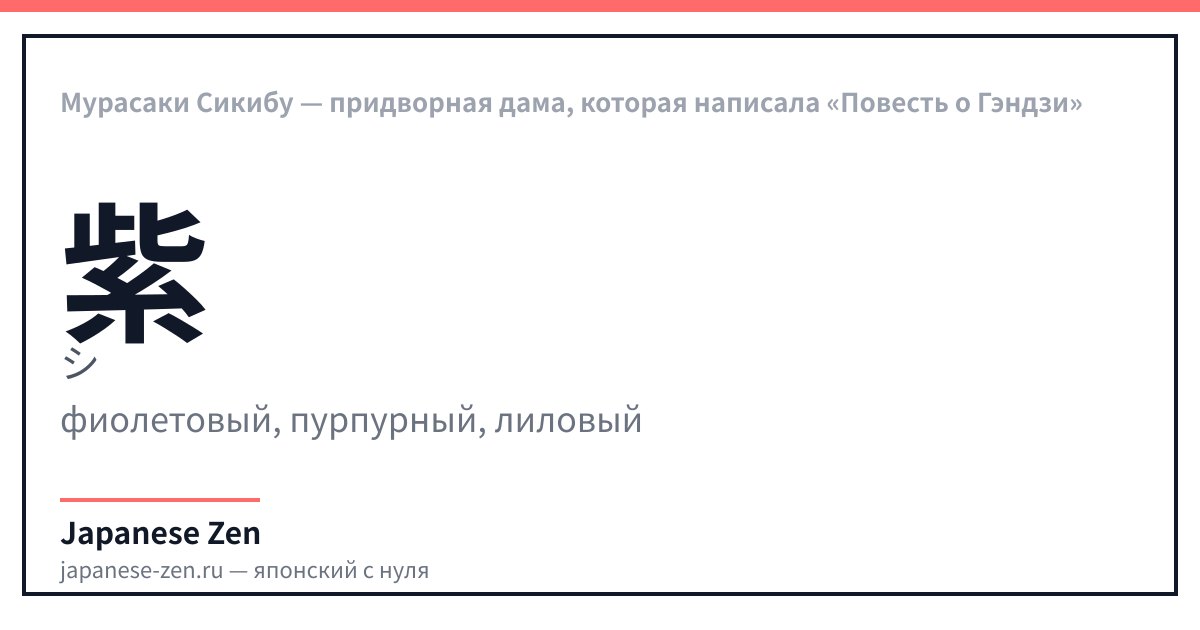
紫 — значение: purple, violet, mauve — онъёми: シ — кунъёми: むらさき — 12 штрих(ов). 紫 — "purple, violet": this character became attached to the writer's nickname, though at first it referred only to the heroine of her novel. It also appears in 紫外線 (ultraviolet) and 紫陽花 (hydrangea).
紫式部 breaks down into 紫 "purple" and 式部 (式 "ceremony, rite" plus 部 "ministry") — "the lady from the Ministry of Ceremonial nicknamed Purple." The character 紫 is read in different ways: the on'yomi SHI in borrowed words like 紫外線, and the kun'yomi murasaki as the ordinary Japanese word for "purple." In 紫陽花 (ajisai, hydrangea) the characters are read only together: it is a Chinese name for the flower that in Japan was applied to the native word あじさい — this kind of reading is called jukujikun.
What the color purple meant at the Heian court
In Japanese court tradition, purple had long been considered the color of the highest dignity — since the systems of official ranks of the early Middle Ages, where the senior ranks were designated by this very color. The Heian court inherited this hierarchy through the system of "forbidden colors" (禁色): certain shades, including deep purple, were permitted only to the highest nobles. Against this background, the nickname "purple" for an educated lady sounded like a kind of compliment, not merely a reference to the heroine of the novel.
| Japanese | Reading | Translation |
|---|---|---|
| 紫式部 | Murasaki Shikibu · Murasaki Shikibu | The writer's nickname as a whole |
| 紫 | murasaki · murasaki | Purple, violet |
| 紫式部日記 | Murasaki Shikibu nikki · Murasaki Shikibu nikki | The Murasaki Shikibu Diary |
| 紫外線 | shigaisen · shigaisen | Ultraviolet |
| 紫陽花 | ajisai · ajisai | Hydrangea |
| 式部 | shikibu · shikibu | Ministry of Ceremonial — part of the writer's nickname |
Write 紫 along the guides — the character for the color that became the writer's second name.
Where you can see Murasaki Shikibu's face today
Murasaki Shikibu is depicted on the 2000-yen banknote issued in 2000: on the reverse side is a scene from the Genji Monogatari Emaki scrolls and a portrait of the writer herself. In 2024, NHK dedicated its annual historical drama "Hikaru Kimi e" ("To the Shining Prince") to her, in which she is called by the invented childhood name Mahiro, since the writer's real name is unknown.
Is it true that she began writing the novel in a temple?
According to legend, Murasaki Shikibu began The Tale of Genji at Ishiyama-dera Temple on Lake Biwa, gazing at the full moon and praying for inspiration. There is no direct evidence for this, but it is precisely with this legend that the temple associates its famous "Genji room" — there, even today, stands a statue of the writer at a writing desk.
FAQ
- Who was Murasaki Shikibu?
- Murasaki Shikibu served as a court lady at the court of Empress Shoshi in the Heian period and is known as the author of The Tale of Genji. She also wrote diaries and poetry, but her real name and exact years of life have not come down to us.
- What was Murasaki Shikibu's real name?
- Unknown: the real names of Heian court ladies were usually not recorded. "Shikibu" refers to her father's post in the Ministry of Ceremonial, and "Murasaki" is a later nickname taken from the heroine of her own novel.
- What did Murasaki Shikibu write besides The Tale of Genji?
- A diary of court life (the Murasaki Shikibu Diary) and her own poetry collection (the Murasaki Shikibu-shu). One of her poems was included in the anthology Hyakunin Isshu as number 57.
- Were Murasaki Shikibu and Sei Shonagon rivals?
- They most likely never met personally: Sei Shonagon left the court around 1000, and Murasaki entered service only in 1005–1006. But in her diary Murasaki Shikibu left a harsh remark about Sei Shonagon, reproaching her for showing off her knowledge of kanji — enough to speak of a literary rivalry.
- Why is Murasaki Shikibu depicted on the 2000-yen banknote?
- The 2000-yen banknote was issued in 2000, and for the reverse side a scene from the Genji Monogatari Emaki scrolls — illustrations for the central novel of Japanese classics — was chosen, along with a portrait of its author.
- How is "Murasaki Shikibu" written in kanji?
- 紫式部, read むらさきしきぶ. 紫 — "purple," the writer's later nickname; 式部 — "Ministry of Ceremonial," where her father served. Literally — "the lady from the Ministry of Ceremonial nicknamed Purple."
Sources
Updated: 2026-09-15