Sei Shōnagon and The Pillow Book: who she was and what the book is about
Sei Shōnagon was a court lady of the Heian period and the author of The Pillow Book (枕草子): observations, lists, and short scenes from life at the court of Empress Teishi. The author's real name is unknown: "Sei" comes from the Kiyohara clan name, and "Shōnagon" was a court office that none of her close relatives held. She served roughly from 993 to 1000, and continued writing the book after her mistress's death.
The Pillow Book stands apart among Heian prose: neither a novel nor a diary, but a scattering of lists, sketches, and sharp judgments by a court lady who clearly delighted in her own powers of observation. Let's look at where the book's strange title came from, what the character 筆 means, and how Peter Greenaway adapted The Pillow Book for film — not at all following the original's plot.
Who is hidden behind the name "Sei Shōnagon"
The exact years of Sei Shōnagon's life are unknown — scholars tentatively suggest around 966 to around 1025, but this is a reconstruction, not a documented fact. "Sei" in her nickname is part of the clan name Kiyohara, and "Shōnagon" is the name of a court office, but neither her father nor other close relatives of Sei Shōnagon held this office, and exactly why it entered her nickname is not established. Her father, Kiyohara no Motosuke, was a well-known poet and took part in compiling the anthology Gosen Wakashū.
What became of her after the empress's death
Empress Teishi died in childbirth in 1000, and soon after that Sei Shōnagon left court service. Her later life is poorly documented: according to indirect evidence, she moved with a new husband to Settsu Province. Later legends portray her as impoverished and lonely in old age, but scholars consider these stories to be later inventions.
What The Pillow Book consists of
枕草子 is divided into three types of passages: "lists" — enumerations such as "things that are endearing" (うつくしきもの) or "things that are irritating" (にくきもの); notes and observations about nature and daily life; and passages of reminiscence about the court of Empress Teishi. The exact number of passages depends on the manuscript — the manuscripts differ both in composition and in the order of the text, so there is no single canonical number. The book begins with the famous line "In spring, the dawn" (春はあけぼの) — an enumeration of what is best at each time of day and season.
The title 枕草子 is usually explained by an episode in the book's afterword: when Empress Teishi's brother, Fujiwara no Korechika, presented her with expensive paper, and the emperor ordered the Shiji to be copied onto the same kind of paper, Teishi asked what should be written on her share. Sei Shōnagon replied that it should be a "pillow," that is, private notes kept by one's bedside rather than an official work. There are other versions of the title's origin, but the story from the afterword is in places considered a literary device by Sei Shōnagon herself rather than an accurate report of what happened.
Which lists in The Pillow Book are the most famous
Among the "lists," the one most often recalled is the opening list of the signs of each season — "In spring, the dawn; in summer, the night; in autumn, the dusk; in winter, the early morning." There is also the list "Things that make the heart beat faster" (心ときめきするもの) — the small details of court life that set the heart racing.
What the brush has to do with it: the character 筆 and the zuihitsu genre
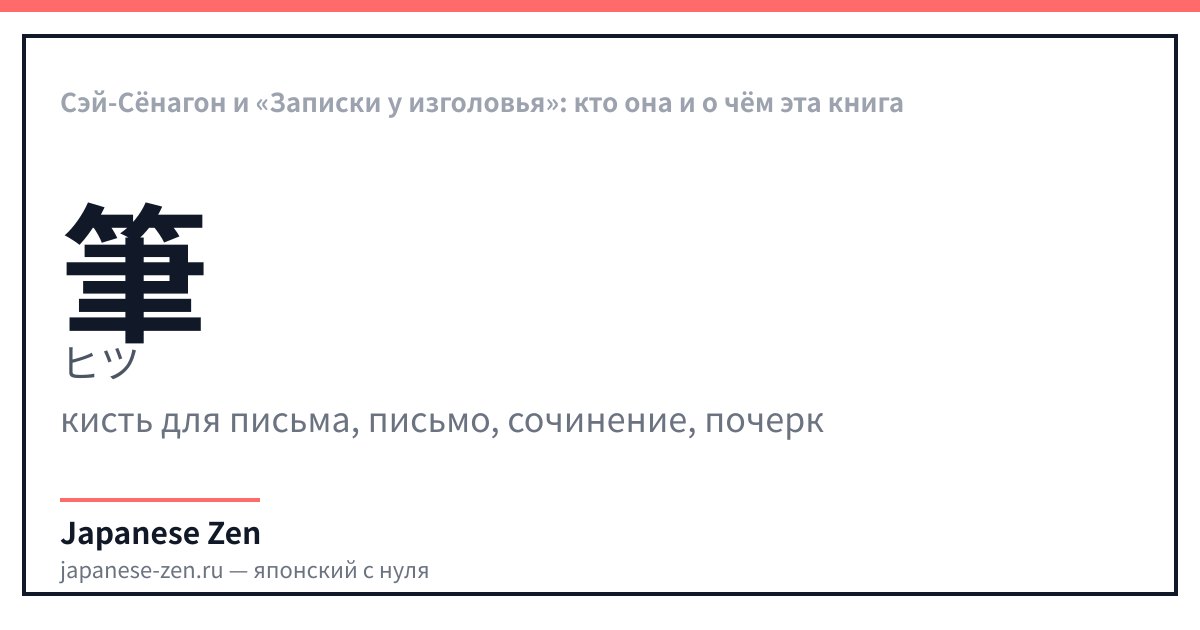
筆 — значение: writing brush, writing, composition, handwriting — онъёми: ヒツ — кунъёми: ふで — 12 штрих(ов). 筆 — "writing brush": the same character gave its name to the zuihitsu genre, "following the brush," of which The Pillow Book is considered a model. It also appears in 鉛筆 (pencil) and 筆者 (the author of a text).
枕草子 = 枕 "pillow, headrest" plus 草子 "notebook, book for reading" — literally "a notebook by the pillow." Another word important to the book is 随筆 (zuihitsu), "following the brush": a genre of free notes without an overall plot, and The Pillow Book is considered one of the first and model examples of this genre in Japanese literature. The character 筆 is read hitsu in Sino-Japanese compounds such as 随筆, and fude as the standalone word "brush"; the same character appears in 鉛筆 (pencil) and 筆者 (the author of a text).
What it means to write "following the brush"
"Zuihitsu" describes not a genre by subject but a way of writing: the author records thoughts and observations in the order they come, without a preliminary plan or a single plot. That is exactly why The Pillow Book is so easy to read out of order, from any point — the book is conceived as a stream of notes, not as a story with a beginning and an end.
| Japanese | Reading | Translation |
|---|---|---|
| 枕草子 | Makura no sōshi · Makura no sōshi | The Pillow Book — the title of the book |
| 随筆 | zuihitsu · zuihitsu | The genre "following the brush" |
| 筆 | fude · fude | Writing brush |
| 鉛筆 | enpitsu · enpitsu | Pencil |
| 筆者 | hissha · hissha | Author of a text |
| 筆箱 | fudebako · fudebako | Pencil case |
Write 筆 along the guides — the character for "brush," which gave its name to the whole literary genre of zuihitsu.
The Pillow Book in translation and on screen
The book was translated into English in full by Ivan Morris — his translation first appeared in 1967 and remains the standard English edition of The Pillow Book, though it has been reprinted many times since. In 1996 the British director Peter Greenaway made the film The Pillow Book, with the Chinese actress Vivian Wu in the lead role. It is a free modern story about calligraphy and skin as a canvas, not an adaptation of Sei Shōnagon's plot — the film is presented as a reinterpretation, not a retelling of the book.
What Murasaki Shikibu herself wrote about her
The only contemporary comment on Sei Shōnagon was left by Murasaki Shikibu in her diary — sharp and unfriendly: she reproached the author of The Pillow Book for ostentatious learning and predicted a bad end for her. Whether the two ladies ever met in person is unknown: Sei Shōnagon left court around 1000, while Murasaki entered service in 1005–1006.
FAQ
- Who was Sei Shōnagon?
- Sei Shōnagon was a court lady of the Heian period and the author of The Pillow Book. From roughly 993 to 1000 she served under Empress Teishi. Her real name is unknown: "Sei" comes from the Kiyohara clan, and "Shōnagon" is the name of a court office.
- What is The Pillow Book about?
- It is about court life through the eyes of an observant and witty woman: there are lists such as "things that delight the eye," sketches of nature through the seasons, and reminiscences of the court of Empress Teishi. The book has no single plot — it is structured as a stream of separate notes.
- Why is the book called The Pillow Book?
- According to one version, it comes from a story in the book's afterword: having received expensive paper, Sei Shōnagon decided to write personal notes on it "for the pillow," that is, to keep by her bedside rather than to prepare an official work. Other versions offer different explanations, and there is no consensus among scholars.
- Who translated The Pillow Book into English?
- The complete English translation of The Pillow Book was made by Ivan Morris — it first appeared in 1967 and remains the standard English edition of the book, though it has been reprinted many times since.
- Were Sei Shōnagon and Murasaki Shikibu rivals?
- There was most likely no personal acquaintance between them: Sei Shōnagon left court around 1000, while Murasaki arrived there only five or six years later. But Murasaki Shikibu left a sharp comment about Sei Shōnagon in her diary, reproaching her for ostentatious learning — enough to give them a reputation as rivals.
- What is The Pillow Book called in Japanese?
- 枕草子, read まくらのそうし: 枕 means "pillow, headrest," and 草子 means "notebook, book for reading." The literal meaning of the title is "a notebook by the pillow," that is, notes for personal reading rather than an official work.
Sources
Updated: 2026-09-15