Shikigami — what they are and whom onmyoji summoned
Shikigami is a spirit servant whom, in Japanese legends, an onmyoji subjugates and sends on errands: to watch, to harm an enemy, to bring news. The most famous example is linked to the legendary Abe no Seimei, who, according to legend, kept his shikigami under the Ichijo Modoribashi bridge because his wife was frightened of them. They are often depicted as paper figures that come to life at the master's word.
Shikigami is not a god or a yokai in itself, but a tool of the onmyoji: something between a familiar and a spell with a will of its own. Let's look at where it comes from, what it looks like, and why the old chronicles say nothing about it.
Who shikigami is and whom they serve
Shikigami (式神) is a spirit servant whom an onmyoji, a master of onmyodo — the Japanese system of divination and magical practices based on the teachings of yin-yang and the five elements — subjugates. The onmyoji summons a shikigami by ritual and sends it to carry out errands: to watch someone, to harm an enemy, to deliver a message, to guard a house. On its own, without the master's command, a shikigami in legends almost never acts.
- Obeys one specific onmyoji and usually does not act of its own will.
- In some legends, invisible until the master needs it.
- In other legends, takes the form of a paper figure that comes to life at a word.
- Can serve as a guard, a spy, or a weapon — depending on the story.
A spirit, a piece of paper, or both
Shikigami has no single canonical appearance: in some legends it is an invisible force that manifests only through the result of its action; in others it is a paper figure (人形 or 形代) that the onmyoji animates with a spell and folds back when the work is done. Both traditions exist in parallel, and this is not a contradiction between sources but a range within the same folkloric image.
Where we know about them from at all
The main source of information about shikigami is medieval collections of setsuwa tales and a whole cycle of legends about Abe no Seimei, a court onmyoji of the 10th–11th centuries. According to one of the most famous stories, Seimei kept his shikigami under the Ichijo Modoribashi bridge in Kyoto, not at his home — because his wife was frightened by the sight of them.
Why they are absent from ancient chronicles
In the Kojiki and the Nihon Shoki (both 8th-century texts), shikigami are not mentioned at all. This is not a gap in research but a matter of timing. Onmyodo as a formalized court practice developed later, and the stories about shikigami and about Abe no Seimei personally took shape over centuries after these early chronicles — already in the tale collections of the Heian period and later.
式 — the sign of ritual in the spirit's name
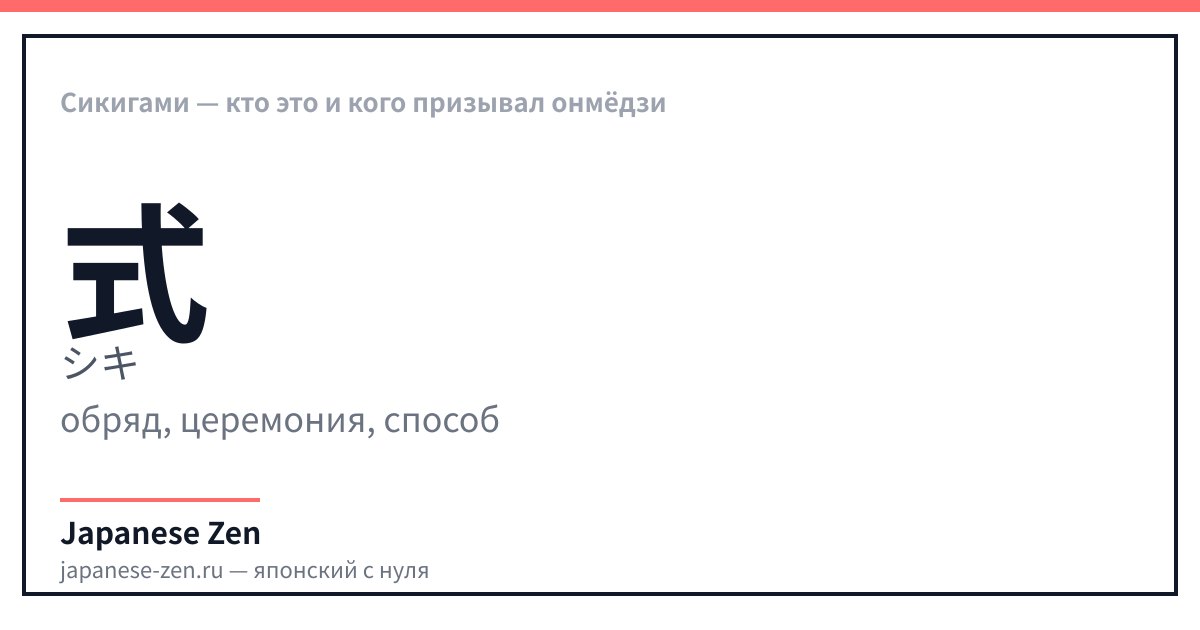
式神 literally combines 式 'ritual, ceremony, formula' and 神 'spirit, deity' — that is, 'a spirit summoned by ritual.' The character 式 sets the whole logic of the word: a shikigami does not exist on its own but only as the result of the onmyoji's ritual action.
式 — значение: ritual, ceremony, method, formula — онъёми: シキ — 6 штрих(ов). 式 — 'ritual, ceremony, method, formula': six strokes, N3 level. The same character appears in 儀式 (ceremony, ritual) and 正式 (official, by the book).
| Japanese | Reading | Translation |
|---|---|---|
| 式神 | shikigami · shikigami | Spirit servant of the onmyoji |
| 陰陽師 | onmyōji · onmyōji | Master of onmyodo, diviner and exorcist |
| 呪術 | jujutsu · jujutsu | Magic, magical techniques |
| 人形 | ningyō · ningyō | Doll, figure — a common form of shikigami |
Why it is read sometimes shikigami, sometimes shikijin
Both readings appear in texts: the more common しきがみ (shikigami) and the more formal しきじん (shikijin), which is closer to the direct onyomi of both characters. The meaning does not change — they are two registers of the same word, not two different concepts.
Write 式 along the guides and study the stroke order.
How shikigami differs from tsukumogami
In retellings, both spirits are sometimes merged into one 'something that comes to life,' but their origins are opposite. A shikigami does not exist until an onmyoji summons it by ritual — it is a spirit on call; without a master it simply does not act. A tsukumogami is the opposite: an ordinary household object that, on its own, without any master or ritual, gains a spirit and will after a hundred years of service.
Common only in appearance
The resemblance is purely visual: both a shikigami in the form of a paper figure and a tsukumogami in the form of animated utensils look like 'the inanimate that suddenly moved.' But one always has a specific person with a ritual behind it, while the other has only its own long term of service. A detailed discussion of the latter is on a separate page about tsukumogami.
FAQ
- What is a shikigami?
- A spirit servant whom, in Japanese legends, an onmyoji — a master of onmyodo — summons and subjugates. A shikigami carries out the master's errands: it watches, harms an enemy, guards a house, or brings news, and without a command it almost never acts on its own.
- Whom did Abe no Seimei summon?
- The legendary court onmyoji Abe no Seimei, according to legend, controlled several shikigami and kept them under the Ichijo Modoribashi bridge in Kyoto, not in his own house — because his wife was frightened of them. This is the most famous of all stories about shikigami.
- Is a shikigami a god, a spirit, or what?
- Neither a kami nor a yokai in the usual sense: a shikigami is a service spirit that exists only as the result of a specific onmyoji's ritual. It is not worshipped in shrines, it has no official cult — it is a figure of folklore and legends about onmyoji, not of religion.
- What does a shikigami look like?
- There is no single appearance: in some legends a shikigami is invisible and manifests only through action; in others it takes the form of a paper figure (人形 or 形代) that the onmyoji animates with a spell and folds back after the work is done. Both versions exist in parallel.
- Is it true that shikigami are absent from the Kojiki or the Nihon Shoki?
- Yes, in both 8th-century chronicles shikigami are not mentioned. Onmyodo as a formalized court practice truly developed later, and the stories about shikigami and about Abe no Seimei took shape after these early texts, in later collections of legends.
- How does a shikigami differ from a tsukumogami?
- A shikigami does not exist without the onmyoji who summoned it — it is a spirit on call, acting by ritual and command. A tsukumogami, by contrast, is an ordinary object that gains a spirit on its own after a hundred years of service, without any master or ritual.
Sources
Updated: 2026-09-10